

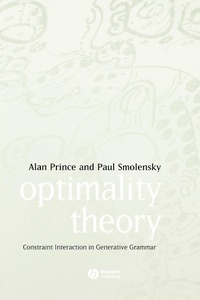
Optimality Theory
Constraint Interaction in Generative Grammar
1st Edition
Published on 2. August 2004
Book
Hardback
304 pages
978-1-4051-1932-0 (ISBN)
Description
This book is the final version of the widely-circulated 1993 Technical Report that introduces a conception of grammar in which well-formedness is defined as optimality with respect to a ranked set of universal constraints.
Final version of the widely circulated 1993 Technical Report that was the seminal work in Optimality Theory, never before available in book format.
Serves as an excellent introduction to the principles and practice of Optimality Theory.
Offers proposals and analytic commentary that suggest many directions for further development for the professional.
Final version of the widely circulated 1993 Technical Report that was the seminal work in Optimality Theory, never before available in book format.
Serves as an excellent introduction to the principles and practice of Optimality Theory.
Offers proposals and analytic commentary that suggest many directions for further development for the professional.
Reviews / Votes
"This is a very important book. Optimality Theory has transformed the field of linguistics more than almost any other development of the past half-century, and Prince and Smolensky started it all." John J. McCarthy, University of Massachusetts, Amherst"OT does not need to permanently influence linguistic theory: it has already done so. Between 1993 and 2004, Prince and Smolensky's Optimality Theory was by far the most widely circulated manuscript among phonologists. Fortunately, it is now available for a larger audience in this text edition." Rene Kager, Utrecht University
More details
Language
English
Place of publication
Hoboken
United Kingdom
Publishing group
John Wiley and Sons Ltd
Target group
Professional and scholarly
Product notice
sewn/stitched
Cloth over boards
Dimensions
Height: 260 mm
Width: 183 mm
Thickness: 21 mm
Weight
772 gr
ISBN-13
978-1-4051-1932-0 (9781405119320)
Copyright in bibliographic data and cover images is held by Nielsen Book Services Limited or by the publishers or by their respective licensors: all rights reserved.
Schweitzer Classification
Other editions
Additional editions
E-Book
05/2008
Wiley-Blackwell
€111.99
Available for download
Persons
Alan Prince is Professor of Linguistics and a member of the Cognitive Science Center at Rutgers University and is, along with Paul Smolensky, one of the founders of Optimality Theory. He has published in journals such as Linguistic Inquiry, Science, Cognition, and Critical Inquiry.
Paul Smolensky is Professor of Cognitive Science at Johns Hopkins University. His publications include Learnability in Optimality Theory (with Bruce Tesar, 2000) and Mathematical Perspectives on Neural Networks (edited with Michael Mozer and David Rumelhart, 1996).
Paul Smolensky is Professor of Cognitive Science at Johns Hopkins University. His publications include Learnability in Optimality Theory (with Bruce Tesar, 2000) and Mathematical Perspectives on Neural Networks (edited with Michael Mozer and David Rumelhart, 1996).
Content
Prefactory Note. Acknowledgments.
1. Preliminaries:.
Background and Overview.
Optimality.
Overall Structure of the Argument.
Overview of Part I.
2. Optimality in Grammar: Core Syllabification in Imdlawn Tashlhiyt Berber:.
The Heart of Dell & Elmedlaoui.
Optimality Theory.
Summary of discussion to date.
3. Generalization-Forms in Domination Hierarchies IBlocking and Triggering: Profuseness and Economy:.
Epenthetic Structure.
Do Something Only When: The Failure of Bottom-up Constructionism.
4. Generalization-Forms in Domination Hierarchies IIDo Something Except When: Blocking, or The Theory of Profuseness:.
Edge-Oriented Infixation.
Interaction of Weight Effects with Extrametricality.
Background: Prominence-Driven Stress Systems.
The Interaction of Weight and Extrametricality: Kelkar's Hindi/Urdu.
Nonfinality and Nonexhaustiveness.
Nonfinality and the Laws of Foot Form: Raw Minimality.
Nonfinality and the Laws of Foot Form:Extended Minimality Effects.
Summary of Discussion of the Except When Effect.
Except meets Only: Triggering and Blocking in a Single Grammar.
5. The Construction of Grammar in Optimality Theory:.
Construction of Harmonic Orderings from Phonetic and Structural Scales.
The Theory of Constraint Interaction.
Comparison of Entire Candidates by a Single Constraint.
Ons: Binary constraints.
Hnuc: Non-binary constraints.
Comparison of Entire Candidates by an Entire Constraint Hierarchy.
Discussion.
Non-locality of interaction.
Strictness of domination.
Serial vs. Parallel Harmony Evaluation and Gen.
Binary vs. Non-binary constraints.
Paoini's Theorem on Constraint Ranking.
Overview of Part II.
6. Syllable Structure Typology I: the CV Theory:.
The Jakobson Typology.
The Faithfulness Interactions.
Groundwork.
Basic CV Syllable Theory.
Onsets.
Codas.
The Theory of Epenthesis Sites.
7. Constraint Interaction in Lardil Phonology:.
The Constraints.
The Ranking.
Some Ranking Logic.
Ranking the Constraints.
Verification of Forms.
Consonant-Final Stems.
Vowel Final Stems.
Discussion.
8. Universal Syllable Theory II: Ordinal Construction of C/V and Onset/Coda Licensing Asymmetry:.
Associational Harmony.
Deconstructing Hnuc: Berber, Take 1.
Restricting to Binary Marks.
Reconstructing the C and V Classes: Emergent Parameter Setting via Constraint Ranking.
Harmonic Completeness of Possible Onsets and Peaks.
Peak- and Margin-Affinity.
Interactions with Parse.
Restricting Deletion and Epenthesis.
Further Necessary Conditions on Possible Onsets and Nuclei.
Sufficient Conditions on Possible Onsets and Nuclei.
The Typology of Onset, Nucleus, and Coda Inventories.
The Typology of Onset and Nucleus Inventories.
Onset/Coda Licensing Asymmetries.
An Example: Berber, Take 2.
Simplifying the Theory by Encapsulating Constraint Packages.
Encapsulating the Association Hierarchies.
An Example: Berber, Take 3.
Sufficiency and Richness of the Encapsulated Theory.
9. Inventory Theory and the Lexicon:.
Language-Particular Inventories.
Harmonic Bounding and Nucleus, Syllable, and Word Inventories.
Segmental Inventories.
Universal Inventories.
Segmental Inventories.
Syllabic Inventories.
Optimality in the Lexicon.
10. Foundational Issues and Theory-Comparisons:.
Thinking about Optimality.
Fear of Optimization.
The Reassurance.
The Connectionism Connection, and other Computation-based Comparisons.
Why Optimality Theory has nothing to do with connectionism.
Why Optimality Theory is deeply connected to connectionism.
Harmony Maximization and Symbolic Cognition.
Analysis of 'Phonotactics+Repair' Theories.
CV Syllable Structure and Repair.
General Structure of the Comparisons: Repair Analysis.
Persistent Rule Theory.
English Closed Syllable Shortening.
Shona Tone Spreading.
Summary.
The Theory of Constraints and Repair Strategies.
Appendix.
A.1 The Cancellation and Cancellation/Domination Lemmas.
A.2 CV Syllable Structure.
A.3 Paoini's Theorem on Constraint-ranking.
References.
Index of Constraints.
Index of Languages.
General Index
1. Preliminaries:.
Background and Overview.
Optimality.
Overall Structure of the Argument.
Overview of Part I.
2. Optimality in Grammar: Core Syllabification in Imdlawn Tashlhiyt Berber:.
The Heart of Dell & Elmedlaoui.
Optimality Theory.
Summary of discussion to date.
3. Generalization-Forms in Domination Hierarchies IBlocking and Triggering: Profuseness and Economy:.
Epenthetic Structure.
Do Something Only When: The Failure of Bottom-up Constructionism.
4. Generalization-Forms in Domination Hierarchies IIDo Something Except When: Blocking, or The Theory of Profuseness:.
Edge-Oriented Infixation.
Interaction of Weight Effects with Extrametricality.
Background: Prominence-Driven Stress Systems.
The Interaction of Weight and Extrametricality: Kelkar's Hindi/Urdu.
Nonfinality and Nonexhaustiveness.
Nonfinality and the Laws of Foot Form: Raw Minimality.
Nonfinality and the Laws of Foot Form:Extended Minimality Effects.
Summary of Discussion of the Except When Effect.
Except meets Only: Triggering and Blocking in a Single Grammar.
5. The Construction of Grammar in Optimality Theory:.
Construction of Harmonic Orderings from Phonetic and Structural Scales.
The Theory of Constraint Interaction.
Comparison of Entire Candidates by a Single Constraint.
Ons: Binary constraints.
Hnuc: Non-binary constraints.
Comparison of Entire Candidates by an Entire Constraint Hierarchy.
Discussion.
Non-locality of interaction.
Strictness of domination.
Serial vs. Parallel Harmony Evaluation and Gen.
Binary vs. Non-binary constraints.
Paoini's Theorem on Constraint Ranking.
Overview of Part II.
6. Syllable Structure Typology I: the CV Theory:.
The Jakobson Typology.
The Faithfulness Interactions.
Groundwork.
Basic CV Syllable Theory.
Onsets.
Codas.
The Theory of Epenthesis Sites.
7. Constraint Interaction in Lardil Phonology:.
The Constraints.
The Ranking.
Some Ranking Logic.
Ranking the Constraints.
Verification of Forms.
Consonant-Final Stems.
Vowel Final Stems.
Discussion.
8. Universal Syllable Theory II: Ordinal Construction of C/V and Onset/Coda Licensing Asymmetry:.
Associational Harmony.
Deconstructing Hnuc: Berber, Take 1.
Restricting to Binary Marks.
Reconstructing the C and V Classes: Emergent Parameter Setting via Constraint Ranking.
Harmonic Completeness of Possible Onsets and Peaks.
Peak- and Margin-Affinity.
Interactions with Parse.
Restricting Deletion and Epenthesis.
Further Necessary Conditions on Possible Onsets and Nuclei.
Sufficient Conditions on Possible Onsets and Nuclei.
The Typology of Onset, Nucleus, and Coda Inventories.
The Typology of Onset and Nucleus Inventories.
Onset/Coda Licensing Asymmetries.
An Example: Berber, Take 2.
Simplifying the Theory by Encapsulating Constraint Packages.
Encapsulating the Association Hierarchies.
An Example: Berber, Take 3.
Sufficiency and Richness of the Encapsulated Theory.
9. Inventory Theory and the Lexicon:.
Language-Particular Inventories.
Harmonic Bounding and Nucleus, Syllable, and Word Inventories.
Segmental Inventories.
Universal Inventories.
Segmental Inventories.
Syllabic Inventories.
Optimality in the Lexicon.
10. Foundational Issues and Theory-Comparisons:.
Thinking about Optimality.
Fear of Optimization.
The Reassurance.
The Connectionism Connection, and other Computation-based Comparisons.
Why Optimality Theory has nothing to do with connectionism.
Why Optimality Theory is deeply connected to connectionism.
Harmony Maximization and Symbolic Cognition.
Analysis of 'Phonotactics+Repair' Theories.
CV Syllable Structure and Repair.
General Structure of the Comparisons: Repair Analysis.
Persistent Rule Theory.
English Closed Syllable Shortening.
Shona Tone Spreading.
Summary.
The Theory of Constraints and Repair Strategies.
Appendix.
A.1 The Cancellation and Cancellation/Domination Lemmas.
A.2 CV Syllable Structure.
A.3 Paoini's Theorem on Constraint-ranking.
References.
Index of Constraints.
Index of Languages.
General Index