

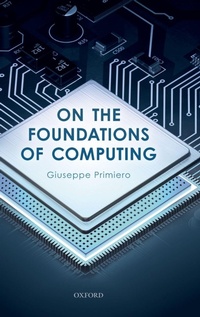
On the Foundations of Computing
Published on 19. November 2019
Book
Hardback
318 pages
978-0-19-883564-6 (ISBN)
Description
Computing, today more than ever before, is a multi-faceted discipline which collates several methodologies, areas of interest, and approaches: mathematics, engineering, programming, and applications. Given its enormous impact on everyday life, it is essential that its debated origins are understood, and that its different foundations are explained. On the Foundations of Computing offers a comprehensive and critical overview of the birth and evolution of computing, and it presents some of the most important technical results and philosophical problems of the discipline, combining both historical and systematic analyses.
The debates this text surveys are among the latest and most urgent ones: the crisis of foundations in mathematics and the birth of the decision problem, the nature of algorithms, the debates on computational artefacts and malfunctioning, and the analysis of computational experiments. By covering these topics, On the Foundations of Computing provides a much-needed resource to contextualize these foundational issues.
For practitioners, researchers, and students alike, a historical and philosophical approach such as what this volume offers becomes essential to understand the past of the discipline and to figure out the challenges of its future.
The debates this text surveys are among the latest and most urgent ones: the crisis of foundations in mathematics and the birth of the decision problem, the nature of algorithms, the debates on computational artefacts and malfunctioning, and the analysis of computational experiments. By covering these topics, On the Foundations of Computing provides a much-needed resource to contextualize these foundational issues.
For practitioners, researchers, and students alike, a historical and philosophical approach such as what this volume offers becomes essential to understand the past of the discipline and to figure out the challenges of its future.
Reviews / Votes
All these topics are analysed from a historical as well as a logical and epistemological point of view which makes the book a complete introduction to the philosophy of computer science. * Nicola Angius, Axiomathes * The author of this book argues that computing has three main foundations, which are mathematical foundations, engineering foundations and experimental foundations. On less than 300 pages, surprisingly broad knowledge of these three areas is presented in the three main chapters... The book can be used as a guide for a course in theoretical computer science. * Gudula Ruenger, zbMATH Open * For practitioners, researchers, and students alike, a historical and philosophical approach such as what this volume offers becomes essential to understand the past of the discipline and to gure out the challenges of its future. * MathSciNet *More details
Language
English
Place of publication
Oxford
United Kingdom
Dimensions
Height: 240 mm
Width: 161 mm
Thickness: 22 mm
Weight
643 gr
ISBN-13
978-0-19-883564-6 (9780198835646)
Copyright in bibliographic data and cover images is held by Nielsen Book Services Limited or by the publishers or by their respective licensors: all rights reserved.
Schweitzer Classification
Other editions
Additional editions
Giuseppe Primiero
On the Foundations of Computing
Book
11/2019
Oxford University Press
€81.60
Shipment within 15-20 days
Giuseppe Primiero
On the Foundations of Computing
E-Book
11/2019
1st Edition
OUP eBook
€53.99
Available for download
Person
Giuseppe Primiero is Associate Professor of Logic at the Department of Philosophy, University of Milan (Italy). He acts as President of the DHST Commission for the History and Philosophy of Computing (HaPoC) and Secretary General of the Association Computability in Europe (CiE). His research interests are primarily in Logic and Computation, Philosophy of Computing and Information.
Content
1: Introduction
2: A fundamental Crisis
3: Computing and Deciding
4: What is Computable?
5: Mechanical Computation
6: On the Nature of Algorithms
7: Computing as a Mathematical Discipline
8: The First Generation of Computers
9: The Laws of Evolution
10: Properties of Implemented Computations
11: Specification and Implementation
12: Computing as an Engineering Discipline
13: Elements of Experimental Computing
14: Models and Simulations
15: Formal Relations
16: Computing as an Experimental Discipline
17: Conclusions
2: A fundamental Crisis
3: Computing and Deciding
4: What is Computable?
5: Mechanical Computation
6: On the Nature of Algorithms
7: Computing as a Mathematical Discipline
8: The First Generation of Computers
9: The Laws of Evolution
10: Properties of Implemented Computations
11: Specification and Implementation
12: Computing as an Engineering Discipline
13: Elements of Experimental Computing
14: Models and Simulations
15: Formal Relations
16: Computing as an Experimental Discipline
17: Conclusions