


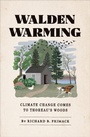
Walden Warming
Climate Change Comes to Thoreau's Woods
Published on 1. April 2014
Book
Hardback
264 pages
978-0-226-68268-6 (ISBN)
Description
In his meticulous notes on the natural history of Concord, Massachusetts, Henry David Thoreau records the first open flowers of highbush blueberry on May 11, 1853. If he were to look for the first blueberry flowers in Concord today, mid-May would be too late. In the 160 years since Thoreau's writings, warming temperatures have pushed blueberry flowering three weeks earlier, and in 2012, following a winter and spring of record-breaking warmth, blueberries began flowering on April 1-six weeks earlier than in Thoreau's time. The climate around Thoreau's beloved Walden Pond is changing, with visible ecological consequences. In Walden Warming, Richard B. Primack uses Thoreau and Walden, icons of the conservation movement, to track the effects of a warming climate on Concord's plants and animals. Under the attentive eyes of Primack, the notes that Thoreau made years ago are transformed from charming observations into scientific data sets. Primack finds that many wildflower species that Thoreau observed-including familiar groups such as irises, asters, and lilies-have declined in abundance or have disappeared from Concord.
Primack also describes how warming temperatures have altered other aspects of Thoreau's Concord, from the dates when ice departs from Walden Pond in late winter, to the arrival of birds in the spring, to the populations of fish, salamanders, and butterflies that live in the woodlands, river meadows, and ponds. Primack demonstrates that climate change is already here, and it is affecting not just Walden Pond but many other places in Concord and the surrounding region. Although we need to continue pressuring our political leaders to take action, Primack urges us each to heed the advice Thoreau offers in Walden: to "live simply and wisely." In the process, we can each minimize our own contributions to our warming climate.
Primack also describes how warming temperatures have altered other aspects of Thoreau's Concord, from the dates when ice departs from Walden Pond in late winter, to the arrival of birds in the spring, to the populations of fish, salamanders, and butterflies that live in the woodlands, river meadows, and ponds. Primack demonstrates that climate change is already here, and it is affecting not just Walden Pond but many other places in Concord and the surrounding region. Although we need to continue pressuring our political leaders to take action, Primack urges us each to heed the advice Thoreau offers in Walden: to "live simply and wisely." In the process, we can each minimize our own contributions to our warming climate.
Reviews / Votes
"Thoreau, in Walden, proposed a 'realometer' to filter out prejudice and delusion. This eloquent new book fills that role for us, reminding us that global warming is not an abstract future proposition but a very profound current reality." (Bill McKibben, author of Oil and Honey: The Making of an Unlikely Activist)"More details
Language
English
Place of publication
Chicago
United States
Publishing group
The University of Chicago Press
Dimensions
Height: 24 mm
Width: 16 mm
Thickness: 3 mm
Weight
539 gr
ISBN-13
978-0-226-68268-6 (9780226682686)
Copyright in bibliographic data and cover images is held by Nielsen Book Services Limited or by the publishers or by their respective licensors: all rights reserved.
Schweitzer Classification
Other editions
Additional editions
E-Book
03/2020
University of Chicago Press
€14.97
Available for download
Person
Richard B. Primack is professor of biology at Boston University. He is the author of Essentials of Conservation Biology and A Primer of Conservation Biology and coauthor of Tropical Rain Forests: An Ecological and Biogeographical Comparison. He lives in Newton, Massachusetts.