

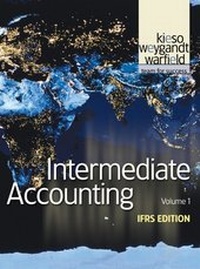
Intermediate Accounting
Volume 1. IFRS Edition
1st Edition
Published on 18. June 2010
Book
Hardback
800 pages
978-0-470-61630-7 (ISBN)
Description
US public companies will have to follow International Financial Reporting Standards as of January 1, 2011. Weygandt's Financial Accounting: IFRS introduces challenging accounting concepts with examples that are familiar to the student while incorporating the new global accounting standards. Following the reputation for accuracy, comprehensiveness, and currency, Weygandt guides students through financial accounting and the period of transition for IFRS readiness. The text prepares student for the requirements they will follow in the coming years.
More details
Other editions
New editions
Book
08/2014
2nd Edition
Wiley
€131.60
Article exhausted; check for reprint
Persons
Content
Chapter 1 Financial Accounting and Accounting Standards.
Chapter 2 Conceptual Framework for Financial Reporting.
Chapter 3 The Accounting Information System.
Chapter 4 Income Statement and Related Information.
Chapter 5 Statement of Financial Position and Statement of Cash Flows.
Chapter 6 Accounting and the Time Value of Money.
Chapter 7 Cash and Receivables.
Chapter 8 Valuation of Inventories: A Cost-Basis Approach.
Chapter 9 Inventories: Additional Valuation Issues.
Chapter 10 Acquisition and Disposition of Property, Plant, and Equipment.
Chapter 11 Depreciation, Impairments, and Depletion.
Chapter 12 Intangible Assets.
Chapter 13 Current Liabilities, Provisions, and Contingencies.
Chapter 14 Non-Current Liabilities.
Chapter 2 Conceptual Framework for Financial Reporting.
Chapter 3 The Accounting Information System.
Chapter 4 Income Statement and Related Information.
Chapter 5 Statement of Financial Position and Statement of Cash Flows.
Chapter 6 Accounting and the Time Value of Money.
Chapter 7 Cash and Receivables.
Chapter 8 Valuation of Inventories: A Cost-Basis Approach.
Chapter 9 Inventories: Additional Valuation Issues.
Chapter 10 Acquisition and Disposition of Property, Plant, and Equipment.
Chapter 11 Depreciation, Impairments, and Depletion.
Chapter 12 Intangible Assets.
Chapter 13 Current Liabilities, Provisions, and Contingencies.
Chapter 14 Non-Current Liabilities.