

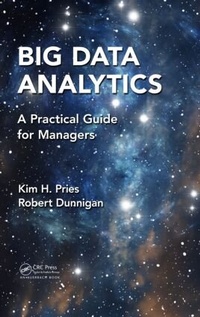
Big Data Analytics
A Practical Guide for Managers
1st Edition
Published on 5. February 2015
Book
Hardback
576 pages
978-1-4822-3451-0 (ISBN)
Description
With this book, managers and decision makers are given the tools to make more informed decisions about big data purchasing initiatives. Big Data Analytics: A Practical Guide for Managers not only supplies descriptions of common tools, but also surveys the various products and vendors that supply the big data market.
Comparing and contrasting the different types of analysis commonly conducted with big data, this accessible reference presents clear-cut explanations of the general workings of big data tools. Instead of spending time on HOW to install specific packages, it focuses on the reasons WHY readers would install a given package.
The book provides authoritative guidance on a range of tools, including open source and proprietary systems. It details the strengths and weaknesses of incorporating big data analysis into decision-making and explains how to leverage the strengths while mitigating the weaknesses.
Describes the benefits of distributed computing in simple terms
Includes substantial vendor/tool material, especially for open source decisions
Covers prominent software packages, including Hadoop and Oracle Endeca
Examines GIS and machine learning applications
Considers privacy and surveillance issues
The book further explores basic statistical concepts that, when misapplied, can be the source of errors. Time and again, big data is treated as an oracle that discovers results nobody would have imagined. While big data can serve this valuable function, all too often these results are incorrect, yet are still reported unquestioningly. The probability of having erroneous results increases as a larger number of variables are compared unless preventative measures are taken.
The approach taken by the authors is to explain these concepts so managers can ask better questions of their analysts and vendors as to the appropriateness of the methods used to arrive at a conclusion. Because the world of science and medicine has been grappling with similar issues in the publication of studies, the authors draw on their efforts and apply them to big data.
Comparing and contrasting the different types of analysis commonly conducted with big data, this accessible reference presents clear-cut explanations of the general workings of big data tools. Instead of spending time on HOW to install specific packages, it focuses on the reasons WHY readers would install a given package.
The book provides authoritative guidance on a range of tools, including open source and proprietary systems. It details the strengths and weaknesses of incorporating big data analysis into decision-making and explains how to leverage the strengths while mitigating the weaknesses.
Describes the benefits of distributed computing in simple terms
Includes substantial vendor/tool material, especially for open source decisions
Covers prominent software packages, including Hadoop and Oracle Endeca
Examines GIS and machine learning applications
Considers privacy and surveillance issues
The book further explores basic statistical concepts that, when misapplied, can be the source of errors. Time and again, big data is treated as an oracle that discovers results nobody would have imagined. While big data can serve this valuable function, all too often these results are incorrect, yet are still reported unquestioningly. The probability of having erroneous results increases as a larger number of variables are compared unless preventative measures are taken.
The approach taken by the authors is to explain these concepts so managers can ask better questions of their analysts and vendors as to the appropriateness of the methods used to arrive at a conclusion. Because the world of science and medicine has been grappling with similar issues in the publication of studies, the authors draw on their efforts and apply them to big data.
More details
Language
English
Place of publication
Oakville
Canada
Target group
Professional and scholarly
Professional Practice & Development
Illustrations
58 s/w Abbildungen, 2 s/w Tabellen
2 Tables, black and white; 58 Illustrations, black and white
Dimensions
Height: 234 mm
Width: 156 mm
Weight
970 gr
ISBN-13
978-1-4822-3451-0 (9781482234510)
Copyright in bibliographic data and cover images is held by Nielsen Book Services Limited or by the publishers or by their respective licensors: all rights reserved.
Schweitzer Classification
Other editions
Additional editions
Book
07/2022
1st Edition
Auerbach
€62.00
Shipment within 10-20 days
E-Book
02/2015
1st Edition
Auerbach Publishers Inc.
€65.99
Available for download
E-Book
02/2015
Auerbach
€65.99
Available for download
Persons
Kim H. Pries has four college degrees: a bachelor of arts in history from the University of Texas at El Paso (UTEP), a bachelor of science in metallurgical engineering from UTEP, a master of science in engineering from UTEP, and a master of science in metallurgical engineering and materials science from Carnegie-Mellon University.
Pries worked as a computer systems manager, a software engineer for an electrical utility, and a scientific programmer under a defense contract for Stoneridge, Incorporated (SRI). He has worked as software manager, engineering services manager, reliability section manager, and product integrity and reliability director.
In addition to his other responsibilities, Pries has provided Six Sigma training for both UTEP and SRI and cost reduction initiatives for SRI. Pries is also a founding faculty member of Practical Project Management. Additionally, in concert with Jon Quigley, Pries was a cofounder and principal with Value Transformation, LLC, a training, testing, cost improvement, and product development consultancy.
He trained for Introduction to Engineering Design and Computer Science and Software Engineering with Project Lead the Way. He currently teaches biotechnology, computer science and software engineering, and introduction to engineering design at the beautiful Parkland High School in the Ysleta Independent School District of El Paso, Texas.
Robert Dunnigan is a manager with Janus Consulting Partners and is based in Dallas, Texas. He holds a bachelor of science in psychology and in sociology with an anthropology emphasis from North Dakota State University. He also holds a master of business administration from INSEAD, "the business school for the world," where he attended the Singapore campus.
As a Peace Corps volunteer, Robert served over 3 years in Honduras developing agribusiness opportunities. As a consultant, he later worked on the Afghanistan Small and Medium Enterprise Development project in Afghanistan, where he traveled the country with his Afghan colleagues and friends seeking opportunities to develop a manufacturing sector in the country.
Robert is an American Society for Quality-certified Six Sigma Black Belt and a Scrum Alliance-certified Scrum Master.
Pries worked as a computer systems manager, a software engineer for an electrical utility, and a scientific programmer under a defense contract for Stoneridge, Incorporated (SRI). He has worked as software manager, engineering services manager, reliability section manager, and product integrity and reliability director.
In addition to his other responsibilities, Pries has provided Six Sigma training for both UTEP and SRI and cost reduction initiatives for SRI. Pries is also a founding faculty member of Practical Project Management. Additionally, in concert with Jon Quigley, Pries was a cofounder and principal with Value Transformation, LLC, a training, testing, cost improvement, and product development consultancy.
He trained for Introduction to Engineering Design and Computer Science and Software Engineering with Project Lead the Way. He currently teaches biotechnology, computer science and software engineering, and introduction to engineering design at the beautiful Parkland High School in the Ysleta Independent School District of El Paso, Texas.
Robert Dunnigan is a manager with Janus Consulting Partners and is based in Dallas, Texas. He holds a bachelor of science in psychology and in sociology with an anthropology emphasis from North Dakota State University. He also holds a master of business administration from INSEAD, "the business school for the world," where he attended the Singapore campus.
As a Peace Corps volunteer, Robert served over 3 years in Honduras developing agribusiness opportunities. As a consultant, he later worked on the Afghanistan Small and Medium Enterprise Development project in Afghanistan, where he traveled the country with his Afghan colleagues and friends seeking opportunities to develop a manufacturing sector in the country.
Robert is an American Society for Quality-certified Six Sigma Black Belt and a Scrum Alliance-certified Scrum Master.
Content
Introduction. The Mother of Invention's Triplets: Moore's Law, the Proliferation of Data, and Data Storage Technology. Hadoop. HBase and Other Big Data Databases. Machine Learning. Statistics. Google. Geographic Information Systems. Discovery. Data Quality. Benefits. Concerns.