

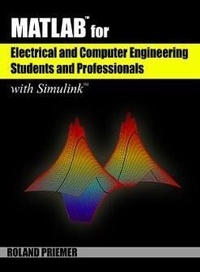
MATLAB (R) for Electrical and Computer Engineering Students and Professionals
With Simulink (R)
Published on 5. July 2013
Book
Paperback/Softback
664 pages
978-1-61353-188-4 (ISBN)
Description
This book combines the teaching of the MATLAB (R) programming language with the presentation and development of carefully selected electrical and computer engineering (ECE) fundamentals. This is what distinguishes it from other books concerned with MATLAB (R): it is directed specifically to ECE concerns. Students will see, quite explicitly, how and why MATLAB (R) is well suited to solve practical ECE problems.
This book is intended primarily for the freshman or sophomore ECE major who has no programming experience, no background in EE or CE, and is required to learn MATLAB (R) programming. It can be used for a course about MATLAB (R) or an introduction to electrical and computer engineering, where learning MATLAB (R) programming is strongly emphasized. A first course in calculus, usually taken concurrently, is essential. The book will also serve EE or CE professionals who need to learn MATLAB (R) and who prefer learning via examples directly relevant to their work.
The distinguishing feature of this MATLAB (R) book is that about 15 per cent develops ECE fundamentals gradually, from very basic principles. Because these fundamentals are interwoven throughout, MATLAB (R) can be applied to solve relevant, practical problems. The plentiful, in-depth example problems to which MATLAB (R) is applied were carefully chosen so that results obtained with MATLAB (R) also provide insights about the fundamentals.
This book is intended primarily for the freshman or sophomore ECE major who has no programming experience, no background in EE or CE, and is required to learn MATLAB (R) programming. It can be used for a course about MATLAB (R) or an introduction to electrical and computer engineering, where learning MATLAB (R) programming is strongly emphasized. A first course in calculus, usually taken concurrently, is essential. The book will also serve EE or CE professionals who need to learn MATLAB (R) and who prefer learning via examples directly relevant to their work.
The distinguishing feature of this MATLAB (R) book is that about 15 per cent develops ECE fundamentals gradually, from very basic principles. Because these fundamentals are interwoven throughout, MATLAB (R) can be applied to solve relevant, practical problems. The plentiful, in-depth example problems to which MATLAB (R) is applied were carefully chosen so that results obtained with MATLAB (R) also provide insights about the fundamentals.
More details
Series
Language
English
Place of publication
New York
United States
Target group
Primary & secondary/elementary & high school
Product notice
Paperback (trade)
Unsewn / adhesive bound
Dimensions
Height: 234 mm
Width: 188 mm
Thickness: 33 mm
Weight
1134 gr
ISBN-13
978-1-61353-188-4 (9781613531884)
Copyright in bibliographic data and cover images is held by Nielsen Book Services Limited or by the publishers or by their respective licensors: all rights reserved.
Schweitzer Classification
Other editions
Additional editions
Roland Priemer
MATLAB (R) for Electrical and Computer Engineering Students and Professionals
With Simulink (R)
E-Book
07/2017
1st Edition
SciTech Publishing Inc
€252.99
Available for download
Person
Roland Priemer has been a faculty member in the Electrical and Computer Engineering (ECE) Department of the University of Illinois at Chicago (UIC) for the past 40 years, during which time he has also consulted for local, national and international corporations and laboratories. He received the UIC Excellence in Teaching Award in 2004, the College of Engineering Excellence in Teaching Award in 2006 and the College of Engineering Harold Simon Award for Excellence in Teaching in 2008. He is currently an Associate Professor, Emeritus at UIC where he teaches the course: "Introduction to Electrical and Computer Engineering" to freshmen.
Content
Chapter 1: MATLAB (R) Environment
Chapter 2: Programs and Functions
Chapter 3: Matrices, Vectors, and Scalars
Chapter 4: Program Flow Control
Chapter 5: Binary Data
Chapter 6: Complex Numbers
Chapter 7: Character Data
Chapter 8: Input/Output
Chapter 9: Graphics
Chapter 10: Debugging
Chapter 11: Symbolic Math
Chapter 12: Signals and Systems
Chapter 13: Introduction to Simulink (R)
Appendix A: Suggestions for Reporting Solutions to End of Chapter Problems
Appendix B: Table of ASCII Codes
Appendix C: Answers to Selected Problems
Chapter 2: Programs and Functions
Chapter 3: Matrices, Vectors, and Scalars
Chapter 4: Program Flow Control
Chapter 5: Binary Data
Chapter 6: Complex Numbers
Chapter 7: Character Data
Chapter 8: Input/Output
Chapter 9: Graphics
Chapter 10: Debugging
Chapter 11: Symbolic Math
Chapter 12: Signals and Systems
Chapter 13: Introduction to Simulink (R)
Appendix A: Suggestions for Reporting Solutions to End of Chapter Problems
Appendix B: Table of ASCII Codes
Appendix C: Answers to Selected Problems