

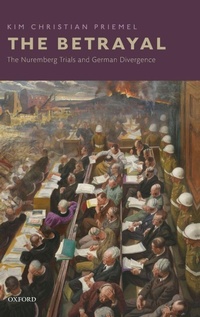
The Betrayal
The Nuremberg Trials and German Divergence
Published on 15. September 2016
Book
Hardback
496 pages
978-0-19-966975-2 (ISBN)
Description
At the end of World War II the Allies faced a threefold challenge: how to punish perpetrators of appalling crimes for which the categories of 'genocide' and 'crimes against humanity' had to be coined; how to explain that these had been committed by Germany, of all nations; and how to reform Germans. The Allied answer to this conundrum was the application of historical reasoning to legal procedure. In the thirteen Nuremberg trials held between 1945 and 1949, and in
corresponding cases elsewhere, a concerted effort was made to punish key perpetrators while at the same time providing a complex analysis of the Nazi state and German history. Building on a long debate about Germany's divergence from a presumed Western path of development, Allied prosecutors sketched a
historical trajectory which had led Germany to betray the Western model. Historical reasoning both accounted for the moral breakdown of a 'civilised' nation and rendered plausible arguments that this had indeed been a collective failure rather than one of a small criminal clique. The prosecutors therefore carefully laid out how institutions such as private enterprise, academic science, the military, or bureaucracy, which looked ostensibly similar to their opposite numbers in the Allied nations,
had been corrupted in Germany even before Hitler's rise to power. While the argument, depending on individual protagonists, subject matters, and contexts, met with uneven success in court, it offered a final twist which was of obvious appeal in the Cold War to come: if Germany had lost its way, it
could still be brought back into the Western fold. The first comprehensive study of the Nuremberg trials, The Betrayal thus also explores how history underpins transitional trials as we encounter them in today's courtrooms from Arusha to The Hague.
corresponding cases elsewhere, a concerted effort was made to punish key perpetrators while at the same time providing a complex analysis of the Nazi state and German history. Building on a long debate about Germany's divergence from a presumed Western path of development, Allied prosecutors sketched a
historical trajectory which had led Germany to betray the Western model. Historical reasoning both accounted for the moral breakdown of a 'civilised' nation and rendered plausible arguments that this had indeed been a collective failure rather than one of a small criminal clique. The prosecutors therefore carefully laid out how institutions such as private enterprise, academic science, the military, or bureaucracy, which looked ostensibly similar to their opposite numbers in the Allied nations,
had been corrupted in Germany even before Hitler's rise to power. While the argument, depending on individual protagonists, subject matters, and contexts, met with uneven success in court, it offered a final twist which was of obvious appeal in the Cold War to come: if Germany had lost its way, it
could still be brought back into the Western fold. The first comprehensive study of the Nuremberg trials, The Betrayal thus also explores how history underpins transitional trials as we encounter them in today's courtrooms from Arusha to The Hague.
Reviews / Votes
Priemel works to explain why Nuremberg looked the way it did, why actors within the system behaved as didactically, and where the cases share commonalities ... Priemel's narrative seeks to offer an illumination, not a defense, of Nuremberg. * Ellen Chapin, Yale Journal of International Affairs * Kim Priemel's The Betrayal is a very thoroughly researched historical but also philosophical and critical narrative of the Nuremberg Trials ... an excellent volume questioning and scrutinising the role of courts ... We recommend The Betrayal especially for peace and justice scholars and for those interested in the possible functions and purposes of courts. Furthermore, legal practitioners and law students might find Kim Priemel's discussion aroundthe contextual aspects of the Nuremberg Trials useful in order to learn more about the historical context, development and genesis of international criminal law. As Priemel himself takes an interdisciplinary approach in analysing the Nuremberg Trials, The Betrayal also serves those with an academic interest in social
sciences and international relations. * Kerry-Luise Prior and Marjana Papa, Volkerrechtsblog * Alongside the analytical through-line focusing on the use (and abuse) of history in the Nuremberg courtrooms, Priemel's volume is full of new information and keen insights into individual moments in the trial. His meticulous research means that there is hardly any aspect of the trials where he merely accepts the conventional wisdom without deep empirical investigation of his own. The Betrayal is in many ways magisterial. It will almost certainly become the
standard work on the Nuremberg trials for the foreseeable future. * Devin Pendas, The Lawfare Book Review * Priemel's comprehensive, broadly researched book covers the Nuremberg Trials' prehistory, the actual proceedings, and their immediate aftermath ... Its strength lies in the meticulous research, the precise detail, and in its degree of differentiation. * Milo Vec, Frankfurter Allgemeine Zeitung [translated] *
More details
Other editions
Additional editions
Book
05/2018
Oxford University Press
€50.83
Shipment within 15-20 days
E-Book
05/2018
1st Edition
OUP eBook
€25.49
Available for download
E-Book
09/2016
1st Edition
OUP eBook
€25.49
Available for download
Person
Kim Christian Priemel is Associate Professor of History at the University of Oslo. He specializes in contemporary European history, the Third Reich, social and economic history, and legal history. He has authored and edited several books and has published in the Journal of Modern History, the Journal of Contemporary History, and Central European History.