

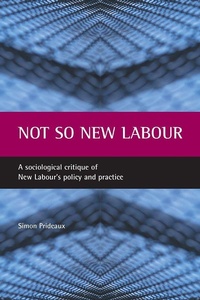
Not so New Labour
A sociological critique of New Labour's policy and practice
1st Edition
Will be published approx. on 23. March 2005
Book
Hardback
176 pages
978-1-86134-460-1 (ISBN)
Description
New Labour has concentrated many of its social policy initiatives in reinvigorating the family, community and work in the paid labour market. But just how 'new' are the ideas driving New Labour's policy and practice?
In this book, Simon Prideaux shows how New Labour has drawn on the ideas and premises of functionalism, which dominated British and American sociological thought during the 1940s, 1950s and 1960s.
The book provides an accessible overview of the theories that underpin the policies of New Labour, including the often labyrinthine theories of Talcott Parsons, Amitai Etzioni and Anthony Giddens; examines the ideas of Charles Murray and John Macmurray, philosophers publicly admired by Tony Blair; looks at the sociological origin of debates and controversies that surround the provision of welfare in both the US and UK and considers the alienating effects that New Deal schemes may have in Britain today.
Not so New Labour's innovative approach to the analysis of social policy under New Labour will be invaluable to academics, students and researchers in social policy, sociology, politics and applied social studies.
In this book, Simon Prideaux shows how New Labour has drawn on the ideas and premises of functionalism, which dominated British and American sociological thought during the 1940s, 1950s and 1960s.
The book provides an accessible overview of the theories that underpin the policies of New Labour, including the often labyrinthine theories of Talcott Parsons, Amitai Etzioni and Anthony Giddens; examines the ideas of Charles Murray and John Macmurray, philosophers publicly admired by Tony Blair; looks at the sociological origin of debates and controversies that surround the provision of welfare in both the US and UK and considers the alienating effects that New Deal schemes may have in Britain today.
Not so New Labour's innovative approach to the analysis of social policy under New Labour will be invaluable to academics, students and researchers in social policy, sociology, politics and applied social studies.
Reviews / Votes
"This is a very readable book, clearly structured and one I would have thought would readily find a place on undergraduate sociology and social policy course reading lists. One of the strengths of Prideaux's book is that it is accessible and it brings together in one volume a diverse assortment of influences on New Labour." Journal of Social Policy "A unique book that presents an original perspective on the American influence on British social policy under Tony Blair's New Labour by debating interesting new evidence from functionalist theory. Highly recommended." Luke Martell, School of Social Sciences, University of SussexMore details
Edition
First Edition
Language
English
Place of publication
Bristol
United Kingdom
Target group
Professional and scholarly
Product notice
Unsewn / adhesive bound
Cloth over boards
Dimensions
Height: 234 mm
Width: 156 mm
ISBN-13
978-1-86134-460-1 (9781861344601)
Copyright in bibliographic data and cover images is held by Nielsen Book Services Limited or by the publishers or by their respective licensors: all rights reserved.
Schweitzer Classification
Other editions
Additional editions
Book
03/2005
1st Edition
Policy Press
€39.80
Shipment within 15-20 days
E-Book
03/2005
1st Edition
Policy Press
€116.09
Available for download
Person
Simon Prideaux is a Researcher in the Sociology and Social Policy department at the University of Leeds. His research interests include the study of welfare policy in the US and UK, moral debates in welfare and general sociological theory.
Content
Introduction; The role and transmission of ideas in policy; Functionalism and society: the American interpretation of Durkheim; From organisational theory to the New Communitarian movement; John Macmurray, the Parsonian legacy and Blair's communitarianisms; Organisational theory and managerialisation: the symbiotic rise of an 'accountancy mentality'; Norms and the dysfunctional underclass: a convenient yet complementary critique form the New Right; 'The Third Way', 'opportunity' and functionalist remedies; 'Workfare' in practice: alienated lessons from the past, present and future; Where to now, Mr Blair? A conclusion.