

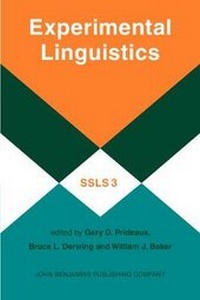
Experimental Linguistics
Integration of theories and applications
Published on 1. January 1980
Book
Paperback/Softback
321 pages
978-90-6439-164-4 (ISBN)
Description
Linguistics has suffered from the lack of interaction between theoretical and experimental activities. In order to carry out experimental studies in language it is, of course, necessary to have a descriptive system for the stimuli, and formal linguistics has provided a plethora of alternative possibilities. In addition, the theory can perhaps suggest some hints as to the direction experimental studies might take, at least to the extent that it suggest various kinds of relation among syntactic or phonological structures. But the theory alone cannot determine the nature of such relations in the cognitive or processing system of the language user. The first section of this volume addresses several of the key theoretical controversies in linguistics and attempts to specify the kinds of experimental evidence which might contribute to their ultimate resolution. The papers in the second section concern the collection of that evidence and its interpretation.
More details
Series
Language
English
Place of publication
Amsterdam
Netherlands
Target group
Professional and scholarly
Weight
585 gr
ISBN-13
978-90-6439-164-4 (9789064391644)
Copyright in bibliographic data and cover images is held by Nielsen Book Services Limited or by the publishers or by their respective licensors: all rights reserved.
Schweitzer Classification
Other editions
Additional editions
Gary D. Prideaux | Bruce L. Derwing | William J. Baker
Experimental Linguistics
Integration of theories and applications
E-Book
01/1980
1st Edition
John Benjamins Publishing Company
€98.99
Available for download
Persons
Content
1. Introduction: Experimental linguistics in historical perspective. (by Derwig, B.L.); 2. PART I: THEORETICAL BASES FOR EXPERIMENTAL LINGUISTICS (editorial introduction); 3. 1. On paraphrase. (by Fletcher, Paul); 4. 2. What is structural ambiguity? (by Patel, P.G.); 5. 3. On theories of focus. (by Andrew, Christine M.); 6. 4. Preliminaries to the experimental investigation of style in language. (by Marckworth, Mary Lois); 7. 5. English pluralization: A testing ground for rule evaluation. (by Derwig, B.L.); 8. PART II: EXPERIMENTAL RESULTS (editorial introduction); 9. 1. Grammatical properties of sentences as a basis for concept formation. (by Baker, Will); 10. 2. Grammatical voice and illocutionary meaning in an aural concept formation task. (by Reid, J. Raymond); 11. 3. Grammatical simplicity or performative efficiency? (by Baker, Will); 12. 4. A performative definition of sentence relatedness. (by Prideaux, Gary D.); 13. 5. Paraphrase relationships among clefted sentences. (by Fletcher, Paul); 14. 6. The recognition of ambiguity. (by Prideaux, Gary D.); 15. 7. An experimental investigation of focus. (by Andrew, Christine M.); 16. 8. A discriminant function analysis of co-variation of a number of syntactic devices in five prose genres. (by Marckworth, Mary Lois); 17. 9. Rule learning and the English inflections (with special emphasis on the plural). (by Derwig, B.L.); 18. 10. Perceptual dimensions of phonemic recognition. (by Ingram, John C.L.); 19. Epilogue: An "information structure" view of language. (by Baker, Will); 20. Bibliography