


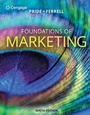
Foundations of Marketing
8th Edition
Published on 26. July 2018
Book
Paperback/Softback
978-0-357-03376-0 (ISBN)
Description
Introduce the essentials and latest trends in marketing with strong visuals and timely discussions in the proven resource for students of all backgrounds -- Pride/Ferrell's FOUNDATIONS OF MARKETING. The seventh edition's extensive coverage of current marketing strategies and concepts addresses social media, sustainability, globalization, customer relationship management, supply chain management, and digital marketing. Emerging topics, such as social and environmental responsibility, entrepreneurship, and new trends in marketing, resonate with students who are striving for success in today's fast-paced, evolving business world. Photos, screenshots, advertisements, and real-world examples make concepts meaningful for students.
More details
Edition
8th edition
Language
English
Place of publication
Florence
United States
Publishing group
Cengage Learning, Inc
Target group
College/higher education
Dimensions
Height: 22 mm
Width: 215 mm
Thickness: 274 mm
Weight
1111 gr
ISBN-13
978-0-357-03376-0 (9780357033760)
Copyright in bibliographic data and cover images is held by Nielsen Book Services Limited or by the publishers or by their respective licensors: all rights reserved.
Schweitzer Classification
Other editions
New editions
William Pride | O. C. Ferrell
Foundations of Marketing
Book
03/2021
9th Edition
South-Western College Publishing
€256.50
Shipment within 15-20 days
Previous edition

William Pride | O. C. Ferrell
Foundations of Marketing
Book
01/2016
7th Edition
South-Western College Publishing
€95.31
Shipment within 15-20 days
Persons
William M. Pride is Professor of Marketing at Mays Business School, Texas A&M University. He received his Ph.D. from Louisiana State University. In addition to this text, he is the co-author of "Cengage Learning's Business," a market-leader. Dr. Pride teaches principles of marketing at both undergraduate and graduate levels and constantly solicits student feedback that is important to revising a "Principles of Marketing" text. Dr. Pride's research interests are in advertising, promotion and distribution channels. His research articles have appeared in major journals in the fields of marketing such as the Journal of Marketing, the Journal of Marketing Research, the Journal of the Academy of Marketing Science and the Journal of Advertising. Dr. Pride is a member of the American Marketing Association, Academy of Marketing Science, Society for Marketing Advances and the Marketing Management Association. He has received the Marketing Fellow Award from the Society for Marketing Advances and the Marketing Innovation Award from the Marketing Management Association. Both of these are lifetime achievement awards. O.C. Ferrell is The James T. Pursell Sr. Eminent Scholar in Ethics and Director of the Center for Ethical Organizational Cultures, Auburn University. He served as the Distinguished Professor of Leadership and Ethics at Belmont University and University Distinguished Professor of Marketing at the Anderson School of Management at University of New Mexico. He has also been on the faculties of the University of Wyoming, Colorado State University, University of Memphis, Texas A&M University, Illinois State University and Southern Illinois University. He received his PhD in marketing from Louisiana State University. He is past president of the Academic Council of the American Marketing Association, and he chaired the American Marketing Association Ethics Committee. Under his leadership, the committee developed the AMA Code of Ethics and the AMA Code of Ethics for Marketing on the Internet. In addition, he is a former member of the Academy of Marketing Science Board of Governors and is a Society of Marketing Advances and Southwestern Marketing Association Fellow and an Academy of Marketing Science Distinguished Fellow. He was the vice president of publications and is president of the Academy of Marketing Science. He was the first recipient of the Marketing Education Innovation Award from the Marketing Management Association. He received a Lifetime Achievement Award from the Macromarketing Society and a special award for service to doctoral students from the Southeast Doctoral Consortium. He received the Harold Berkman Lifetime Service Award from the Academy of Marketing Science and, more recently, the Cutco/Vector Distinguished Marketing Educator Award. Dr. Ferrell is the co-author of 20 books and more than 100 published articles and papers. His articles have been published in the Journal of Marketing Research, the Journal of Marketing, the Journal of Business Ethics and the Journal of Business Research as well as other journals.
Content
PART I: STRATEGIC MARKETING AND ITS ENVIRONMENT.
1. Customer-Driven Strategic Marketing.
2. Planning, Implementing, and Evaluating Marketing Strategies.
3. The Marketing Environment, Social Responsibility, and Ethics.
PART II: MARKETING RESEARCH AND TARGET MARKETS.
4. Marketing Research and Information Systems.
5. Target Market Segmentation and Evaluation.
PART III: CUSTOMER BEHAVIOR AND E-MARKETING.
6. Consumer Buying Behavior.
7. Business Markets and Buying Behavior.
8. Reaching Global Markets.
9. Digital Marketing and Social Networking.
PART IV: PRODUCT AND PRICE DECISIONS.
10. Product, Branding, and Packing Concepts.
11. Developing and Managing Goods and Services
12. Pricing Concepts and Management.
13. Marketing Channels and Supply-Chain Management.
14. Retailing, Direct Marketing, and Wholesaling.
PART V: PROMOTION DECISIONS.
15. Integrated Marketing Communications.
16. Advertising and Public Relations.
17. Personal Selling and Sales Promotion.
Online Appendices.
Appendix A: Financial Analysis in Marketing.
Appendix B: Sample Marketing Plan.
Appendix C: Careers in Marketing.
Learning Path:
Self-Assessments: engage students by helping them make personal connections to the content presented in the chapter. Students are able to see how their responses compare to others (anonymously) in their class, school and across the country.
The chapter content serves as a foundation and reference source for the course. Concept Checks are short, automatically graded assessments that appear in-line in the reader and allow students to check their understanding of key concepts one section at a time before moving on. These concept-based questions also allow you to ensure students are familiar with those concepts before coming to class so you can go further with the time you have. There are also valuable study tools like highlighting, note taking, dictionary, flashcards, a text-to-speech tool, and more.
Chapter Assignment: These pre-built homework assignments include scenario-based questions with a variety of different problem types assessing comprehensive understanding of the entire chapter. These are automatically graded and include rejoinder feedback for right and wrong answers.
Video Quiz: Highlighting relevant companies, these videos and their corresponding activities help students solidify core chapter concepts by tying chapter themes or topics to real-world examples.
Study Tools: Students will find flashcards, lecture slides and Adaptive Test Prep, which allows students to ease the high anxiety that is often experienced around preparation for and taking exams.
You Make the Decision: Students are put in the shoes of a marketer in these interactive, media-rich activities. Following a scenario related to course content covered so far, students are presented with decision points as they progress through this interactive activity. Every decision a student makes impacts the outcome of the scenario, creating a unique marketing experience for each student. Appearing at the beginning of each part, these activities act as a summative opportunity, ultimately aiding students in connecting concepts from multiple lessons.
Group Projects and Role Play Activities: These video activities at the part level, powered by YouSeeU, are designed to take the headaches out of managing group dynamics, these group assignments can automatically place students into groups based on matching mutual availability. Students work in teams - as they would in marketing - to tackle assignments related to each major part covered in the course. Utilizing tools like scheduling and hosting virtual meetings, sharing documents and videos, and assigning milestones and tasks, these activities provide students with experience working in teams and utilizing real-world collaboration tools.
Marketing Plan Assignments: These flexible, modular assignments at the part level allow you to assign a complete marketing plan in stages - or pick only specific sections to assign. Fe
1. Customer-Driven Strategic Marketing.
2. Planning, Implementing, and Evaluating Marketing Strategies.
3. The Marketing Environment, Social Responsibility, and Ethics.
PART II: MARKETING RESEARCH AND TARGET MARKETS.
4. Marketing Research and Information Systems.
5. Target Market Segmentation and Evaluation.
PART III: CUSTOMER BEHAVIOR AND E-MARKETING.
6. Consumer Buying Behavior.
7. Business Markets and Buying Behavior.
8. Reaching Global Markets.
9. Digital Marketing and Social Networking.
PART IV: PRODUCT AND PRICE DECISIONS.
10. Product, Branding, and Packing Concepts.
11. Developing and Managing Goods and Services
12. Pricing Concepts and Management.
13. Marketing Channels and Supply-Chain Management.
14. Retailing, Direct Marketing, and Wholesaling.
PART V: PROMOTION DECISIONS.
15. Integrated Marketing Communications.
16. Advertising and Public Relations.
17. Personal Selling and Sales Promotion.
Online Appendices.
Appendix A: Financial Analysis in Marketing.
Appendix B: Sample Marketing Plan.
Appendix C: Careers in Marketing.
Learning Path:
Self-Assessments: engage students by helping them make personal connections to the content presented in the chapter. Students are able to see how their responses compare to others (anonymously) in their class, school and across the country.
The chapter content serves as a foundation and reference source for the course. Concept Checks are short, automatically graded assessments that appear in-line in the reader and allow students to check their understanding of key concepts one section at a time before moving on. These concept-based questions also allow you to ensure students are familiar with those concepts before coming to class so you can go further with the time you have. There are also valuable study tools like highlighting, note taking, dictionary, flashcards, a text-to-speech tool, and more.
Chapter Assignment: These pre-built homework assignments include scenario-based questions with a variety of different problem types assessing comprehensive understanding of the entire chapter. These are automatically graded and include rejoinder feedback for right and wrong answers.
Video Quiz: Highlighting relevant companies, these videos and their corresponding activities help students solidify core chapter concepts by tying chapter themes or topics to real-world examples.
Study Tools: Students will find flashcards, lecture slides and Adaptive Test Prep, which allows students to ease the high anxiety that is often experienced around preparation for and taking exams.
You Make the Decision: Students are put in the shoes of a marketer in these interactive, media-rich activities. Following a scenario related to course content covered so far, students are presented with decision points as they progress through this interactive activity. Every decision a student makes impacts the outcome of the scenario, creating a unique marketing experience for each student. Appearing at the beginning of each part, these activities act as a summative opportunity, ultimately aiding students in connecting concepts from multiple lessons.
Group Projects and Role Play Activities: These video activities at the part level, powered by YouSeeU, are designed to take the headaches out of managing group dynamics, these group assignments can automatically place students into groups based on matching mutual availability. Students work in teams - as they would in marketing - to tackle assignments related to each major part covered in the course. Utilizing tools like scheduling and hosting virtual meetings, sharing documents and videos, and assigning milestones and tasks, these activities provide students with experience working in teams and utilizing real-world collaboration tools.
Marketing Plan Assignments: These flexible, modular assignments at the part level allow you to assign a complete marketing plan in stages - or pick only specific sections to assign. Fe