

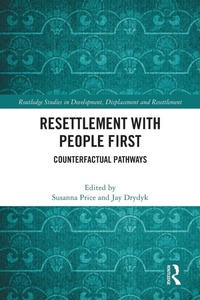
Resettlement with People First
Counterfactual Pathways
1st Edition
Published on 6. May 2025
Book
Paperback/Softback
268 pages
978-1-032-55877-6 (ISBN)
Description
Should people in the way lose out as new reservoirs, mines, plantations, or superhighways displace them from their homes and livelihoods? What if the process of resettlement were made accountable to those impacted, empowering them to achieve just outcomes and to share in the benefits of development projects? This book seeks to answer these questions, putting forward powerful counterfactual case studies to assess what problems real-world development projects would likely have avoided if the project had included the affected people in decision making about whether and how they should resettle.
Drawing on contributions from leading and emerging scholars from around the world, this book considers cases involving dams, mines, roads, and housing, amongst others, from Asia, Africa, and South America. In each case, the counterfactual approach invites us to reconsider how the dynamics of accountability play out through resettlement hazards and the asymmetries of power relations in the negotiation of displacement benefits and redress. Considering a range of theoretical and ethical perspectives, the book concludes with practical, alternative policy suggestions for displacement arising both from development and from slow onset climate change.
This book's novel approach focussing on the people's agency in the dynamics of governance, accountability, and (dis)empowerment in development projects with displacement and resettlement will appeal to academic researchers, development practitioners, and policymakers.
Drawing on contributions from leading and emerging scholars from around the world, this book considers cases involving dams, mines, roads, and housing, amongst others, from Asia, Africa, and South America. In each case, the counterfactual approach invites us to reconsider how the dynamics of accountability play out through resettlement hazards and the asymmetries of power relations in the negotiation of displacement benefits and redress. Considering a range of theoretical and ethical perspectives, the book concludes with practical, alternative policy suggestions for displacement arising both from development and from slow onset climate change.
This book's novel approach focussing on the people's agency in the dynamics of governance, accountability, and (dis)empowerment in development projects with displacement and resettlement will appeal to academic researchers, development practitioners, and policymakers.
More details
Series
Language
English
Place of publication
London
United Kingdom
Publishing group
Taylor & Francis Ltd
Target group
College/higher education
Professional and scholarly
Academic, Postgraduate, and Undergraduate Advanced
Illustrations
15 s/w Tabellen, 11 s/w Abbildungen, 11 s/w Zeichnungen
15 Tables, black and white; 11 Line drawings, black and white; 11 Illustrations, black and white
Dimensions
Height: 234 mm
Width: 156 mm
Thickness: 15 mm
Weight
433 gr
ISBN-13
978-1-032-55877-6 (9781032558776)
Copyright in bibliographic data and cover images is held by Nielsen Book Services Limited or by the publishers or by their respective licensors: all rights reserved.
Schweitzer Classification
Other editions
Additional editions
E-Book
12/2023
1st Edition
Taylor & Francis
€60.49
Available for download
Book
12/2023
1st Edition
Routledge
€206.60
Shipment within 10-20 days
E-Book
12/2023
1st Edition
Taylor & Francis
€60.49
Available for download
Persons
Susanna Price was the first international resettlement specialist recruited to the Asian Development Bank, Manila. Now based in the College of Asia and the Pacific at the Australian National University (ANU) she publishes regularly on displacement, resettlement, and social analysis. Her PhD is from Kyoto University, Japan.
Jay Drydyk is Professor of Philosophy at Carleton University, Canada; past President of the International Development Ethics Association; and past President of the Human Development and Capability Association. He is a Canadian philosopher whose research examines development from perspectives in ethics and social/political philosophy including the capability approach. Recent publications include the Routledge Handbook of Development Ethics (with Lori Keleher) in 2019.
Jay Drydyk is Professor of Philosophy at Carleton University, Canada; past President of the International Development Ethics Association; and past President of the Human Development and Capability Association. He is a Canadian philosopher whose research examines development from perspectives in ethics and social/political philosophy including the capability approach. Recent publications include the Routledge Handbook of Development Ethics (with Lori Keleher) in 2019.
Content
1. How participation affects involuntary resettlement: Evidence from the World Bank 2. Kariba resettlement and decision-making 3. Alternative development paths in Manantali, Mali 4. What if: Free, Prior and Informed Consent for Pak Mun Dam? 5. Meaningful participation and governance for the Pehuenche: Pangue and Ralco dams 6. Mapping and identification of 'unanticipated' impact: The Jamuna bridge project 7. Resettler input and equity outcomes in climate-related resettlement in Iloilo, the Philippines 8. Empowerment through consultation and participation: A counterfactual case study in Odisha State, India 9. Empowerment through agreement making: Ahafo Gold Mine in Ghana 10. Shifting power to affected communities: A counterfactual study of an IFC investment in a Guinean bauxite mine 11. What if? Some conclusions