

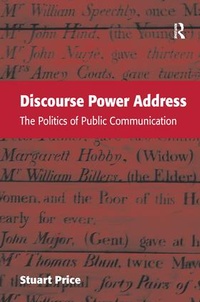
Discourse Power Address
The Politics of Public Communication
1st Edition
Published on 28. December 2006
Book
Hardback
264 pages
978-0-7546-4818-5 (ISBN)
Description
'Discourse Power Address' identifies the existence of 'directive' address, a form of strategic communication which is employed in a number of dominant practices, including Advertising, Politics, Public Relations and Corporate representation. Stuart Price argues that the simulation of intimacy in authoritarian address masks a drive to power, in which the creation of propositions by powerful social actors is based on the 'timeliness' of utterance rather than any real adherence to truth or genuine explanation. Election broadcasts, political speeches, TV commercials and corporate advertisements are all scrutinised in order to evaluate competing perspectives on the creation and circulation of meaning; particular reference is made to theories of discourse, ideology and address. In the course of his argument, the author proposes an original method for determining how authoritarian address attempts to make an impact on audiences. Providing a cross-disciplinary contribution to the fields of Communication, Language, Media and Political Studies, this book provides an original, clear-sighted contribution to the debate on language and power, and will provide an essential resource for lecturers, researchers, students, activists and policy-makers.
Reviews / Votes
'The work of Stuart Price has consistently expressed, through both his research and his teaching, the central importance of maintaining a critical, analytical perspective in a field which is in danger of atrophy. This latest publication demonstrates the key importance of his work. It is a book for those involved in discourse analysis, in media and cultural studies and should be on the reading list of all related undergraduate and postgraduate courses. It should also be compulsory reading for all journalists and broadcasters.' Robert Ferguson, University of London Institute of Education, UK '...an enormously informative and refreshing read...I would strongly recommend this book to both graduate and post-graduate students...One of the strengths of this book is that the writer strives throughout to acquaint the reader with all the terms and concepts that he mentions, which makes this book a good introductory study...' Discourse Studies '...Stuart Price provides analysis of election broadcasts, political speeches, TV commercials and corporate advertisements to support his position that the simulation of intimacy in authoritarian address is hiding a drive to power. The book focuses on one form of authoritarian address, which attempts to impinge on the receiver's subjectivity. Price refers to this type of representation as directive. The book identifies public communication that pursues instrumental goals, goals that are to the benefit of the producers of the text.' SociologyMore details
Language
English
Place of publication
London
United Kingdom
Publishing group
Taylor & Francis Ltd
Target group
College/higher education
Dimensions
Height: 234 mm
Width: 156 mm
Weight
650 gr
ISBN-13
978-0-7546-4818-5 (9780754648185)
Copyright in bibliographic data and cover images is held by Nielsen Book Services Limited or by the publishers or by their respective licensors: all rights reserved.
Schweitzer Classification
Other editions
Additional editions
Book
06/2019
1st Edition
Routledge
€79.51
Shipment within 10-20 days
E-Book
03/2017
Routledge
€67.49
Available for download
E-Book
03/2017
Routledge
€67.49
Available for download
Person
Stuart Price is Senior Lecturer in Media and Cultural Production, and Research Associate in the International Cultural Planning and Policy Unit, at De Montfort University, UK. He produced the first mass-market media studies book for the higher education sector and went on to write a series of books on communication and media. His current research includes work on rhetoric and the 'war on terror' and studies of gendered identity and film.
Content
Contents: Introduction: Definitions and perspectives; Theoretical background: critical theory and commercial culture; Discourse and ideology; Discourse and modernity; Advertising and corporate address; Ideology, commerce and politics; Politics and electoral address; Conclusion; Bibliography; Index.