

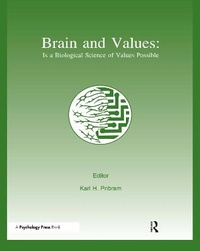
Brain and Values
Is A Biological Science of Values Possible?
Published on 1. May 1998
Book
Paperback/Softback
576 pages
978-0-8058-3154-2 (ISBN)
Description
This 5th volume of the Appalachian Conference discusses how the brain processes information, the role of memory and value, and models of creativity. It pursues aspects of cognitive neuroscience and behavioral neurodynamics, such as the topic of values and quantum-distributed processing in the brain.
More details
Series
Language
English
Place of publication
Philadelphia
United States
Publishing group
Taylor & Francis Inc
Target group
College/higher education
Professional and scholarly
Dimensions
Height: 276 mm
Width: 219 mm
Weight
1070 gr
ISBN-13
978-0-8058-3154-2 (9780805831542)
Copyright in bibliographic data and cover images is held by Nielsen Book Services Limited or by the publishers or by their respective licensors: all rights reserved.
Schweitzer Classification
Other editions
Additional editions
E-Book
01/2018
1st Edition
Psychology Press Ltd
€204.99
Available for download
E-Book
01/2018
Psychology Press Ltd
€204.99
Available for download
Book
08/2017
1st Edition
Psychology Press Ltd
€282.26
Shipment within 10-20 days
Person
Pribram, Karl H.
Content
Contents: R.J. Sternberg, Keynote: Successful Intelligence: An Expanded Approach to Understanding Intelligence. K.H. Pribram, Ruminations on Sex and Death; Memory and Value. Part I: Introduction. B.J. MacLennan, Mixing Memory and Desire: Want and Will in Neural Modeling. K.H. Pribram, On Brain and Value: Utility, Preference, Play, and Creativity. P. Werbos, Values, Goals and Utility in an Engineering-Based Theory of Mammalian Intelligence. Part II: Preference. T.R. Zentall, Stimulus Class Formation in Animals. Y.M. Yufik, Virtual Associative Networks: A Framework for Cognitive Modeling. T.P. Vogl, K.T. Blackwell, D.L. Alkon, Self-Organization of Cortical Information Processing. T. Kohonen, The Self-Organizing Map, A Possible Model of Brain Maps. H. Stapp, Pragmatic Approach to Consciousness. G.E. Schwartz, L.G. Russek, Do All Dynamical Systems Have Memory? Implications of the Systematic Memory Hypothesis for Science and Society. Part III: Utility. C.A. Ahern, F.B. Wood, C.M. McBrien, Preserved Semantic Memory in an Amnesic Child. B.B. Murdock, The Role of Memory in the Brain, Values, and Choice. T.R. Zentall, L.R. Sherburne, Transfer of Value in Simultaneous Discriminations: Implications for Cognitive and Social Processes. A.N. Schore, The Experience-Dependent Maturation of an Evaluative System in the Cortex. R. McCraty, M. Atkinson, D. Tomasion, W.A. Tiller, The Electricity of Touch: Detection and Measurement of Cardiac Energy. L. Deeke, W. Lang, Readiness For Action. Part IV: Creativity. R.J. Sternberg, A Larmarckian Model of Creativity. S. Leven, Metaphor, Healing, and Creativity: Re-Framing as a Biological Phenomenon. R.T. Bradley, Values, Agency, and the Theory of Quantum Vacuum Interaction. A. Amsel, On Cognitive Maps, Vicarious Trial-and-Error, and Impulsivity. J.L. McClelland, Role of the Hippocampus in Learning and Memory: A Computational Analysis. Part V: Afterword. K.H. Pribram, Commentary on J.L. McClelland. J.L. McClelland, McClelland Reactions to Pribram's Commentary. K. Pribram, Commentary on the Relation Between Value and Amnesia.