

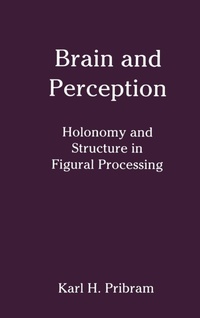
Brain and Perception
Holonomy and Structure in Figural Processing
1st Edition
Published on 1. June 1991
Book
Hardback
420 pages
978-0-89859-995-4 (ISBN)
Description
Presented as a series of lectures, this important volume achieves four major goals:
1) It integrates the results of the author's research as applied to pattern perception -- reviewing current brain research and showing how several lines of inquiry have been converging to produce a paradigm shift in our understanding of the neural basis of figural perception.
2) It updates the holographic hypothesis of brain function in perception.
3) It emphasizes the fact that both distributed (holistic) and localized (structural) processes characterize brain function.
4) It portrays a neural systems analysis of brain organization in figural perception by computational models -- describing processing in terms of formalisms found useful in ordering data in 20th-century physical and engineering sciences.
The lectures are divided into three parts: a Prolegomenon outlining a theoretical framework for the presentation; Part I dealing with the configural aspects of perception; and Part II presenting its cognitive aspects. The appendices were developed in a collaborative effort by the author, Kunio Yasue, and Mari Jibu (both of Notre Dame Seishin University of Okayama, Japan).
1) It integrates the results of the author's research as applied to pattern perception -- reviewing current brain research and showing how several lines of inquiry have been converging to produce a paradigm shift in our understanding of the neural basis of figural perception.
2) It updates the holographic hypothesis of brain function in perception.
3) It emphasizes the fact that both distributed (holistic) and localized (structural) processes characterize brain function.
4) It portrays a neural systems analysis of brain organization in figural perception by computational models -- describing processing in terms of formalisms found useful in ordering data in 20th-century physical and engineering sciences.
The lectures are divided into three parts: a Prolegomenon outlining a theoretical framework for the presentation; Part I dealing with the configural aspects of perception; and Part II presenting its cognitive aspects. The appendices were developed in a collaborative effort by the author, Kunio Yasue, and Mari Jibu (both of Notre Dame Seishin University of Okayama, Japan).
Reviews / Votes
"...this book should rapidly gain recognition as a groundbreaking work of the first order and an indispensable text in the areas Pribram covers....equally indispensable as a major first step toward the integration of brain, mind, and universe into a single comprehensible system."-World Futures
"Although most investigators are aware of the problem and of the importance of attaining a resolution, few have risen to the challenge, and even fewer have done so quite as strikingly as Pribram."
-Contemporary Psychology
More details
Series
Language
English
Place of publication
Mahwah
United States
Publishing group
Taylor & Francis Inc
Target group
College/higher education
Professional and scholarly
Dimensions
Height: 235 mm
Width: 157 mm
Thickness: 27 mm
Weight
759 gr
ISBN-13
978-0-89859-995-4 (9780898599954)
Copyright in bibliographic data and cover images is held by Nielsen Book Services Limited or by the publishers or by their respective licensors: all rights reserved.
Schweitzer Classification
Other editions
Additional editions
E-Book
09/2013
1st Edition
Psychology Press Ltd
€73.99
Available for download
E-Book
09/2013
1st Edition
Psychology Press Ltd
€73.99
Available for download
Person
Karl H. Pribram
Content
Contents: Preface. Acknowledgments. Viewpoint. Prolegomenon.Aims and Origins. Outlines of a Holonomic Brain Theory. Part I: Configural Aspects. Transformational Realism: The Optic Array, the Optical Image and the Retinal Process. Imaging: Cooperativity in Primary Sensory Systems. Object-Forms and Object Spaces: Sensory-Motor Reciprocity. Images of Achievement and Action Spaces: Somatic Processes in the Control of Action. Part II: Cognitive Aspects. Comprehension: Contributions of the Posterior Cerebral Convexity in Enhancing Processing Span. Familiarization and Valuation: The Contributions of the Amygdala System to the Demarcation of an Episode. Irrelevance and Innovation: The Contributions of the Hippocampus and Limbic Forebrain to the Processing of Context. Envisioning Proprieties and Priorities; Practical Inference: The Far Frontal Cortex as Executive Processor. Epilogue. Appendices: Neurodynamics: A Theory of Nonlocal Cortical Processing. Symmetry, Invariance and Group Theory in Object Perception. The Definition of Context. Familiarization as Transfer Among Contexts. The Formation of Prototypes. Neurodynamics and Innovation. The Neurodynamics of Covariation and Inference.