

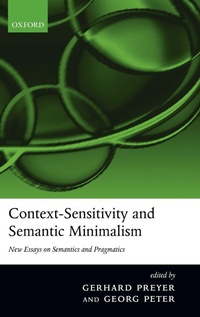
Context-Sensitivity and Semantic Minimalism
New Essays on Semantics and Pragmatics
Published on 25. October 2007
Book
Hardback
374 pages
978-0-19-921332-0 (ISBN)
Description
Fifteen specially written papers examine the ways in which the content of what we say is dependent on the context in which we say it. At the centre of the current debate on this subject is Cappelen and Lepore's claim that context-sensitivity in language is best captured by a combination of semantic minimalism and speech act pluralism. Using this theory as their starting point, the contributors to this volume develop a variety of different views about the role of context in communication, and reveal its wide-ranging implications for all issues in the philosophy of language and linguistics.
More details
Language
English
Place of publication
Oxford
United Kingdom
Target group
College/higher education
Dimensions
Height: 240 mm
Width: 161 mm
Thickness: 25 mm
Weight
725 gr
ISBN-13
978-0-19-921332-0 (9780199213320)
Copyright in bibliographic data and cover images is held by Nielsen Book Services Limited or by the publishers or by their respective licensors: all rights reserved.
Schweitzer Classification
Other editions
Additional editions
Gerhard Preyer | Georg Peter
Context-Sensitivity and Semantic Minimalism
New Essays on Semantics and Pragmatics
Book
10/2007
Oxford University Press
€50.12
Shipment within 15-20 days
Persons
Content
Introduction: Semantics and Pragmatics: Some Central Issues ; PART I: THE DEFENCE OF MODERATE CONTEXTUALISM ; 1. Content, Context and Composition ; 2. A Little Sensitivity goes a Long Way ; 3. Radical Minimalism, Moderate Contextualism ; 4. How and Why to Be a Moderate Contextualist ; 5. Moderately Insensitive Semantics ; 6. Sense and Insensitivity: Or where Minimalism meets Contextualism ; 7. Prudent Semantics Meets Wanton Speech Act Pluralism ; PART II: ON CRITIQUES OF SEMANTIC MINIMALISM ; 8. How Insensitive Can You Be? Meanings, Propositions, Context, and Semantical Underdeterminacy ; 9. Semantic Minimalism and Nonindexical Contextualism ; 10. Minimal (Disagreement about) Semantics ; 11. Minimal Propositions, Cognitive Safety Mechanisms, and Psychological Reality ; 12. Minimalism and Modularity ; 13. Minimalism, Psychological Reality, Meaning and Use ; PART II: BACK TO SEMANTIC MINIMALISM ; 14. Minimalism versus Contextualism in Semantics ; Index