

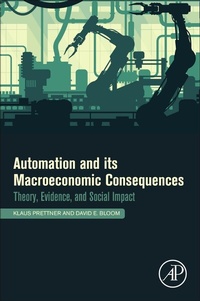
Automation and Its Macroeconomic Consequences
Theory, Evidence, and Social Impacts
Published on 17. June 2020
Book
Paperback/Softback
248 pages
978-0-12-818028-0 (ISBN)
Description
Automation and Its Macroeconomic Consequences reveals new ways to understand the economic characteristics of our increasing dependence on machines. Illuminating technical and social elements, it describes economic policies that could counteract negative income distribution consequences of automation without hampering the adoption of new technologies. Arguing that modern automation cannot be compared to the Industrial Revolution, it considers consequences of automation such as spatial patterns, urbanization, and regional concerns. In touching upon labor, growth, demographic, and policy, Automation and its Macroeconomic Consequences stands at the intersection of technology and economics, offering a comprehensive portrait illustrated by empirical observations and examples.
More details
Language
English
Place of publication
San Diego
United States
Publishing group
Elsevier Science Publishing Co Inc
Target group
College/higher education
Upper-division undergraduates, graduate students, researchers, and professionals working in labor economics, development economics, and industrial innovation.
Dimensions
Height: 229 mm
Width: 152 mm
Weight
520 gr
ISBN-13
978-0-12-818028-0 (9780128180280)
Copyright in bibliographic data and cover images is held by Nielsen Book Services Limited or by the publishers or by their respective licensors: all rights reserved.
Schweitzer Classification
Other editions
Additional editions
Klaus Prettner | David E. Bloom
Automation and Its Macroeconomic Consequences
Theory, Evidence, and Social Impacts
E-Book
06/2020
Academic Press
€86.95
Available for download
Persons
Klaus Prettner is professor of economics with a focus on growth and distribution at the University of Hohenheim and speaker of the research network "Inequality and Economic Policy Analysis (INEPA)?. His main areas of interest are the economic consequences of automation and the interrelations between economic growth and inequality. Prettner received a Ph.D. in Economics from the University of Vienna in 2009. He has published his research in journals such as Journal of Monetary Economics, Economic Journal, Journal of Economic Growth, Journal of Health Economics, Research Policy, Journal of Urban Economics, Health Affairs, Economic Theory, Economica, and the Journal of Economic Behavior & Organization. David E. Bloom is Clarence James Gamble Professor of Economics and Demography at the Harvard T.H. Chan School of Public Health. He is also Research Associate at the National Bureau of Economic Research and Research Fellow at IZA - Institute of Labor Economics. Bloom received a B.S. in Industrial and Labor Relations from Cornell University in 1976 and a Ph.D. in Economics and Demography from Princeton University in 1981. Bloom previously served on the public policy faculty at Carnegie-Mellon University and on the economics faculties at Harvard University and Columbia University. In recent years, he has written extensively on the links among health, education, population, and labor, and on economic valuation.
Content
Introduction
The stylized facts
Empirical evidence on the economic effects of automation
A simple macroeconomic framework for analyzing automation
Endogenous savings and extensions of the baseline model
Automation as a potential response to the challenges of demographic change
Policy challenges
Peering into the future: long-run economic and social consequences of automation; with an epilogue on COVID-19
The stylized facts
Empirical evidence on the economic effects of automation
A simple macroeconomic framework for analyzing automation
Endogenous savings and extensions of the baseline model
Automation as a potential response to the challenges of demographic change
Policy challenges
Peering into the future: long-run economic and social consequences of automation; with an epilogue on COVID-19