

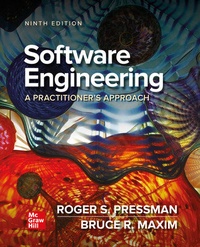
Software Engineering: A Practitioner's Approach
9th Edition
Published on 4. November 2019
Book
Paperback/Softback
978-1-259-87297-6 (ISBN)
Description
For almost four decades, Software Engineering: A Practitioner's Approach (SEPA) has been the world's leading textbook in software engineering. The ninth edition represents a major restructuring and update of previous editions, solidifying the book's position as the most comprehensive guide to this important subject.
More details
Edition
9th edition
Language
English
Place of publication
OH
United States
Target group
College/higher education
Weight
1109 gr
ISBN-13
978-1-259-87297-6 (9781259872976)
Copyright in bibliographic data and cover images is held by Nielsen Book Services Limited or by the publishers or by their respective licensors: all rights reserved.
Schweitzer Classification
Persons
Roger S. Pressman is an internationally recognized authority on software process improvement and software engineering technologies. He was president of R. S. Pressman and Associates Inc., a consultancy specializing in software engineering and is also the founder and chief technology officer of EVANNEX (R), an automotive aftermarket company that specializes in the design and manufacture of accessories for the Tesla line of electric vehicles.
Bruce R. Maxim has worked as a software engineer, project manager, professor, author, and consultant for more than thirty years. Dr. Maxim is a professor of computer and information science and collegiate professor of engineering at the University of Michigan-Dearborn. Dr. Maxim's professional experience includes managing research information systems at a medical school, directing instructional computing for a medical campus, and working as a statistical programmer. Dr. Maxim served as the chief technology officer for a game development company.
Bruce R. Maxim has worked as a software engineer, project manager, professor, author, and consultant for more than thirty years. Dr. Maxim is a professor of computer and information science and collegiate professor of engineering at the University of Michigan-Dearborn. Dr. Maxim's professional experience includes managing research information systems at a medical school, directing instructional computing for a medical campus, and working as a statistical programmer. Dr. Maxim served as the chief technology officer for a game development company.
Content
1) Software and Software Engineering
Part One - The Software Process
2) Process Models
3) Agility and Process
4) Recommended Process Model
5) Human Aspects of Software Engineering
Part Two - Modeling
6) Principles That Guide Practice
7) Understanding Requirements
8) Requirements Modeling - A Recommended Approach
9) Design Concepts
10) Architectural Design - A Recommended Approach
11) Component-Level Design
12) User Experience Design
13) Design for Mobility
14) Pattern-Based Design
Part Three - Quality and Security
15) Quality Concepts
16) Reviews - A Recommended Approach
17) Software Quality Assurance
18) Software Security Engineering
19) Software Testing - Component Level
20) Software Testing - Integration Level
21) Software Testing - Specialized Testing for Mobility
22) Software Configuration Management
23) Software Metrics and Analytics
Part Four - Managing Software Projects
24) Project Management Concepts
25) Creating a Viable Software Plan
26) Risk Management
27) A Strategy for Software Support
Part Five - Advanced Topics
28) Software Process Improvement
29) Emerging Trends in Software Engineering
30) Concluding Comments
Appendix I - An Introduction to UML
Appendix II - Data Science for Software Engineers
Part One - The Software Process
2) Process Models
3) Agility and Process
4) Recommended Process Model
5) Human Aspects of Software Engineering
Part Two - Modeling
6) Principles That Guide Practice
7) Understanding Requirements
8) Requirements Modeling - A Recommended Approach
9) Design Concepts
10) Architectural Design - A Recommended Approach
11) Component-Level Design
12) User Experience Design
13) Design for Mobility
14) Pattern-Based Design
Part Three - Quality and Security
15) Quality Concepts
16) Reviews - A Recommended Approach
17) Software Quality Assurance
18) Software Security Engineering
19) Software Testing - Component Level
20) Software Testing - Integration Level
21) Software Testing - Specialized Testing for Mobility
22) Software Configuration Management
23) Software Metrics and Analytics
Part Four - Managing Software Projects
24) Project Management Concepts
25) Creating a Viable Software Plan
26) Risk Management
27) A Strategy for Software Support
Part Five - Advanced Topics
28) Software Process Improvement
29) Emerging Trends in Software Engineering
30) Concluding Comments
Appendix I - An Introduction to UML
Appendix II - Data Science for Software Engineers