

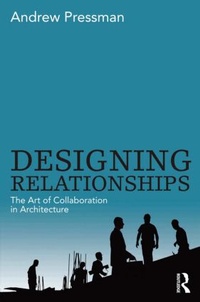
Designing Relationships: The Art of Collaboration in Architecture
1st Edition
Published on 15. January 2014
Book
Paperback/Softback
120 pages
978-0-415-50628-1 (ISBN)
Description
In today's dynamic practice environment, collaboration and teamwork skills are increasingly critical to the successful completion of building projects. Indeed, it is the careful nurturing of comradeship among complementary but distinctive egos that drives creativity underlying the hi-tech algorithms that help shape complex projects.
Designing Relationships: The Art of Collaboration in Architecture focuses on the skill set necessary to facilitate effective teamwork and collaboration among all stakeholders no matter what project delivery mode or technology is deployed. This book provides valuable guidance on how to design and construct buildings in a team context from inception to completion. It is the less tangible elements of collaboration and teamwork that provide the magic that transforms the most challenging projects into great works of architecture, and it is these more nuanced and subtle skills which the book brings to the fore. Showing examples of best and worst practice to illustrate the principles with real-life situations, this book presents the reader with an approach that is flexible and applicable to their everyday working life.
Designing Relationships: The Art of Collaboration in Architecture focuses on the skill set necessary to facilitate effective teamwork and collaboration among all stakeholders no matter what project delivery mode or technology is deployed. This book provides valuable guidance on how to design and construct buildings in a team context from inception to completion. It is the less tangible elements of collaboration and teamwork that provide the magic that transforms the most challenging projects into great works of architecture, and it is these more nuanced and subtle skills which the book brings to the fore. Showing examples of best and worst practice to illustrate the principles with real-life situations, this book presents the reader with an approach that is flexible and applicable to their everyday working life.
Reviews / Votes
Designing Relationships does a great service to the AEC industry by demystifying the techniques, mindsets, and strategies that together form the art of collaboration.Renee Cheng, AIA, Professor, Head of the School of Architecture, University of Minnesota
Designing Relationships is a must-read for those who still believe architects can and should lead the collaborative processRandall Deutsch, AIA, Associate Professor, University of Illinois
Designing Relationships can help all architects meet the challenges of a more complex design and construction environment in the twenty-first century.
Robert Ivy, FAIA, Chief Executive Officer of the American Institute of Architects
More details
Language
English
Place of publication
London
United Kingdom
Publishing group
Taylor & Francis Ltd
Target group
College/higher education
Professional and scholarly
Postgraduate, Professional, Professional Practice & Development, and Undergraduate
Illustrations
5 s/w Photographien bzw. Rasterbilder, 4 s/w Zeichnungen
4 Line drawings, black and white; 5 Halftones, black and white
Dimensions
Height: 234 mm
Width: 156 mm
Weight
262 gr
ISBN-13
978-0-415-50628-1 (9780415506281)
Copyright in bibliographic data and cover images is held by Nielsen Book Services Limited or by the publishers or by their respective licensors: all rights reserved.
Schweitzer Classification
Other editions
Additional editions
Book
01/2014
1st Edition
Routledge
€267.82
Shipment within 15-20 days
E-Book
01/2014
1st Edition
Routledge
€47.49
Available for download
E-Book
01/2014
1st Edition
Routledge
€47.49
Available for download
Person
Andrew Pressman, FAIA, an architect, Professor Emeritus at the University of New Mexico, and Lecturer at the University of Maryland, leads his own architectural firm in Washington, DC. He has written numerous critically acclaimed books and articles, and holds a Master's degree from the Harvard University Graduate School of Design.
Content
Foreword Preface Acknowledgments 1. Introduction to Collaboration 2. Alternative Collaboration Models for Architecture 3. Traditional Collaboration in Practice 4. Collaboration and Technology 5. Snapshots of Effective and Ineffective Collaboration Notes Illustration Credits Index