

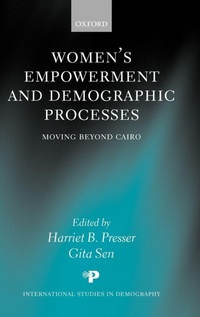
Women's Empowerment and Demographic Processes
Moving Beyond Cairo
Published on 31. August 2000
Book
Hardback
440 pages
978-0-19-829731-4 (ISBN)
Description
There is general consensus among the international population community that the commitment achieved at the International Conference on Population and Development (Cairo, 1994) to womens empowerment, along with the related goals of improving womens reproductive health and securing their reproductive rights, represented a paradigm shift in the discourse about population and development, even though there are differences in view whether this is a positive change or not. But while the rhetoric about womens empowerment is pervasive, the concept remains ill-defined, and its relationship to demographic processes has not been well articulated, either theoretically or empirically. This book brings together leading researchers and policy advocates to explore whether the concept of womens empowerment is indeed useful for an understanding of key demographic processes. Its contributors identify new directions for demographic research from the analysis of available data that measure womens empowerment, and point to the implications for population-related policies.
Demographic research has focused relatively little to date on gender, let alone the question of power. Yet critiques of available data argue that traditional womens-status indicators, such as education and employment, are often not sensitive enough to capture the nuances of gender power relations and the ways in which they govern womens and mens reproductive behaviour. This book moves forward to the complex task of conceptualizing, measuring, and analysing womens empowerment. In laying this groundwork, it provides critically important insights into the causes and consequences of population change, including migration. The book combines conceptual and empirical research with policy directions and considers the relevance of economic, social, and cultural contexts for the health and well-being of women, adolescents, and children. The countries under study are of both the North and the South. This book represents state-of-the-art knowledge on the two-way linkages between womens empowerment and demographic processes.
Demographic research has focused relatively little to date on gender, let alone the question of power. Yet critiques of available data argue that traditional womens-status indicators, such as education and employment, are often not sensitive enough to capture the nuances of gender power relations and the ways in which they govern womens and mens reproductive behaviour. This book moves forward to the complex task of conceptualizing, measuring, and analysing womens empowerment. In laying this groundwork, it provides critically important insights into the causes and consequences of population change, including migration. The book combines conceptual and empirical research with policy directions and considers the relevance of economic, social, and cultural contexts for the health and well-being of women, adolescents, and children. The countries under study are of both the North and the South. This book represents state-of-the-art knowledge on the two-way linkages between womens empowerment and demographic processes.
Reviews / Votes
Excellent and long-overdue collection of essays ... In their introductory essay, Presser and Sen provide an admirable overview. * Population and Development Review * This book is a useful resource for researchers and practitioners who are looking for tools and for models to follow in transforming an ideological and academic commitment to women's empowerment into solid empirical research. * Gender & Society * The chapters by Shireen Jejeebhoy and by Sunita Kishor are very useful case studies in how to take on the daunting question of measuring women's empowerment. * Gender & Society * This book does make necessary contributions to the study of both gender and of demographic processes, largely because it gathers together a broad set of analytic tools, schemata, and concepts for talking about women's empowerment - a veritable "tool kit" for those who want to study empowerment but are not sure where to begin or how to approach this vast topic. * Gender & Society *More details
Series
Language
English
Place of publication
Oxford
United Kingdom
Target group
Professional and scholarly
Illustrations
5 Zeichnungen
5 line drawings
Dimensions
Height: 240 mm
Width: 161 mm
Thickness: 28 mm
Weight
828 gr
ISBN-13
978-0-19-829731-4 (9780198297314)
Copyright in bibliographic data and cover images is held by Nielsen Book Services Limited or by the publishers or by their respective licensors: all rights reserved.
Schweitzer Classification
Persons
Harriet Presser is Distinguished Professor and Director of the Center on Population, Gender, and Social Inequality at the University of Maryland. Gita Sen is Professor of Economics at the Indian Institute of Mangement in Bangalore, and Adjunct Lecturer, Harvard School of Public Health
Editor
Distinguished Professor and Director of the Center on Population, Gender, and Social InequalityDistinguished Professor and Director of the Center on Population, Gender, and Social Inequality, University of Maryland, College Park
Professor of EconomicsProfessor of Economics, Indian Institute of Mangement, Bangalore
Content
PART I. INTRODUCTION ; PART II. THEORETICAL PERSPECTIVES ON WOMEN'S EMPOWERMENT ; PART III. WOMEN'S EMPOWERMENT AND REPRODUCTIVE HEALTH ; PART IV. WOMEN'S EMPOWERMENT AND SOCIO-DEMOGRAPHIC PROCESSES ; PART V. FUTURE DIRECTIONS FOR POPULATION POLICY