

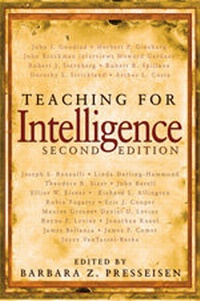
Teaching for Intelligence
2nd Edition
Published on 9. January 2008
Book
Hardback
336 pages
978-1-4129-5554-6 (ISBN)
Description
"A wonderful collection that addresses issues important in today's classrooms. This is an invaluable tool for any educator willing to strive for personal, student, and schoolwide excellence."
-Gayla LeMay, Social Studies Teacher
Louise Radloff Middle School, Duluth, GA
"Presseisen has skillfully assembled an exceptionally fine collection of articles."
-Burt Saxon, Adjunct Professor
Yale University and Southern Connecticut State University
A vast world of thought, inquiry, and wisdom for educating all learners.
This remarkable collection features an interview with Howard Gardner and includes contributions from such luminaries as Robert J. Sternberg, Robert R. Spillane, Arthur L. Costa, Linda Darling-Hammond, Dorothy Strickland, Joseph S. Renzulli, and Joyce VanTassel-Baska. The insightful articles encourage educators to examine their perspectives about the nature of intelligence, standardized testing, and curriculum requirements. Readers will be able to evaluate critical questions such as:
What does teaching for intelligence mean?
Who is the intelligent learner?
What do educators and scientists have to say about teaching for intelligence?
Updated with current research, this thought-provoking resource looks closely at current classroom instructional practice, students' intellectual development, and how educators view students in the learning process.
-Gayla LeMay, Social Studies Teacher
Louise Radloff Middle School, Duluth, GA
"Presseisen has skillfully assembled an exceptionally fine collection of articles."
-Burt Saxon, Adjunct Professor
Yale University and Southern Connecticut State University
A vast world of thought, inquiry, and wisdom for educating all learners.
This remarkable collection features an interview with Howard Gardner and includes contributions from such luminaries as Robert J. Sternberg, Robert R. Spillane, Arthur L. Costa, Linda Darling-Hammond, Dorothy Strickland, Joseph S. Renzulli, and Joyce VanTassel-Baska. The insightful articles encourage educators to examine their perspectives about the nature of intelligence, standardized testing, and curriculum requirements. Readers will be able to evaluate critical questions such as:
What does teaching for intelligence mean?
Who is the intelligent learner?
What do educators and scientists have to say about teaching for intelligence?
Updated with current research, this thought-provoking resource looks closely at current classroom instructional practice, students' intellectual development, and how educators view students in the learning process.
Reviews / Votes
"Presseisen has skillfully assembled an exceptionally fine collection of articles." -- Burt Saxon, Adjunct Professor "A wonderful collection that address issues important in today's classrooms. This is an invaluable tool for any educator willing to strive for personal, student, and schoolwide excellence." -- Gayla LeMay, Social Studies Teacher "Contributions by a range of educators address key issues for modern classrooms and make the second edition a 'must' for any college-level library strong in education and teaching programs." -- California Bookwatch, February 2008 "This is one of the rare collections that might be of great benefit to all American educators. Presseisen offers a book rich with important ideas. The essays not only inform readers, but encourage deeper examination and invite discussion on the nature of intelligence and its relationship to matters such as standards, testing, and curriculum development. It is a must for educators and would greatly benefit and enlighten politicians and parents too." -- CHOICE, May 2008 "The eminent contributors to this collection of articles present current research that will encourage educators to think critically and reflectively about their own perspectives on classroom instructional practice, students' intellectual development, and the student's role in the learning process. An invaluable resource." -- Curriculum Connections, Spring 2008More details
Edition
2nd Revised edition
Language
English
Place of publication
Thousand Oaks
United States
Publishing group
SAGE Publications Inc
Target group
Professional and scholarly
Edition type
Revised edition
Dimensions
Height: 229 mm
Width: 152 mm
Weight
650 gr
ISBN-13
978-1-4129-5554-6 (9781412955546)
Copyright in bibliographic data and cover images is held by Nielsen Book Services Limited or by the publishers or by their respective licensors: all rights reserved.
Schweitzer Classification
Other editions
Additional editions
Barbara Z. Presseisen
Teaching for Intelligence
Book
12/2007
2nd Edition
Corwin Press Inc
€51.00
Shipment within 10-20 days
Content
Introduction: Teaching for Intelligence
Acknowledgements
Section 1. The Value of Intelligence Theory
On the Habit of Informed Skepticism - Theodore R. Sizer
Narratives of the Educative Surround - John I. Goodlad
Truth, Beauty, and Goodness: Education for All Human Beings - John Brockman interviews Howard Gardner
Art, Imagination, and School Renewal - Maxine Greene
Schools Should Nurture Wisdom - Robert J. Sternberg
Section 2. The Intelligent Learner
Teacher Learning That Supports Student Learning - Linda Darling-Hammond
Did You Ask a Good Question Today? - John Barell
The Misunderstood Role of the Arts in Human Development - Elliot W. Eisner
What Really Matters in Teaching Children to Read - Richard L. Allington
Section 3. Instructing for Intelligence
Teaching for Intelligence: The Intellectual Life of Schools - Robert R. Spillane
The Intelligence-Friendly Classroom: It Just Makes Sense - Robin Fogarty
Teaching for Intelligence: In Search of Best Practices - James Bellanca
Mediative Environments: Creating Conditions for Intellectual Growth - Arthur L. Costa
Differentiating Instruction in the Classroom: Tapping Into the Intelligence of Every Learner - Dorothy S. Strickland
Teaching for Intelligence: Parameters for Change - Eric J. Cooper, Daniel U. Levine
Considerations in Introducing Instructional Interventions - Daniel U. Levine, Rayna F. Levine
Section 4. Special Concerns of Teaching for Intelligence
Working With Kids Like Mario - Jonathan Kozol
Challenging Preschool Education: Meeting the Intellectual Needs of All Children - Herbert P. Ginsburg
Infusing Higher-Order Thinking Into Science and Language Arts - Joyce VanTassel-Baska
A Practical Approach for Developing the Gifts and Talents of All Students - Joseph S. Renzulli
Creating the Climate and Conditions for Children to Learn - James P. Comer
About the Contributors
Index
Acknowledgements
Section 1. The Value of Intelligence Theory
On the Habit of Informed Skepticism - Theodore R. Sizer
Narratives of the Educative Surround - John I. Goodlad
Truth, Beauty, and Goodness: Education for All Human Beings - John Brockman interviews Howard Gardner
Art, Imagination, and School Renewal - Maxine Greene
Schools Should Nurture Wisdom - Robert J. Sternberg
Section 2. The Intelligent Learner
Teacher Learning That Supports Student Learning - Linda Darling-Hammond
Did You Ask a Good Question Today? - John Barell
The Misunderstood Role of the Arts in Human Development - Elliot W. Eisner
What Really Matters in Teaching Children to Read - Richard L. Allington
Section 3. Instructing for Intelligence
Teaching for Intelligence: The Intellectual Life of Schools - Robert R. Spillane
The Intelligence-Friendly Classroom: It Just Makes Sense - Robin Fogarty
Teaching for Intelligence: In Search of Best Practices - James Bellanca
Mediative Environments: Creating Conditions for Intellectual Growth - Arthur L. Costa
Differentiating Instruction in the Classroom: Tapping Into the Intelligence of Every Learner - Dorothy S. Strickland
Teaching for Intelligence: Parameters for Change - Eric J. Cooper, Daniel U. Levine
Considerations in Introducing Instructional Interventions - Daniel U. Levine, Rayna F. Levine
Section 4. Special Concerns of Teaching for Intelligence
Working With Kids Like Mario - Jonathan Kozol
Challenging Preschool Education: Meeting the Intellectual Needs of All Children - Herbert P. Ginsburg
Infusing Higher-Order Thinking Into Science and Language Arts - Joyce VanTassel-Baska
A Practical Approach for Developing the Gifts and Talents of All Students - Joseph S. Renzulli
Creating the Climate and Conditions for Children to Learn - James P. Comer
About the Contributors
Index