

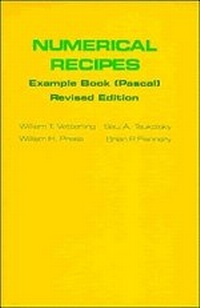
Numerical Recipes Example Book (Pascal)
Published on 24. November 1989
Book
Paperback/Softback
231 pages
978-0-521-37675-4 (ISBN)
Description
Designed to accompany Numerical Recipes in Pascal the example book provides listings of demonstration programs (source code) that illustrate the use of each Pascal procedure found in the main book. This book will be a valuable aid to users wishing to incorporate Pascal programs into their own applications programs and to conduct simple validation tests. The programs found in this book are different from the original example book in Pascal (which will be phased out). Furthermore, they are not compatible with the Pascal programs found in the appendix of the original (FORTRAN) version of Numerical Recipes. The Pascal appendix is being dropped from the FORTRAN book with the publication of Numerical Recipes in Pascal. The revised example diskette contains the machine-readable source code for the programs found in the revised example book. (It only contains the programs; it does not contain any text found in the book.) N.B. The diskette that accompanies the revised example book replaces the extant Numerical Recipes Example Diskette (Pascal). The revised diskette is only compatible with the programs listed in the revised example book.
More details
Language
English
Place of publication
Cambridge
United Kingdom
Target group
College/higher education
Product notice
Paperback (trade)
Illustrations
Worked examples or Exercises
Dimensions
Height: 228 mm
Width: 152 mm
Thickness: 13 mm
Weight
345 gr
ISBN-13
978-0-521-37675-4 (9780521376754)
Copyright in bibliographic data and cover images is held by Nielsen Book Services Limited or by the publishers or by their respective licensors: all rights reserved.
Schweitzer Classification
Persons
Content
Preface; 1. Preliminaries; 2. Linear algebraic equations; 3. Interpolation and extrapolation; 4. Integration of functions; 5. Evaluation of functions; 6. Special functions; 7. Random numbers; 8. Sorting; 9. Root finding and sets of equations; 10. Minimization and maximization of functions; 11. Eigensystems; 12. Fourier methods; 13. Statistical description of data; 14. Modeling of data; 15. Ordinary differential equations; 16. Two-point boundary value problems; 17. Partial differential equations; Index of demonstrated programs.