

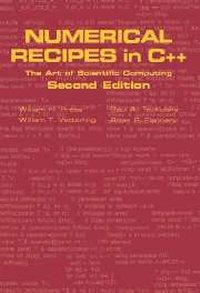
Numerical Recipes in C++
The Art of Scientific Computing
2nd Edition
Published on 7. February 2002
Book
Hardback
1032 pages
978-0-521-75033-2 (ISBN)
Description
Now the acclaimed Second Edition of Numerical Recipes is available in the C++ object-oriented programming language. Including and updating the full mathematical and explanatory contents of Numerical Recipes in C, this new version incorporates completely new C++ versions of the more than 300 Numerical Recipes routines that are widely recognized as the most accessible and practical basis for scientific computing. The product of a unique collaboration among four leading scientists in academic research and industry, Numerical Recipes is a complete text and reference book on scientific computing. In a self-contained manner it proceeds from mathematical and theoretical considerations to actual practical computer routines. Highlights include linear algebra, interpolation, special functions, random numbers, nonlinear sets of equations, optimization, eigensystems, Fourier methods and wavelets, statistical tests, ODEs and PDEs, integral equations and inverse theory. The authors' approach to C++ preserves the efficient execution that C users expect, while simultaneously employing a clear, object-oriented interface to the routines. Tricks and tips for scientific computing in C++ are liberally included. The routines, in ANSI/ISO C++ source code, can thus be used with almost any existing C++ vector/matrix class library, according to user preference. A simple class library for stand-alone use is also included in the book. Both scientific programmers new to C++, and experienced C++ programmers who need access to the Numerical Recipes routines, can benefit from this important new version of an invaluable, classic text.
Reviews / Votes
'... an instant 'classic,' a book that should be purchased and read by anyone who uses numerical methods...' American Journal of Physics '... a book that should be on your desk (not your shelf) if you have any interest in the analysis of data or the formulation of models.' Human Biology 'This encyclopedic book should be read (or at least owned) not only by those who must roll their own numerical methods, but by all who must use prepackaged programs.' New Scientist 'These books are a must for anyone doing scientific computing.' Journal of the American Chemical Society '... a first port of call for accessible software, Numerical Recipes is extrmely valuable ... this volume is a welcome addition to the Numerical Recipes stable.' A. R. Harker, Contemporary Physics 'It performs a very valuable function in not only providing a correct method for a given problem, but in also helping the reader identify the most appropriate method for the task in hand ... the C++ style used in the book is excellent ... The book is beautifully produced, very clear, and easy to read ... This is a book that every computer laboratory and every serious scientist should read.' Computing ReviewsMore details
Edition
2nd Revised edition
Language
English
Place of publication
Cambridge
United Kingdom
Target group
Professional and scholarly
College/higher education
Edition type
Revised edition
Illustrations
ove Line drawings, unspecified
Dimensions
Height: 260 mm
Width: 185 mm
Thickness: 45 mm
Weight
1769 gr
ISBN-13
978-0-521-75033-2 (9780521750332)
Copyright in bibliographic data and cover images is held by Nielsen Book Services Limited or by the publishers or by their respective licensors: all rights reserved.
Schweitzer Classification
Other editions
New editions
William H. Press | Saul A. Teukolsky | William T. Vetterling
Numerical Recipes 3rd Edition
The Art of Scientific Computing
Book
09/2007
3rd Edition
Cambridge University Press
€128.50
Available immediately
Persons
Content
1. Preliminaries; 2. Solution of linear algebraic equations; 3. Interpolation and extrapolation; 4. Integration of functions; 5. Evaluation of functions; 6. Special functions; 7. Random numbers; 8. Sorting; 9. Root finding and nonlinear sets of equations; 10. Minimization or maximization of functions; 11. Eigensystems; 12. Fast Fourier transform; 13. Fourier and spectral applications; 14. Statistical description of data; 15. Modeling of data; 16. Integration of ordinary differential equations; 17. Two point boundary value problems; 18. Integral equations and inverse theory; 19. Partial differential equations; 20. Less-numerical algorithms; References.