

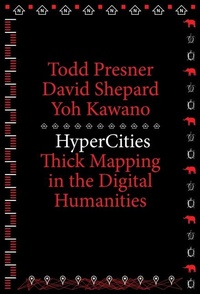
HyperCities
Thick Mapping in the Digital Humanities
Published on 7. July 2014
Book
Paperback/Softback
216 pages
978-0-674-72534-8 (ISBN)
Description
The prefix "hyper" refers to multiplicity and abundance. More than a physical space, a hypercity is a real city overlaid with information networks that document the past, catalyze the present, and project future possibilities. Hypercities are always under construction.
Todd Presner, David Shepard, and Yoh Kawano put digital humanities theory into practice to chart the proliferating cultural records of places around the world. A digital platform transmogrified into a book, it explains the ambitious online project of the same name that maps the historical layers of city spaces in an interactive, hypermedia environment. The authors examine the media archaeology of Google Earth and the cultural-historical meaning of map projections, and explore recent events-the "Arab Spring" and the Fukushima nuclear power plant disaster-through social media mapping that incorporates data visualizations, photographic documents, and Twitter streams. A collaboratively authored and designed work, HyperCities includes a "ghost map" of downtown Los Angeles, polyvocal memory maps of LA's historic Filipinotown, avatar-based explorations of ancient Rome, and hour-by-hour mappings of the Tehran election protests of 2009.
Not a book about maps in the literal sense, HyperCities describes thick mapping: the humanist project of participating and listening that transforms mapping into an ethical undertaking. Ultimately, the digital humanities do not consist merely of computer-based methods for analyzing information. They are a means of integrating scholarship with the world of lived experience, making sense of the past in the layered spaces of the present for the sake of the open future.
Todd Presner, David Shepard, and Yoh Kawano put digital humanities theory into practice to chart the proliferating cultural records of places around the world. A digital platform transmogrified into a book, it explains the ambitious online project of the same name that maps the historical layers of city spaces in an interactive, hypermedia environment. The authors examine the media archaeology of Google Earth and the cultural-historical meaning of map projections, and explore recent events-the "Arab Spring" and the Fukushima nuclear power plant disaster-through social media mapping that incorporates data visualizations, photographic documents, and Twitter streams. A collaboratively authored and designed work, HyperCities includes a "ghost map" of downtown Los Angeles, polyvocal memory maps of LA's historic Filipinotown, avatar-based explorations of ancient Rome, and hour-by-hour mappings of the Tehran election protests of 2009.
Not a book about maps in the literal sense, HyperCities describes thick mapping: the humanist project of participating and listening that transforms mapping into an ethical undertaking. Ultimately, the digital humanities do not consist merely of computer-based methods for analyzing information. They are a means of integrating scholarship with the world of lived experience, making sense of the past in the layered spaces of the present for the sake of the open future.
Reviews / Votes
A provocative overview and theoretical explication of 'thick mapping' projects that show enormous potential for complex, multilayered, multidimensional explorations of urban areas. HyperCities is an important book that makes signal contributions to the digital humanities. -- Matthew K. Gold, Associate Professor of English and Digital Humanities, Graduate Center, City University of New YorkMore details
Series
Language
English
Place of publication
Cambridge, Mass
United States
Product notice
Paperback (trade)
Unsewn / adhesive bound
Illustrations
75 color illustrations
Dimensions
Height: 210 mm
Width: 142 mm
Thickness: 20 mm
Weight
412 gr
ISBN-13
978-0-674-72534-8 (9780674725348)
Copyright in bibliographic data and cover images is held by Nielsen Book Services Limited or by the publishers or by their respective licensors: all rights reserved.
Schweitzer Classification
Persons
Todd Presner is Professor of Germanic Languages, Comparative Literature, and Digital Humanities at the University of California, Los Angeles. David Shepard is Lead Academic Programmer at the Center for Digital Humanities at the University of California, Los Angeles. Yoh Kawano is Campus GIS Coordinator at the Institute for Digital Research and Education and lecturer in the Luskin School of Public Affairs at the University of California, Los Angeles.