

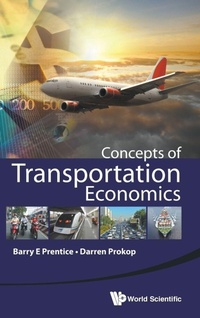
Concepts Of Transportation Economics
Published on 13. January 2016
Book
Hardback
332 pages
978-981-4656-16-0 (ISBN)
Description
Transportation is the world's largest invisible industry. Modern society is completely dependent on transportation to sustain its way of life, and it is all around us constantly. Yet the economics of transportation is a mystery to most people. Why do air fares rise and fall? Why do urban transit systems struggle to survive and require such large public subsidies? Why does freight transport cost more to move in one direction than an equal distance in another? Why is the government so heavily involved in transportation? Concepts of Transportation Economics provides explanations to these queries and many more, as well-renowned experts in the field, Barry E Prentice and Darren Prokop interpret the unique dynamics underlying transportation through the lens of applied economics, and demonstrate that the operations of transportation are completely logical and obvious once the concepts that underlie business decisions and consumer reactions are explained.
More details
Language
English
Place of publication
Singapore
Singapore
Target group
College/higher education
Dimensions
Height: 235 mm
Width: 157 mm
Thickness: 22 mm
Weight
633 gr
ISBN-13
978-981-4656-16-0 (9789814656160)
Copyright in bibliographic data and cover images is held by Nielsen Book Services Limited or by the publishers or by their respective licensors: all rights reserved.
Schweitzer Classification
Persons
Content
Communications and Technical Change; Logistics and Economics of Technological Change in the Supply Chain; Freight versus Passenger Demand for Transportation; Elasticity of Derived Demand for Transport; Role of Transport in Trade; Laws of Variable Proportions and Scale; Direct Costs and Scale Economies; Cost Economies and Traceability; Cost Relationships: Joint, Common and Constant Costs; Elasticity of Supply; Modal Supply Characteristics; Markets and Competition in Transportation; Externalities, Public Supply and Marginal Cost Pricing; Social Costs and Benefits; Spatial and Temporal Pricing in Transportation; Fronthaul and Backhaul Pricing; Peak Load Pricing; Congestion Cost Pricing; Price Discrimination; Transportation, Investment and Generalized Cost; Cost Benefit Analysis and Investment in Infrastructure; Intermodal Competition; Location and Land Settlement; Site Rents, Industrial Location; Gateways, Hubs and Trade Corridors; Transportation and Government Policy; Regulation and Deregulation; Taxation and Subsidization; Issues of Economic Development; Regulatory Enforcement and Compliance; The Role of Fines; Adverse Selection and Moral Hazard;