

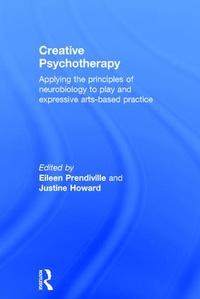
Creative Psychotherapy
Applying the principles of neurobiology to play and expressive arts-based practice
Published on 20. September 2016
Book
Hardback
214 pages
978-1-138-90091-2 (ISBN)
Description
Creative Psychotherapy brings together the expertise of leading authors and clinicians from around the world to synthesise what we understand about how the brain develops, the neurological impact of trauma and the development of play. The authors explain how to use this information to plan developmentally appropriate interventions and guide creative counselling across the lifespan.
The book includes a theoretical rationale for various creative media associated with particular stages of neural development, and examines how creative approaches can be used with all client groups suffering from trauma. Using case studies and exemplar intervention plans, the book presents ways in which creative activities can be used sequentially to support healing and development in young children, adolescents and adults.
Creative Psychotherapy will be of interest to mental health professionals working with children, adolescents and adults, including play and arts therapists, counsellors, family therapists, psychologists, social workers, psychiatrists and teachers. It will also be a valuable resource for clinically oriented postgraduate students, and therapists who work with victims of interpersonal trauma.
The book includes a theoretical rationale for various creative media associated with particular stages of neural development, and examines how creative approaches can be used with all client groups suffering from trauma. Using case studies and exemplar intervention plans, the book presents ways in which creative activities can be used sequentially to support healing and development in young children, adolescents and adults.
Creative Psychotherapy will be of interest to mental health professionals working with children, adolescents and adults, including play and arts therapists, counsellors, family therapists, psychologists, social workers, psychiatrists and teachers. It will also be a valuable resource for clinically oriented postgraduate students, and therapists who work with victims of interpersonal trauma.
Reviews / Votes
This book is a timely and valuable gift to the field of play and expressive arts-based psychotherapy. Neurosequential development is essential knowledge for therapists who work with individuals across the lifespan and specifically to address concerns arising in childhood. Prendiville and Howard have logically sequenced this volume to incorporate neurobiological principles with targeted sensory interventions for lower brain regions and with creative art, narrative and imaginative play interventions to progress neural integration for higher brain systems. A synaptic tree of therapeutic knowledge. - Judi Parson, PhD, RN, APPTA RPT-S: Lecturer in Mental Health - Child Play Therapy at Deakin University, AustraliaCreative Psychotherapy is a fantastic addition to the child therapy literature. This volume offers a wonderfully rich integration of current neurobiological research with various play and expressive therapeutic practices. The worlds of clinical practice and developmental research often exist in parallel. Creative Psychotherapy helps bridge these worlds, to the benefit of practitioners, researchers, and most importantly, the children who we try to understand and help. - Henry Kronengold, PhD, Clinical Supervisor, Doctoral Program in Clinical Psychology, City University of New York, USA
"I enjoyed the book immensely. I felt like I walked right into it and couldn't leave it alone! Some areas I read and re-read several times, then was so intrigued I went to the reference texts to study them. I'm excited to see where this goes!" - Joan Wilson, Registered Psychotherapist, Certified Play Therapy Supervisor, Trainer and Supervisor with the Theraplay (R) Institute
More details
Language
English
Place of publication
London
United Kingdom
Publishing group
Taylor & Francis Ltd
Target group
College/higher education
Professional and scholarly
Postgraduate, Professional, and Professional Practice & Development
Illustrations
6 s/w Photographien bzw. Rasterbilder, 2 s/w Zeichnungen, 2 s/w Tabellen
2 Tables, black and white; 2 Line drawings, black and white; 6 Halftones, black and white
Dimensions
Height: 234 mm
Width: 156 mm
Weight
460 gr
ISBN-13
978-1-138-90091-2 (9781138900912)
Copyright in bibliographic data and cover images is held by Nielsen Book Services Limited or by the publishers or by their respective licensors: all rights reserved.
Schweitzer Classification
Other editions
New editions

Eileen Prendiville | Justine Howard
Creative Psychotherapy
Neurobiologically Informed Play and Expressive Arts-Based Therapies
Book
approx. 09/2026
2nd Edition
Routledge
€185.50
Not yet published
Additional editions
Eileen Prendiville | Justine Howard
Creative Psychotherapy
Applying the principles of neurobiology to play and expressive arts-based practice
E-Book
09/2016
Routledge
€36.99
Available for download
Eileen Prendiville | Justine Howard
Creative Psychotherapy
Applying the principles of neurobiology to play and expressive arts-based practice
E-Book
09/2016
Routledge
€36.99
Available for download
Eileen Prendiville | Justine Howard
Creative Psychotherapy
Applying the principles of neurobiology to play and expressive arts-based practice
Book
09/2016
Routledge
€52.90
Shipment within 10-20 days
Persons
Eileen Prendiville is the Course Director for the MA in Creative Psychotherapy and Play Therapy at Ireland's Children's Therapy Centre. She is heavily involved in providing play therapy and creative psychotherapy training, both nationally and internationally. She devised 'The Therapeutic Touchstone', an innovative approach for use when working with vulnerable and dependent clients and, with Justine Howard, co-authored Play Therapy Today: Contemporary practice for individuals, groups and parents.
Dr Justine Howard is an Associate Professor at the College of Human and Health Science at Swansea University. She is a Chartered Psychologist and specialist in developmental and therapeutic play. Her consultancy activity has included the delivery of training courses in play for a wide range of professional groups across children's services. She is internationally recognized as an expert in play and child development, and has published numerous journal articles, book chapters and books in this field.
Dr Justine Howard is an Associate Professor at the College of Human and Health Science at Swansea University. She is a Chartered Psychologist and specialist in developmental and therapeutic play. Her consultancy activity has included the delivery of training courses in play for a wide range of professional groups across children's services. She is internationally recognized as an expert in play and child development, and has published numerous journal articles, book chapters and books in this field.
Content
Dedication Introduction Foreword Section 1: Applying the principles of neurobiology to play and expressive arts-based practice 1: Neurobiology for psychotherapists 2: Neurobiologically informed psychotherapy 3: The role of non-directive and directive/Focused approaches to play and expressive arts therapy for children, adolescents, and adults 4: Counselling skills in action with children, adolescents and adults Section 2: Working with the Brainstem and Midbrain 5: The role of music and rhythm in the development, integration and repair of the self 6: Being, becoming and healing through movement and touch 7: Coming Alive: Finding joy through sensory play Section 3: Working with the Limbic and Cortical Systems 8: Art in Psychotherapy: The healing power of images 9: Sandtray Therapy: A neurobiological approach 10: Telling Tales: Weaving new neural networks 11: A Growing Brain - A growing imagination Conclusion & Discussion