

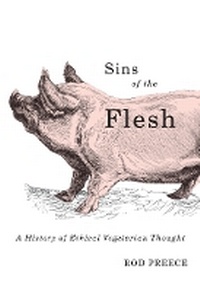
Sins of the Flesh
A History of Ethical Vegetarian Thought
Will be published approx. on 7. October 2008
Book
Hardback
416 pages
978-0-7748-1509-3 (ISBN)
Description
Unlike previous books on the history of vegetarianism, Sins of theFlesh examines the history of vegetarianism in its ethicaldimensions, from the origins of humanity through to the present. Fullethical consideration for animals resulting in the eschewing of flesharose after the Aristotelian period in Greece and recurred in AncientRome, but then mostly disappeared for centuries. It was not until theturn of the nineteenth century that vegetarian thought was revived andenjoyed some success; it subsequently went into another period ofdecline that lasted through much of the twentieth century. Theauthority-questioning cultural revolution of the 1960s brought a freshresurgence of vegetarian ethics that continues to the present day.
Reviews / Votes
"In the field of animal studies, Rod Preece is a world-renowned scholar, and this current volume confirms that his reputation is well deserved. - Jodey Castricano, editor of Animal Subjects Preece's nuanced assessments of this history are worthy of consideration by both animal rightists and their opponents. - Daniel A. Dombrowski, author of The Philosophy of Vegetarianism The issue of our ethical obligations to nonhuman animals has been the subject of lively debate, and many books have been written on the subject. Sins of the Flesh will be an important addition to this literature. - Steve F. Sapontzis, author of Morals, Reason, and Animals"More details
Language
English
Place of publication
Vancouver
Canada
Product notice
sewn/stitched
Dimensions
Height: 229 mm
Width: 152 mm
Weight
732 gr
ISBN-13
978-0-7748-1509-3 (9780774815093)
Copyright in bibliographic data and cover images is held by Nielsen Book Services Limited or by the publishers or by their respective licensors: all rights reserved.
Schweitzer Classification
Person
Rod Preece is a professor emeritus atWilfrid Laurier University.
Content
Introduction: Bill of Fare to the Feast: The Whats and Whys ofVegetarianism
1: The Human in Prehistory
2: Eastern Religions and Practice
3: Pythagoreanism
4: Greek Philosophy and Roman Imperium
5: Judaism and The Earlier Christian Heritage
6: Bogomils, Cathars, and the Later Medieval Mind
7: The Humanism of the Renaissance
8: The Cartesians and their Adversaries in the Seventeenth andEighteenth Centuries
9: Preaching without Practising: From Mandeville and Pope to Goldsmithand Wagner
10: Militant Advocates: From Oswald and Ritson to Shelley, Phillips,and Gompertz
11: The Victorians, the Edwardians, and the Founding of the VegetarianSociety
12: Vegetarians and Vegans in the Twentieth Century
13: Vegetarianism in North America
Postscript: Prospects
1: The Human in Prehistory
2: Eastern Religions and Practice
3: Pythagoreanism
4: Greek Philosophy and Roman Imperium
5: Judaism and The Earlier Christian Heritage
6: Bogomils, Cathars, and the Later Medieval Mind
7: The Humanism of the Renaissance
8: The Cartesians and their Adversaries in the Seventeenth andEighteenth Centuries
9: Preaching without Practising: From Mandeville and Pope to Goldsmithand Wagner
10: Militant Advocates: From Oswald and Ritson to Shelley, Phillips,and Gompertz
11: The Victorians, the Edwardians, and the Founding of the VegetarianSociety
12: Vegetarians and Vegans in the Twentieth Century
13: Vegetarianism in North America
Postscript: Prospects