

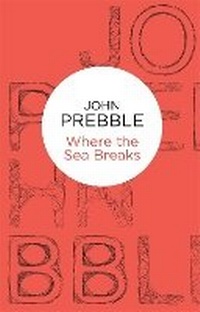
Where the Sea Breaks
Published on 18. October 2012
Book
Paperback/Softback
146 pages
978-1-4472-3368-8 (ISBN)
Description
A German bomber crash-lands on a small Scottish island and the Nazi pilot, with his crew of three, seizes control of the place. Two guns are stripped from the wreckage; an inquisitive collie-dog is killed; a young man is shot dead beside his radio . . . and 'martial law' is declared.
As thundering seas cut off the island from the mainland, John Prebble works out this wartime story to its terrifying climax. Methodically, brutally the Nazi officer shapes his plans; dumbly, sullenly the Scottish folk hold out and bide their time.
Whose nerves will be the first to crack?
As thundering seas cut off the island from the mainland, John Prebble works out this wartime story to its terrifying climax. Methodically, brutally the Nazi officer shapes his plans; dumbly, sullenly the Scottish folk hold out and bide their time.
Whose nerves will be the first to crack?
More details
Language
English
Place of publication
London
United Kingdom
Publishing group
Pan Macmillan
Target group
Interest Age: From 18 years
Product notice
Paperback (UK-trade)
Dimensions
Height: 234 mm
Width: 156 mm
Thickness: 9 mm
Weight
236 gr
ISBN-13
978-1-4472-3368-8 (9781447233688)
Copyright in bibliographic data and cover images is held by Nielsen Book Services Limited or by the publishers or by their respective licensors: all rights reserved.
Schweitzer Classification
Person
John Prebble was a journalist, novelist, documentarian and historian. He was born in England but his family moved to Canada following WWI, later returning to England where Prebble was educated at Latymer School.
Prebble began his writing life as a journalist in 1934, and drew on his experiences as an artilleryman in WWII when he wrote his first novel, Where the Sea Breaks, published in 1944. He joined the Communist Party of Great Britain, but abandoned it after World War II. His Canadian prairie experience also influenced his work: The Buffalo Soldier is a historical novel about the American West.
Scottish history formed the subject of many of Prebble's subsequent novels. His Fire and Sword Trilogy, focused on the fall of the clan system in 17th Century Scotland. Culloden was the first book, chronicling the defeat of the clans in one pivotal battle. The second book of the trilogy, The Highland Clearances (1963), remains one of Prebble's best known works because the subject matter is still one of great historical debate. Glencoe (1966), the final book, was a study of the causes and effects of the Glencoe massacre of 1692. His later works, Mutiny (1975) and The King's Jaunt (1988) extended the theme.
Prebble also co-wrote the screenplay of the film Zulu, as well as radio dramas and documentaries. He was awarded an OBE in 1998, just three years before his death.
Prebble began his writing life as a journalist in 1934, and drew on his experiences as an artilleryman in WWII when he wrote his first novel, Where the Sea Breaks, published in 1944. He joined the Communist Party of Great Britain, but abandoned it after World War II. His Canadian prairie experience also influenced his work: The Buffalo Soldier is a historical novel about the American West.
Scottish history formed the subject of many of Prebble's subsequent novels. His Fire and Sword Trilogy, focused on the fall of the clan system in 17th Century Scotland. Culloden was the first book, chronicling the defeat of the clans in one pivotal battle. The second book of the trilogy, The Highland Clearances (1963), remains one of Prebble's best known works because the subject matter is still one of great historical debate. Glencoe (1966), the final book, was a study of the causes and effects of the Glencoe massacre of 1692. His later works, Mutiny (1975) and The King's Jaunt (1988) extended the theme.
Prebble also co-wrote the screenplay of the film Zulu, as well as radio dramas and documentaries. He was awarded an OBE in 1998, just three years before his death.