

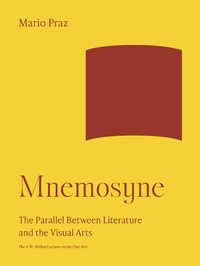
Mnemosyne
The Parallel Between Literature and the Visual Arts
Published on 15. August 2023
Book
Paperback/Softback
280 pages
978-0-691-25218-6 (ISBN)
Description
The classic study of the timeless relationship between literature and the visual arts
In his search for a common link between literature and the visual arts, Mario Praz draws on the abundant evidence of mutual understanding and correspondence they have long shared. Praz explains that within literature, each epoch has "its peculiar handwriting or handwritings, which, if one could interpret them, would reveal a character, even a physical appearance," and while these characteristics belong to the general style of a given period, the personality of the writer does not fail to pierce through. Praz contends that something similar occurs in art. He shows how the likeness between the arts within various periods of history can ultimately be traced to structural similarities that arise out of the characteristic way in which the people of a certain epoch see and memorize facts aesthetically. Mnemosyne, at once the goddess of memory and the mother of the muses, presides over this view of the arts. In illustrating her influence, Praz ranges widely through Western sources, providing an incomparable tour of the literary and pictorial arts.
In his search for a common link between literature and the visual arts, Mario Praz draws on the abundant evidence of mutual understanding and correspondence they have long shared. Praz explains that within literature, each epoch has "its peculiar handwriting or handwritings, which, if one could interpret them, would reveal a character, even a physical appearance," and while these characteristics belong to the general style of a given period, the personality of the writer does not fail to pierce through. Praz contends that something similar occurs in art. He shows how the likeness between the arts within various periods of history can ultimately be traced to structural similarities that arise out of the characteristic way in which the people of a certain epoch see and memorize facts aesthetically. Mnemosyne, at once the goddess of memory and the mother of the muses, presides over this view of the arts. In illustrating her influence, Praz ranges widely through Western sources, providing an incomparable tour of the literary and pictorial arts.
Reviews / Votes
"One of the most urbane and sophisticated cultural tours ever put between two covers." * Virginia Quarterly Review * "Mnemosyne is really a great tour down the centuries through galleries, libraries, churches, gardens, and salons, which at every point opens up surprising and penetrating views. Mr. Praz is a man whose breadth of culture is almost unmatched. His outlook is open and humane, his insight attractive, and his mind passionately curious: he has a phenomenal capacity for bringing valuable things out of hiding." * Yale Review * "The lectures constitute a tour de force and, as with everything from his pen, there is much that is new and stimulating. . . . After reading this admirable volume there can be little doubt that historians of art and literature-no less than the gentle reader-will learn much from it about the problems of seeking to establish parallels between the arts." * Apollo *More details
Series
Language
English
Place of publication
New Jersey
United States
Target group
College/higher education
Professional and scholarly
Product notice
Paperback (trade)
Illustrations
121 b/w illus.
Dimensions
Height: 275 mm
Width: 175 mm
Thickness: 15 mm
Weight
542 gr
ISBN-13
978-0-691-25218-6 (9780691252186)
Copyright in bibliographic data and cover images is held by Nielsen Book Services Limited or by the publishers or by their respective licensors: all rights reserved.
Schweitzer Classification
Other editions
Additional editions
E-Book
10/2023
1st Edition
Princeton University Press
€33.99
Available for download
Person
Mario Praz (1896-1982) was professor emeritus of English language and literature at the University of Rome. His books include The Romantic Agony, Studies in Seventeenth-Century Imagery, and The Flaming Heart.