

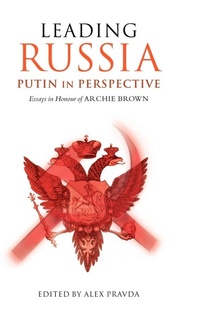
Leading Russia: Putin in Perspective
Essays in Honour of Archie Brown
Published on 26. May 2005
Book
Hardback
320 pages
978-0-19-927614-1 (ISBN)
Description
Leaders and leadership continue to dominate Russia's political development. Like his predecessors in the Kremlin, Vladimir Putin has made a crucial impact on the substance and style of Russian politics. His efforts to use traditional tools of state power to manage democracy and market capitalism have had mixed effects on both.
Leading Russia investigates the ambiguities and contradictions of Putin's rule from four perspectives. The volume first considers his leadership in the context of Russia's convulsive historical cycle of revolutionary transformation, breakdown, consolidation, and stagnation. The study then analyses how normative and institutional components of democracy have fared under Putin's regime of stronger executive control. It proceeds to examine the strengths and weaknesses of presidential power vis-a-vis bureaucratic, regional, and corporate groups. The volume concludes with two assessments of the strategic direction in which Putin is taking Russia. They explore the tensions between bureaucratic-authoritarian trends and Putin's apparent commitment to electoral democracy, market capitalism, and alignment with the West.
The book helps to deepen our understanding of the cultural and institutional factors shaping Putin's leadership approach and policy priorities. More widely, it sheds light on the complexity of the relationship between post-communist leadership, democracy, and economic modernization.
Leading Russia investigates the ambiguities and contradictions of Putin's rule from four perspectives. The volume first considers his leadership in the context of Russia's convulsive historical cycle of revolutionary transformation, breakdown, consolidation, and stagnation. The study then analyses how normative and institutional components of democracy have fared under Putin's regime of stronger executive control. It proceeds to examine the strengths and weaknesses of presidential power vis-a-vis bureaucratic, regional, and corporate groups. The volume concludes with two assessments of the strategic direction in which Putin is taking Russia. They explore the tensions between bureaucratic-authoritarian trends and Putin's apparent commitment to electoral democracy, market capitalism, and alignment with the West.
The book helps to deepen our understanding of the cultural and institutional factors shaping Putin's leadership approach and policy priorities. More widely, it sheds light on the complexity of the relationship between post-communist leadership, democracy, and economic modernization.
Reviews / Votes
This is a significant book and a nice tribute to Oxford's Archie Brown, long a distinguished student of Soviet leadership. * Foreign Affairs * ...this book's value lies in its ability to accurately describe the complexities and contradictions of the Putin era to date. * Europe-Asia Studies *More details
Language
English
Place of publication
Oxford
United Kingdom
Target group
Professional and scholarly
Scholars and students of Politics, Russian Studies, East European Studies, Transitional Economies, and Contemporary History, especially those with an interest in Vladimir Putin and his role in Russia's political development
Illustrations
halftone frontispiece
Dimensions
Height: 240 mm
Width: 161 mm
Thickness: 22 mm
Weight
646 gr
ISBN-13
978-0-19-927614-1 (9780199276141)
Copyright in bibliographic data and cover images is held by Nielsen Book Services Limited or by the publishers or by their respective licensors: all rights reserved.
Schweitzer Classification
Other editions
Additional editions
E-Book
05/2005
1st Edition
Oxford University Press
€98.36
Available for download
Person
Edited by Alex Pravda, Director of the Russian and Eurasian Studies Centre, St Antony's College, Oxford
Content
1. Archie Brown ; 2. Introduction: Putin in Perspective ; 3. Regimes of Political Consolidation: The Putin Presidency in Soviet and Post-Soviet Perspective ; 4. Soviet Political Leadership and 'Sovietological' Modelling ; 5. Russian Corruption and State Weakness in Comparative Post-Communist Perspective ; 6. Putin and the Attenuation of Russian Democracy ; 7. Majority Control and Executive Dominance: Parliament-President Relations in Putin's Russia ; 8. Putin's Popularity and its Implications for Democracy in Russia ; 9. Putin as Patron: Cadres Policy in the Russian Transition ; 10. Putin and the 'Oligarchs': A Two-Sided Commitment Problem ; 11. Putin's Reform of the Russian Federation ; 12. Vladimir Putin's Political Choice: Towards Bureaucratic Authoritarianism ; 13. Putin's Foreign Policy Choices ; An Annotated Bibliography of Published Work by Archie Brown