

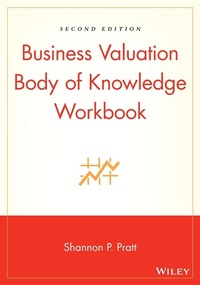
Business Valuation Body of Knowledge Workbook
2nd Edition
Published on 24. January 2003
Book
Paperback/Softback
192 pages
978-0-471-27066-9 (ISBN)
Description
Sample exam questions and updated information on the latest developments in the field for valuation candidates and professionals
Includes questions and exercises that typically appear on accreditation exams
Covers the most frequently encountered errors on reports and in examinations
Reflects the latest business valuation developments, viewpoints, court case references, and data resources
Contains hundreds of multiple-choice and true/false questions, short problems, and fill-in-the-blank questions
Includes eight hours of CPE credit through a self-study examination
A companion to Shannon Pratt's Business Valuation Body of Knowledge, Second Edition or a stand-alone resource, the Business Valuation Body of Knowledge Workbook, Second Edition keeps ABV, ASA, CBA, and CVA candidates and current practitioners up to speed on the latest developments in this constantly changing discipline.
Order your copy today!
Includes questions and exercises that typically appear on accreditation exams
Covers the most frequently encountered errors on reports and in examinations
Reflects the latest business valuation developments, viewpoints, court case references, and data resources
Contains hundreds of multiple-choice and true/false questions, short problems, and fill-in-the-blank questions
Includes eight hours of CPE credit through a self-study examination
A companion to Shannon Pratt's Business Valuation Body of Knowledge, Second Edition or a stand-alone resource, the Business Valuation Body of Knowledge Workbook, Second Edition keeps ABV, ASA, CBA, and CVA candidates and current practitioners up to speed on the latest developments in this constantly changing discipline.
Order your copy today!
More details
Edition
2nd edition
Language
English
Place of publication
New York
United States
Target group
Professional and scholarly
Product notice
Paperback (trade)
Unsewn / adhesive bound
Illustrations
Exhibits: 0 B&W, 0 Color
Dimensions
Height: 254 mm
Width: 178 mm
Thickness: 11 mm
Weight
373 gr
ISBN-13
978-0-471-27066-9 (9780471270669)
Copyright in bibliographic data and cover images is held by Nielsen Book Services Limited or by the publishers or by their respective licensors: all rights reserved.
Schweitzer Classification
Other editions
Additional editions
Shannon P. Pratt
Business Valuation Body of Knowledge Workbook
E-Book
06/2003
2nd Edition
Wiley
€65.99
Available for download
Person
Shannon P. Pratt, CFA, FASA, MCBA, CM&AA, is the Chairman and CEO of Shannon Pratt Valuations, Inc. a premier business valuation firm located in Portland, Oregon, and is the founder and Editor Emeritus of Business Valuation Resources, LLC. Over a distinguished career of close to four decades, he has performed valuation engagements for M&A, ESOPs, gift and estate taxation, marital dissolution, shareholder oppression and dissent, and numerous other purposes. He has conducted numerous fairness and solvency opinions, has testified in a wide variety of federal and state courts across the country, and frequently participates in arbitration and mediation proceedings. Dr. Pratt is one of the most successful and respected authors in his field. He is the author or coauthor of several industry standards, including Valuing a Business: The Analysis and Appraisal of Closely Held Companies, Valuing Small Businesses and Professional Practices, The Market Approach to Valuing Businesses, Standards of Value, Business Valuation and Taxes, The Lawyer's Business Valuation Handbook, and Cost of Capital.
Content
Preface. Acknowledgments.
Basic Formulas.
Section One: Questions.
PART I: BUSINESS VALUATION ENGAGEMENT ENVIRONMENT.
Business Valuation Legal and Regulatory Environment.
Business Valuation Professional Environment.
Business Valuation Engagement.
Litigation Service Engagements.
PART II: TERMINOLOGY AND NOTATION.
International Glossary of Business Valuation Terms.
Notation System Used in This Book.
PART III: VALUATION APPROACHES AND METHODS.
Overview of Valuation Approaches and Methods.
Income Approach: Cost of Capital.
Income Approach: Discounting Method.
Income Approach: Capitalization Method.
Market Approach: Guideline Public Company Method.
Market Approach: Guideline Merger and Acquisition Method.
Prior Transactions, Offers, and Buy-Sell Agreements.
Adjusted Net Asset Method.
Excess Earnings Method.
Discounts and Premiums.
Reconciliation and Value Conclusion.
PART IV: ANALYSIS OF THE COMPANY.
Financial Statement Analysis.
Using Economic and Industry Data.
Site Visits and Interviews.
PART V: SUPPORTING DATA.
Sources of Supporting Data.
PART VI: VALUATIONS FOR SPECIFIC PURPOSES.
Tax-Related Valuations.
Employee Stock Ownership Plans.
Shareholder Buyouts and Disputes.
Marital Dissolutions.
Section 2: Answers.
PART I: Business Valuation Engagement Environment.
Business Valuation Legal and Regulatory Environment.
Business Valuation Professional Environment.
Business Valuation Engagement.
Litigation Service Engagements.
PART II: Terminology and Notation.
International Glossary of Business Valuation Terms.
Notation System Used in This Book.
PART III: VALUATION APPROACHES AND METHODS.
Overview of Valuation Approaches and Methods.
Income Approach: Cost of Capital.
Income Approach : Discounting Method.
Income Approach: Capitalization Method.
Market Approach: Guideline Public Company Method.
Market Approach : Guideline Merger and Acquisition Method.
Prior Transactions, Offers, and Buy-Sell Agreements.
Adjusted Net Asset Method.
Excess Earnings Method.
Discounts and Premiums.
Reconciliation and Value Conclusion.
PART IV: ANALYSIS OF THE COMPANY.
Financial Statement Analysis.
Using Economic and Industry Data.
Site Visits and Interviews.
PART V: SUPPORTING DATA.
Sources of Supporting Data.
PART VI: VALUATIONS FOR SPECIFIC PURPOSES.
Tax-related Valuations.
Employee Stock Ownership Plans.
Shareholder Buyouts and Disputes.
Marital Dissolutions.
CPE Self-Study Examination.
Index.
Basic Formulas.
Section One: Questions.
PART I: BUSINESS VALUATION ENGAGEMENT ENVIRONMENT.
Business Valuation Legal and Regulatory Environment.
Business Valuation Professional Environment.
Business Valuation Engagement.
Litigation Service Engagements.
PART II: TERMINOLOGY AND NOTATION.
International Glossary of Business Valuation Terms.
Notation System Used in This Book.
PART III: VALUATION APPROACHES AND METHODS.
Overview of Valuation Approaches and Methods.
Income Approach: Cost of Capital.
Income Approach: Discounting Method.
Income Approach: Capitalization Method.
Market Approach: Guideline Public Company Method.
Market Approach: Guideline Merger and Acquisition Method.
Prior Transactions, Offers, and Buy-Sell Agreements.
Adjusted Net Asset Method.
Excess Earnings Method.
Discounts and Premiums.
Reconciliation and Value Conclusion.
PART IV: ANALYSIS OF THE COMPANY.
Financial Statement Analysis.
Using Economic and Industry Data.
Site Visits and Interviews.
PART V: SUPPORTING DATA.
Sources of Supporting Data.
PART VI: VALUATIONS FOR SPECIFIC PURPOSES.
Tax-Related Valuations.
Employee Stock Ownership Plans.
Shareholder Buyouts and Disputes.
Marital Dissolutions.
Section 2: Answers.
PART I: Business Valuation Engagement Environment.
Business Valuation Legal and Regulatory Environment.
Business Valuation Professional Environment.
Business Valuation Engagement.
Litigation Service Engagements.
PART II: Terminology and Notation.
International Glossary of Business Valuation Terms.
Notation System Used in This Book.
PART III: VALUATION APPROACHES AND METHODS.
Overview of Valuation Approaches and Methods.
Income Approach: Cost of Capital.
Income Approach : Discounting Method.
Income Approach: Capitalization Method.
Market Approach: Guideline Public Company Method.
Market Approach : Guideline Merger and Acquisition Method.
Prior Transactions, Offers, and Buy-Sell Agreements.
Adjusted Net Asset Method.
Excess Earnings Method.
Discounts and Premiums.
Reconciliation and Value Conclusion.
PART IV: ANALYSIS OF THE COMPANY.
Financial Statement Analysis.
Using Economic and Industry Data.
Site Visits and Interviews.
PART V: SUPPORTING DATA.
Sources of Supporting Data.
PART VI: VALUATIONS FOR SPECIFIC PURPOSES.
Tax-related Valuations.
Employee Stock Ownership Plans.
Shareholder Buyouts and Disputes.
Marital Dissolutions.
CPE Self-Study Examination.
Index.