

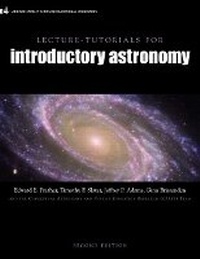
Lecture Tutorials for Introductory Astronomy
2nd Edition
Published on 29. February 2008
Book
Paperback/Softback
144 pages
978-0-13-239226-6 (ISBN)
Description
Funded by the National Science Foundation, Lecture-Tutorials for Introductory Astronomy is designed to help make large lecture-format courses more interactive with easy-to-implement student activities that can be integrated into existing course structures. The Second Edition of the Lecture-Tutorials for Introductory Astronomy contains nine new activities that focus on planetary science, system related topics, and the interactions of Light and matter. These new activities have been created using the same rigorous class-test development process that was used for the highly successful first edition. Each of the 38 Lecture-Tutorials, presented in a classroom-ready format, challenges students with a series of carefully designed questions that spark classroom discussion, engage students in critical reasoning, and require no equipment.
More details
Edition
2nd edition
Language
English
Place of publication
United States
Publishing group
Pearson Education (US)
Target group
College/higher education
Dimensions
Height: 279 mm
Width: 216 mm
Weight
345 gr
ISBN-13
978-0-13-239226-6 (9780132392266)
Copyright in bibliographic data and cover images is held by Nielsen Book Services Limited or by the publishers or by their respective licensors: all rights reserved.
Schweitzer Classification
Other editions
New editions
Edward Prather | Edward E. Prather | Tim P. Slater
Lecture- Tutorials for Introductory Astronomy
Book
01/2013
3rd Edition
Pearson
€88.99
Shipment within 10-20 days
Previous edition
Jeff P. Adams | Edward E. Prather | Tim P. Slater
Lecture Tutorials for Introductory Astronomy
Book
04/2005
Pearson
€24.75
Article exhausted; check for reprint
Content
The Night Sky
1. Position
2. Motion
3. Seasonal Stars
4. Solar vs. Sidereal Day
5. Ecliptic
6. Star Charts
Fundamentals of Astronomy
7. Kepler's 2nd Law
8. Kepler's 3rd Law
9. Newton's Laws and Gravity
10. Apparent and Absolute Magnitudes of Stars
11. The Parsec
12. Parallax and Distance
13. Spectroscopic Parallax
Nature of Light in Astronomy
14. The Electromagnetic (EM) Spectrum of Light
15. Telescopes and Earth's Atmosphere
16. Luminosity, Temperature and Size
17. Blackbody Radiation
18. Types of Spectra
19. Light and Atoms
20. Analyzing Spectra
21. Doppler Shift
Our Solar System
22. The Cause of Moon Phases
23. Predicting Moon Phases
24. Path of Sun
25. Seasons
26. Observing Retrograde Motion
27. Earth's Changing Surface
28. Temperature and Formation of Our Solar System
29. Sun Size
Stars Galaxies and Beyond
30. H-R Diagram
31. Star Formation and Lifetimes
32. Binary Stars
33. The Motion of Extrasolar Planets
34. Stellar Evolution
35. Milky Way Scales
36. Galaxy Classification
37. Looking at Distant Objects
38. Expansion of the Universe
1. Position
2. Motion
3. Seasonal Stars
4. Solar vs. Sidereal Day
5. Ecliptic
6. Star Charts
Fundamentals of Astronomy
7. Kepler's 2nd Law
8. Kepler's 3rd Law
9. Newton's Laws and Gravity
10. Apparent and Absolute Magnitudes of Stars
11. The Parsec
12. Parallax and Distance
13. Spectroscopic Parallax
Nature of Light in Astronomy
14. The Electromagnetic (EM) Spectrum of Light
15. Telescopes and Earth's Atmosphere
16. Luminosity, Temperature and Size
17. Blackbody Radiation
18. Types of Spectra
19. Light and Atoms
20. Analyzing Spectra
21. Doppler Shift
Our Solar System
22. The Cause of Moon Phases
23. Predicting Moon Phases
24. Path of Sun
25. Seasons
26. Observing Retrograde Motion
27. Earth's Changing Surface
28. Temperature and Formation of Our Solar System
29. Sun Size
Stars Galaxies and Beyond
30. H-R Diagram
31. Star Formation and Lifetimes
32. Binary Stars
33. The Motion of Extrasolar Planets
34. Stellar Evolution
35. Milky Way Scales
36. Galaxy Classification
37. Looking at Distant Objects
38. Expansion of the Universe