

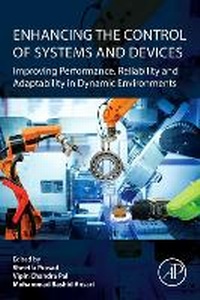
Enhancing the Control of Systems and Devices
Improving Performance, Reliability and Adaptability in Dynamic Environments
Published on 29. May 2026
Book
Paperback/Softback
436 pages
978-0-443-30285-5 (ISBN)
Description
Enhancing the Control of Systems and Devices: Improving Performance, Reliability and Adaptability in Dynamic Environments provides an in-depth exploration of the application of sophisticated control design strategies to enhance the control of systems and devices in terms of performance, reliability, and adaptability in dynamic environments. A sophisticated control design strategy refers to the use of advanced and intricate control techniques to achieve specific objectives in complex systems.
More details
Language
English
Place of publication
San Diego
United States
Publishing group
Elsevier Science Publishing Co Inc
Target group
Professional and scholarly
Product notice
Paperback (trade)
Unsewn / adhesive bound
Dimensions
Height: 229 mm
Width: 152 mm
Weight
450 gr
ISBN-13
978-0-443-30285-5 (9780443302855)
Copyright in bibliographic data and cover images is held by Nielsen Book Services Limited or by the publishers or by their respective licensors: all rights reserved.
Schweitzer Classification
Other editions
Additional editions
Sheetla Prasad | Vipin Chandra Pal | Mohammad Rashid Ansari
Enhancing the Control of Systems and Devices
Improving Performance, Reliability and Adaptability in Dynamic Environments
E-Book
06/2026
Elsevier
€199.99
Available for download
Persons
Dr. Sheetla Prasad is an Associate Professor at the Department of Electrical, Electronics and Communication Engineering, Galgotias University, Uttar Pradesh, India. Sheetla Prasad received the bachelor's degree (B.Tech.) in Electrical and Electronics Engineering from Biju Patnaik University of Technology, Rourkela, India in 2010, the master in technology (M.Tech.) in Power Systems from National Institute of Technology, Tiruchirappalli India in 2012, and the philosophy of doctorate (Ph.D.) degree in Electrical Engineering from Motilal Nehru National Institute of Technology Allahabad, India in 2017 respectively. His research interest includes, sliding mode control, load frequency control, cyber-attacks on automatic generation systems, microgrid operation and control, Intelligent controller design, Multi-terminal DC system power flow control, droop control.
Dr. Vipin Chandra Pal is an Assistant Professor in the Department of Electronics and Instrumentation Engineering, National Institute of Technology Silchar, Assam, India. He has completed his Ph.D. in the area of control systems from Motilal Nehru National Institute of Technology Allahabad, Uttar Pradesh in 2017. He did his M.Tech. (with Gold Medal) in Control & Instrumentation Engineering from the department of Electrical Engineering, Motilal Nehru National Institute of Technology Allahabad, UP in 2012 and B.Tech in Electronics Instrumentation and Control Engineering form Uttar Pradesh Technical University Lucknow, UP in 2006. His research interests include Time delay Systems, Modeling and control of Electric Vehicle, model order reduction, electronic devices and renewable energy applications, Biological Control System.
Dr. Mohamad Rashid Ansari is a Professor at the Department of Electrical, Electronics and Communication Engineering, Galgotias University, India. He has earned his B.Tech., from, AMU, Aligarh in 2001, M.Tech. (Digital Systems), from MNNIT, Allahabad, in the year 2003 and completed his Ph.D. from Jamia Millia Islamia (A Central University) in 2019. He is having more than twenty years of teaching and research experience. His areas of interest include Control Systems, Artificial Intelligent, Network-on-Chip, Digital Signal Processing and Image Processing.
Dr. Vipin Chandra Pal is an Assistant Professor in the Department of Electronics and Instrumentation Engineering, National Institute of Technology Silchar, Assam, India. He has completed his Ph.D. in the area of control systems from Motilal Nehru National Institute of Technology Allahabad, Uttar Pradesh in 2017. He did his M.Tech. (with Gold Medal) in Control & Instrumentation Engineering from the department of Electrical Engineering, Motilal Nehru National Institute of Technology Allahabad, UP in 2012 and B.Tech in Electronics Instrumentation and Control Engineering form Uttar Pradesh Technical University Lucknow, UP in 2006. His research interests include Time delay Systems, Modeling and control of Electric Vehicle, model order reduction, electronic devices and renewable energy applications, Biological Control System.
Dr. Mohamad Rashid Ansari is a Professor at the Department of Electrical, Electronics and Communication Engineering, Galgotias University, India. He has earned his B.Tech., from, AMU, Aligarh in 2001, M.Tech. (Digital Systems), from MNNIT, Allahabad, in the year 2003 and completed his Ph.D. from Jamia Millia Islamia (A Central University) in 2019. He is having more than twenty years of teaching and research experience. His areas of interest include Control Systems, Artificial Intelligent, Network-on-Chip, Digital Signal Processing and Image Processing.
Editor
Associate Professor, Department of Electrical, Electronics and Communication Engineering, Galgotias University, Uttar Pradesh, India
Assistant Professor, Department of Electronics and Instrumentation Engineering, National Institute of Technology Silchar, Assam, India
Department of Electrical, Electronics and Communication Engineering, Galgotias University, Uttar Pradesh, India
Content
1. Introduction: Foundations of Advanced Control Design in Process Engineering
2. Fundamentals of Control Systems in Process Engineering
3. Linear Model Predictive Control: Concepts and Applications
4. Robust Adaptive Control: Theory and Application
5. Scalability of the Nonlinear Control Scheme with its Efficacy Analysis
6. Reduced order modelling based on Sub-optimal control design of Bicycle Robot
7. Neural Network-observer based Adaptive Finite-time Frequency Control of Cyber-physical Power Systems
8. Machine Learning-based Adaptive Control
9. Distributed Adaptive Fault-tolerant Consensus Control of Multi-agent Systems with Deception attacks
10. Perception and Planning of Autonomous Vehicle Driving
11. Sensor Data Fusion: Techniques and Practical Applications
12. Cybersecurity Measures and its Mitigation
13. EYE on HMI is a Comprehensive Framework Designed to Track Human Machine Interfaces in Control Areas
2. Fundamentals of Control Systems in Process Engineering
3. Linear Model Predictive Control: Concepts and Applications
4. Robust Adaptive Control: Theory and Application
5. Scalability of the Nonlinear Control Scheme with its Efficacy Analysis
6. Reduced order modelling based on Sub-optimal control design of Bicycle Robot
7. Neural Network-observer based Adaptive Finite-time Frequency Control of Cyber-physical Power Systems
8. Machine Learning-based Adaptive Control
9. Distributed Adaptive Fault-tolerant Consensus Control of Multi-agent Systems with Deception attacks
10. Perception and Planning of Autonomous Vehicle Driving
11. Sensor Data Fusion: Techniques and Practical Applications
12. Cybersecurity Measures and its Mitigation
13. EYE on HMI is a Comprehensive Framework Designed to Track Human Machine Interfaces in Control Areas