

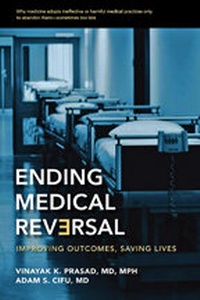
Ending Medical Reversal
Improving Outcomes, Saving Lives
Published on 27. December 2015
Book
Hardback
280 pages
978-1-4214-1772-1 (ISBN)
Description
We expect medicine to progress in an orderly fashion, with good medical practices being replaced by better ones. But some tests and therapies are discontinued because they are found to be worse, or at least no better, than what they replaced. Medications like Vioxx and procedures such as vertebroplasty for back pain caused by compression fractures are among the medical "advances" that turned out to be dangerous or useless. What Dr Vinayak K Prasad and Dr Adam S Cifu call medical reversal happens when doctors start using a medication, procedure, or diagnostic tool without a robust evidence base-and then stop using it when it is found not to help, or even to harm, patients. Drs Prasad and Cifu narrate fascinating stories from every corner of medicine to explore why medical reversals occur, how they are harmful, and what can be done to avoid them. They explore the difference between medical innovations that improve care and those that only appear to be promising.
They also outline a comprehensive plan to reform medical education, research funding and protocols, and the process for approving new drugs that will ensure that more of what gets done in doctors' offices and hospitals is truly effective.
They also outline a comprehensive plan to reform medical education, research funding and protocols, and the process for approving new drugs that will ensure that more of what gets done in doctors' offices and hospitals is truly effective.
Reviews / Votes
Every doctor should read this book. JAMA Internal Medicine Dr. Prasad and Dr. Cifu offer a five-step plan, including pointers for determining if a given treatment is really able to do what you want it to do, and advice on finding a like-minded doctor who won't object to a certain amount of back-seat driving. Of course, there are no guarantees that their tips will endure forever, but they probably have a longer shelf life than most medical advice. New York Times When I describe Ending Medical Reversal as revolutionary, I don't use the term lightly. Go out and read it-right now. Common Sense Family Dr. ... Should be considered for undergraduate reading lists. Keep a copy in the pharmacy or your briefcase as a great icebreaker or discussion point with other local healthcare professionals. The Pharmaceutical Journal [A]n excellent and realistic discussion of some of the horror stories that occur in medical practice...The examples are quite interesting and certainly educational for all readers. Highly recommended. Choice Ending Medical Reversal goes far in teaching medical students and practicing physicians alike how to learn on our own. The Lancet This has to be on the reading list for medical and nursing students. Nursing TimesMore details
Language
English
Place of publication
Baltimore, MD
United States
Illustrations
9 s/w Zeichnungen
9 Line drawings, black and white
Dimensions
Height: 229 mm
Width: 152 mm
Thickness: 23 mm
Weight
499 gr
ISBN-13
978-1-4214-1772-1 (9781421417721)
DOI
10.1353/book.49286
Copyright in bibliographic data and cover images is held by Nielsen Book Services Limited or by the publishers or by their respective licensors: all rights reserved.
Schweitzer Classification
Other editions
Additional editions
Book
07/2019
Johns Hopkins University Press
€32.40
Shipment within 10-20 days
E-Book
12/2015
Johns Hopkins University Press
€18.99
Available for download
Persons
Vinayak K. Prasad, MD, MPH, is a practicing hematologist-oncologist and internal medicine physician. He is an assistant professor of medicine and public health at Oregeon Health & Science University. Adam S. Cifu, MD, is a professor of medicine at the University of Chicago. He is a practicing general internist, medical educator, and the coauthor of Symptom to Diagnosis: An Evidence-Based Guide.
Content
Introduction
Part I
Examples, Frequency, and Consequences
1. What Is Medical Reversal?
2. Subjective Outcomes
Why Feeling Better Is Often Misleading
3. Surrogate Outcomes
4. Screening Tests
5. Systems Failure
6. Finding Flawed Therapies on Our Own
7. The Frequency of Medical Reversal
8. The Harms of Medical Reversal
Today's Patients, Tomorrow's Patients, and the Health-Care Field
Part II
9. A Primer on Evidence-Based Medicine
What Is Evidence in Medicine?
10. What Really Made You Better
When Evidence Gets Complicated
Part III
11. Scientific Progress, Revolution, and Medical Reversal
12. Sources of Flawed Data
13. Why Are We So Attracted to Flawed Therapies?
Part IV
14. Medical Education
A Very Good Place to Start
15. Academic Medicine
16. Reforming the System
The Burden of Proof and Nudging Our Way Past Reversal
17. How Not to Become a Victim of Reversal
18. Beyond Dogma
When Randomized Trials Are Unnecessary
Acknowledgments
Appendix
References
Index
Part I
Examples, Frequency, and Consequences
1. What Is Medical Reversal?
2. Subjective Outcomes
Why Feeling Better Is Often Misleading
3. Surrogate Outcomes
4. Screening Tests
5. Systems Failure
6. Finding Flawed Therapies on Our Own
7. The Frequency of Medical Reversal
8. The Harms of Medical Reversal
Today's Patients, Tomorrow's Patients, and the Health-Care Field
Part II
9. A Primer on Evidence-Based Medicine
What Is Evidence in Medicine?
10. What Really Made You Better
When Evidence Gets Complicated
Part III
11. Scientific Progress, Revolution, and Medical Reversal
12. Sources of Flawed Data
13. Why Are We So Attracted to Flawed Therapies?
Part IV
14. Medical Education
A Very Good Place to Start
15. Academic Medicine
16. Reforming the System
The Burden of Proof and Nudging Our Way Past Reversal
17. How Not to Become a Victim of Reversal
18. Beyond Dogma
When Randomized Trials Are Unnecessary
Acknowledgments
Appendix
References
Index