

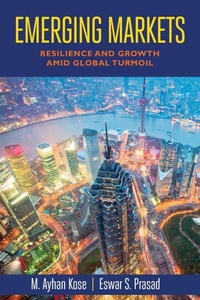
Emerging Markets
Resilience and Growth amid Global Turmoil
Published on 11. November 2010
Book
Paperback/Softback
224 pages
978-0-8157-0564-2 (ISBN)
Description
Emerging market economies (EMEs) have become the darlings of international investors and the focus of enormous attention in academic, media, and policy circles. M. Ayhan Kose and Eswar Prasad present the definitive account of the evolution of EMEs and use the lens of the global financial crisis to evaluate their strengths and weaknesses.
Led by a set of large and dynamic countries?including Brazil, China, India, and Russia?EMEs have become a dominant presence in the world economy. They now account for a substantial share of world output and have been a major driver of global growth during the past decade. They are significant players in international trade and financial flows and are beginning to exert rising clout in global policy debates. However, the financial crisis of 2007?09 and the worldwide recession that followed cast a pall over the notion that EMEs had become self-reliant and ""decoupled"" from demand conditions in and financial flows from advanced countries.
Kose and Prasad, prominent experts on emerging market economies and globalization, draw on their extensive research to assess the resilience of EMEs in the face of the global financial crisis. Their analysis shows that EMEs, as a group, weathered the crisis much better than the advanced countries, and most of these economies have bounced back rapidly from the global recession. The authors track down the reasons for this resilience and explain why some countries in this group have done better than others. Based on this analysis, they draw lessons for the durability and sustainability of these economies' long-term growth. This book is important reading for anyone trying to anticipate the future growth of emerging markets or contemplating business opportunities in these economies.
Led by a set of large and dynamic countries?including Brazil, China, India, and Russia?EMEs have become a dominant presence in the world economy. They now account for a substantial share of world output and have been a major driver of global growth during the past decade. They are significant players in international trade and financial flows and are beginning to exert rising clout in global policy debates. However, the financial crisis of 2007?09 and the worldwide recession that followed cast a pall over the notion that EMEs had become self-reliant and ""decoupled"" from demand conditions in and financial flows from advanced countries.
Kose and Prasad, prominent experts on emerging market economies and globalization, draw on their extensive research to assess the resilience of EMEs in the face of the global financial crisis. Their analysis shows that EMEs, as a group, weathered the crisis much better than the advanced countries, and most of these economies have bounced back rapidly from the global recession. The authors track down the reasons for this resilience and explain why some countries in this group have done better than others. Based on this analysis, they draw lessons for the durability and sustainability of these economies' long-term growth. This book is important reading for anyone trying to anticipate the future growth of emerging markets or contemplating business opportunities in these economies.
More details
Language
English
Place of publication
United States
Publishing group
Bloomsbury Publishing Plc
Target group
Professional and scholarly
Dimensions
Height: 229 mm
Width: 152 mm
Thickness: 13 mm
Weight
371 gr
ISBN-13
978-0-8157-0564-2 (9780815705642)
Copyright in bibliographic data and cover images is held by Nielsen Book Services Limited or by the publishers or by their respective licensors: all rights reserved.
Schweitzer Classification
Other editions
Additional editions
E-Book
02/2011
1st Edition
Brookings Institution
€28.49
Available for download
E-Book
02/2011
1st Edition
Brookings Institution
€28.49
Available for download
Persons
Eswar Prasad holds the New Century Chair in International Economics. He is the Tolani Senior Professor of Trade Policy at Cornell University and a Research Associate at the National Bureau of Economic Research. He was previously head of the Financial Studies Division and the China Division at the IMF.M. Ayhan Kose is assistant to the director in the International Monetary Fund's Research Department. He previously served as an economist for the United States and Canada desks of the IMF. He is the coeditor of the IMF Economic Review, the editor of the IMF Research Bulletin, and an executive editor of the Journal of Asian Economics.
Content
Contents: Chapter 1. Changes in the World Economic Order: A Roadmap Chapter 2. Rising Global Linkages and International Business Cycles: A Survey Chapter 3. Constructing the Database Chapter 4. Shifting Dynamics of Global GDP and Growth Chapter 5. Global Trade Linkages Chatper 6. Global Financial Linkages Chapter 7. Business Cycle Volatility Chapter 8. Business Cycle Comovement Chapter 9. Exploring the Sources of Business Cycle Comovement Chapter 10. Macroeconomics of Recessions and Financial Crises Chapter 11. Emerging Markets during the Global Financial Crisis Chapter 12. The Good and the Ugly: Emerging Asia and Emerging Europe Chapter 13. What Explains the Resilience of Emerging Markets? Chapter 14. Conclusions and Policy Implications Appendix: List of Countries and Country Groups