

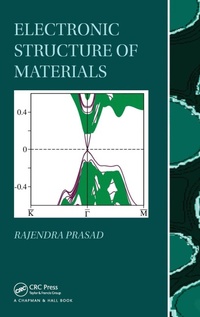
Electronic Structure of Materials
1st Edition
Published on 23. July 2013
Book
Hardback
469 pages
978-1-4665-0468-4 (ISBN)
Description
Most textbooks in the field are either too advanced for students or don't adequately cover current research topics. Bridging this gap, Electronic Structure of Materials helps advanced undergraduate and graduate students understand electronic structure methods and enables them to use these techniques in their work.
Developed from the author's lecture notes, this classroom-tested book takes a microscopic view of materials as composed of interacting electrons and nuclei. It explains all the properties of materials in terms of basic quantities of electrons and nuclei, such as electronic charge, mass, and atomic number. Based on quantum mechanics, this first-principles approach does not have any adjustable parameters.
The first half of the text presents the fundamentals and methods of electronic structure. Using numerous examples, the second half illustrates applications of the methods to various materials, including crystalline solids, disordered substitutional alloys, amorphous solids, nanoclusters, nanowires, graphene, topological insulators, battery materials, spintronic materials, and materials under extreme conditions.
Every chapter starts at a basic level and gradually moves to more complex topics, preparing students for more advanced work in the field. End-of-chapter exercises also help students get a sense of numbers and visualize the physical picture associated with the problem. Students are encouraged to practice with the electronic structure calculations via user-friendly software packages.
Developed from the author's lecture notes, this classroom-tested book takes a microscopic view of materials as composed of interacting electrons and nuclei. It explains all the properties of materials in terms of basic quantities of electrons and nuclei, such as electronic charge, mass, and atomic number. Based on quantum mechanics, this first-principles approach does not have any adjustable parameters.
The first half of the text presents the fundamentals and methods of electronic structure. Using numerous examples, the second half illustrates applications of the methods to various materials, including crystalline solids, disordered substitutional alloys, amorphous solids, nanoclusters, nanowires, graphene, topological insulators, battery materials, spintronic materials, and materials under extreme conditions.
Every chapter starts at a basic level and gradually moves to more complex topics, preparing students for more advanced work in the field. End-of-chapter exercises also help students get a sense of numbers and visualize the physical picture associated with the problem. Students are encouraged to practice with the electronic structure calculations via user-friendly software packages.
Reviews / Votes
"This book gives an excellent introduction to the electronic structure of materials for newcomers to the field. ... very useful as a source of fundamental knowledge for theoretical calculations. ... I can recommend this book without hesitation to all interested in electronic structure of materials, particularly to those entering the field. It is written at a level appropriate to advanced undergraduate and graduate students. Also, it is a good book for researchers with a chemistry, physics, or materials background."-MRS Bulletin, Volume 39, August 2014
More details
Language
English
Place of publication
Bosa Roca
United States
Publishing group
Taylor & Francis Inc
Target group
College/higher education
Illustrations
200 s/w Abbildungen, 6 s/w Tabellen
6 Tables, black and white; 200 Illustrations, black and white
Dimensions
Height: 240 mm
Width: 161 mm
Thickness: 30 mm
Weight
866 gr
ISBN-13
978-1-4665-0468-4 (9781466504684)
Copyright in bibliographic data and cover images is held by Nielsen Book Services Limited or by the publishers or by their respective licensors: all rights reserved.
Schweitzer Classification
Other editions
Additional editions
Rajendra Prasad
Electronic Structure of Materials
E-Book
07/2013
1st Edition
CRC Press
€158.99
Available for download
Rajendra Prasad
Electronic Structure of Materials
E-Book
07/2013
1st Edition
CRC Press
€158.99
Available for download
Person
Rajendra Prasad is a professor of physics at the Indian Institute of Technology (IIT) Kanpur. He received a PhD in physics from the University of Roorkee (now renamed as IIT Roorkee) and completed postdoctoral work at Northeastern University. Dr. Prasad is a fellow of the National Academy of Sciences, India. Spanning over four decades, his research work focuses on the electronic structure of metals, disordered alloys, atomic clusters, transition metal oxides, ferroelectrics, multiferroics, and topological insulators.
Content
Introduction. Quantum Description of Materials. Density Functional Theory. Energy Band Theory. Methods of Electronic Structure Calculations I. Methods of Electronic Structure Calculations II. Methods of Electronic Structure Calculations III. Disordered Alloys. First-Principles Molecular Dynamics. Materials Design Using Electronic Structure Tools. Amorphous Materials. Atomic Clusters and Nanowires. Surfaces, Interfaces, and Superlattices. Graphene and Nanotubes. Quantum Hall Effects and Topological Insulators. Ferroelectric and Multiferroic Materials. High-Temperature Superconductors. Spintronics Materials. Battery Materials. Materials in Extreme Environments. Appendices. References. Index.