

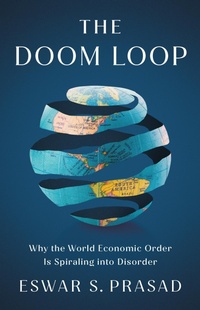
The Doom Loop
Why the World Economic Order Is Spiraling Into Disorder
Published on 3. February 2026
Book
Hardback
368 pages
978-1-5417-0593-7 (ISBN)
Description
The acclaimed economist and author of The Future of Money argues that the forces meant to stabilize the world’s economy are in fact driving global instability
“An excellent survey of some of the most important issues in international affairs today.” —Financial Times
Global economic power is shifting, liberal market-oriented democracies face growing domestic turmoil, and international trade and financial integration is crumbling. How did we get here?
In The Doom Loop, economist Eswar Prasad argues that the very forces that we long believed could stabilize the world order are fueling its destabilization. Rather than promoting shared prosperity, globalization has instead deepened economic inequality, stoked political backlash, and prompted escalating trade wars. Institutions like the International Monetary Fund and World Trade Organization, founded to foster international cooperation, have failed to adapt to twenty-first-century realities. The rise of “middle power” countries like India, Brazil, and Indonesia once suggested a stable multipolar future, but today, such nations are increasingly forced to pick sides as the United States and China fight for global dominance.
Prasad argues that we are caught in a destructive feedback loop between economics, domestic politics, and geopolitics. The Doom Loop offers a clear-eyed and bracing account of a world spiraling into disorder, and makes it clear that old solutions cannot pull us out—we need radically new solutions to solve the world’s problems.
“An excellent survey of some of the most important issues in international affairs today.” —Financial Times
Global economic power is shifting, liberal market-oriented democracies face growing domestic turmoil, and international trade and financial integration is crumbling. How did we get here?
In The Doom Loop, economist Eswar Prasad argues that the very forces that we long believed could stabilize the world order are fueling its destabilization. Rather than promoting shared prosperity, globalization has instead deepened economic inequality, stoked political backlash, and prompted escalating trade wars. Institutions like the International Monetary Fund and World Trade Organization, founded to foster international cooperation, have failed to adapt to twenty-first-century realities. The rise of “middle power” countries like India, Brazil, and Indonesia once suggested a stable multipolar future, but today, such nations are increasingly forced to pick sides as the United States and China fight for global dominance.
Prasad argues that we are caught in a destructive feedback loop between economics, domestic politics, and geopolitics. The Doom Loop offers a clear-eyed and bracing account of a world spiraling into disorder, and makes it clear that old solutions cannot pull us out—we need radically new solutions to solve the world’s problems.
More details
Language
English
Place of publication
United States
Product notice
sewn/stitched
Cloth over boards
Dimensions
Height: 239 mm
Width: 166 mm
Thickness: 35 mm
Weight
543 gr
ISBN-13
978-1-5417-0593-7 (9781541705937)
Copyright in bibliographic data and cover images is held by Nielsen Book Services Limited or by the publishers or by their respective licensors: all rights reserved.
Schweitzer Classification
Other editions
Additional editions
E-Book
02/2026
PublicAffairs
€15.99
Available for download
Person
Eswar S. Prasad is the Tolani Senior Professor of Trade Policy at Cornell University and a senior fellow at the Brookings Institution. He is the author of The Future of Money, which was listed among the best books of the year by The Economist, the Financial Times, Foreign Affairs, and The Week. Prasad lives in Arlington, Virginia, and Ithaca, New York.