

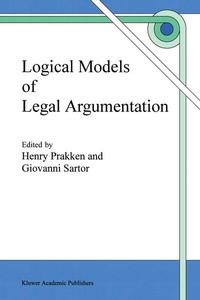
Logical Models of Legal Argumentation
Published on 31. December 1996
Book
Hardback
III, 216 pages
978-0-7923-4413-1 (ISBN)
Description
In the study of forms of legal reasoning, logic and argumentation theory long followed separate tracks. `Legal logicians' tended to focus on a deductive reconstruction of justifying a decision, disregarding the dialectical process leading to the chosen justification. Others instead emphasized the adversarial and discretionary nature of legal reasoning, involving reasonable evaluation of alternative choices, and the use of analogical reasoning.
Recently, however, developments in Artificial Intelligence and Law have paved the way for overcoming this separation. Logic has widened its scope to defensible argumentation, and informal accounts of analogy and dialectics have inspired the construction of computer programs. Thus the prospect is emerging of an integrated logical and dialectical account of legal argument, adding to the understanding of legal reasoning, and providing a formal basis for computer tools that assist and mediate legal debates while leaving room for human initiative.
This book presents contributions to this development. From a logical point of view it covers topics such as evaluating conflicting arguments, weighing reasons, modelling legal disputes as a dialogue game, the role of the burden of proof, the relation between principles, rules, reasons and facts, and the relation between deductive and nondeductive arguments. Written by leading scholars in the field and building on recent developments in logic and Artificial Intelligence, the chapters provide a state-of-the-art account of research on the logical aspects of legal argument.
Recently, however, developments in Artificial Intelligence and Law have paved the way for overcoming this separation. Logic has widened its scope to defensible argumentation, and informal accounts of analogy and dialectics have inspired the construction of computer programs. Thus the prospect is emerging of an integrated logical and dialectical account of legal argument, adding to the understanding of legal reasoning, and providing a formal basis for computer tools that assist and mediate legal debates while leaving room for human initiative.
This book presents contributions to this development. From a logical point of view it covers topics such as evaluating conflicting arguments, weighing reasons, modelling legal disputes as a dialogue game, the role of the burden of proof, the relation between principles, rules, reasons and facts, and the relation between deductive and nondeductive arguments. Written by leading scholars in the field and building on recent developments in logic and Artificial Intelligence, the chapters provide a state-of-the-art account of research on the logical aspects of legal argument.
More details
Edition
Reprinted from artificial intelligence and law, 4:3-4, 1997
Language
English
Place of publication
Dordrecht
Netherlands
Target group
Professional and scholarly
Research
Edition type
New edition
Illustrations
III, 216 p.
Dimensions
Height: 241 mm
Width: 160 mm
Thickness: 17 mm
Weight
506 gr
ISBN-13
978-0-7923-4413-1 (9780792344131)
DOI
10.1007/978-94-011-5668-4
Schweitzer Classification
Other editions
Additional editions
H. Prakken | Giovanni Sartor
Logical Models of Legal Argumentation
E-Book
12/2012
Springer
€160.49
Available for download
H. Prakken | Giovanni Sartor
Logical Models of Legal Argumentation
Book
10/2012
Springer
€171.19
Shipment within 15-20 days
Content
Editors' Introduction.- A Model of Argumentation and Its Application to Legal Reasoning.- A Theory of Legal Reasoning and a Logic to Match.- Abstract Argumentation.- Jumps and Logic in the Law.- A Dialectical Model of Assessing Conflicting Arguments in Legal Reasoning.