

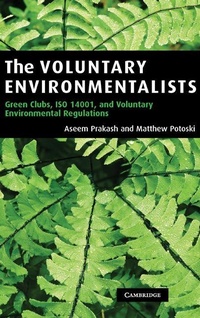
The Voluntary Environmentalists
Green Clubs, ISO 14001, and Voluntary Environmental Regulations
Published on 29. June 2006
Book
Hardback
226 pages
978-0-521-86041-3 (ISBN)
Description
Can businesses voluntarily adopt progressive environmental policies? Most environmental regulations are based on the assumption that the pursuit of profit leads firms to pollute the environment, and therefore governments must impose mandatory regulations. However, new instruments such as voluntary programs are increasingly important. Drawing on the economic theory of club goods, this book offers a theoretical account of voluntary environmental programs by identifying the institutional features that influence conditions under which programs can be effective. By linking program efficacy to club design, it focuses attention on collective action challenges faced by green clubs. Several analytic techniques are used to investigate the adoption and efficacy of ISO 14001, the most widely recognized voluntary environmental program in the world. These analyses show that, while the value of ISO 14001's brand reputation varies across policy and economic contexts, on average ISO 14001 members pollute less and comply better with governmental regulations.
Reviews / Votes
'When do firms choose to follow voluntary environmental standards? Why do they apparently seek less freedom to pollute? Using the theory of green clubs and evidence from ISO 14001, Prakash and Potoski help resolve these policy mysteries. The Voluntary Environmentalists should interest readers concerned with finding innovative ways to improve environmental performance.' James T. Hamilton, Duke University 'This excellent and well-researched study provides a valuable resource for scholars and practitioners in determining how to adjust our regulatory and other strategies to the demands of a new and more challenging era of environmental problem-solving.' Daniel J. Fiorino, American University 'Prakash and Potoski have given us the most theoretically and empirically compelling study of voluntary environmental regulation in political science, economics and public policy combined.' Dan Carpenter, Harvard UniversityMore details
Language
English
Place of publication
Cambridge
United Kingdom
Target group
Professional and scholarly
Illustrations
12 Tables, unspecified
Dimensions
Height: 235 mm
Width: 157 mm
Thickness: 18 mm
Weight
524 gr
ISBN-13
978-0-521-86041-3 (9780521860413)
Copyright in bibliographic data and cover images is held by Nielsen Book Services Limited or by the publishers or by their respective licensors: all rights reserved.
Schweitzer Classification
Other editions
Additional editions

Aseem Prakash | Matthew Potoski
The Voluntary Environmentalists
Green Clubs, ISO 14001, and Voluntary Environmental Regulations
E-Book
04/2011
1st Edition
Cambridge University Press
€27.99
Available for download
Aseem Prakash
Voluntary Environmentalists
Green Clubs, ISO 14001, and Voluntary Environmental Regulations
E-Book
06/2006
Cambridge University Press
€23.49
Available for download
Persons
Aseem Prakash is Professor of Political Science and the Walker Family Professor for the College of Arts and Sciences at the University of Washington. He is the founding, General Editor of the Cambridge University Press Series on Business and Public Policy and the co-editor of the Journal of Policy Analysis and Management. Professor Prakash's research examines core issues in the study of governance: how do institutions emerge, how they diffuse and get adopted, and how they impact outcomes. In doing so, he studies the complex relationship of businesses with governments and non-governmental organizations. His recent work focuses on the emergence, recruitment/diffusion, and efficacy of voluntary programs in the for-profit as well as the non-profit sectors. He is also examining issues pertaining to (1) NGO advocacy, (2) Corporate Responsibility, and (3) the influence of trade and FDI networks on the cross-country diffusion of rules, standards, and norms in areas such as the environment, human rights, labor rights, property rights and women's rights. Aseem Prakash is co-editor of Advocacy Organizations and Collective Action (Cambridge University Press, 2010), Voluntary Regulations of NGOs and Nonprofits: An Accountability Club Framework (Cambridge University Press, 2010), Voluntary Programs: A Club Theory Perspective (2009), Coping with Globalization (2000), Responding to Globalization (2000) and Globalization and Governance (1999). He received a joint Ph.D. from the Department of Political Science and the School of Public and Environmental Affairs (SPEA), Indiana University, Bloomington. His dissertation won the Academy of Management's 1998 Organization and the Natural Environment best dissertation award. Prior to gaining his Ph.D., he received an MBA from the Indian Institute of Management, Ahmedabad, and worked for Procter and Gamble, India. From 1997 to 2002, he served as Assistant Professor of Strategic Management and Public Policy at the School of Business, George W Matthew Potoski is an Associate Professor in the Department of Political Science, Iowa State University.
Content
Tables; Figures; List of appendices; Preface; 1. Introduction; 2. Green clubs: an institutionalist perspective; 3. ISO 14001 and voluntary programs; 4. Adopting ISO 14001; 5. ISO 14001 and firms' performance; 6. Conclusions and future directions; References; Index.