

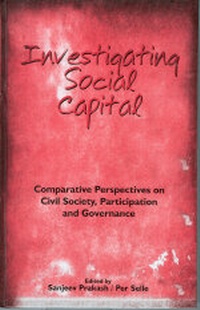
Investigating Social Capital
Comparative Perspectives on Civil Society, Participation and Governance
1st Edition
Published on 14. April 2004
Book
Hardback
315 pages
978-0-7619-9690-3 (ISBN)
Description
Current interest in the concept of social capital stems largely from empirical studies of civil society, voluntary organizations and democratic institutions in the developed world. Of late, researchers working on problems of economic development, poverty and governance in developing countries have also begun to use the concept in order to understand the institutional variables required for sustained development and democratic governance. However, despite its increasing popularity, a great deal of confusion still surrounds the concept.
Bringing together perspectives from the fields of development studies and the political theory of institutions, this important volume provides a critical analysis of social capital and helps to clarify the concept. Based on studies of social capital and civil society in Scandinavia, India, Italy, and the Netherlands, the contributors test the robustness of the concept in different contexts within a broad comparative framework.
Combining quantitative and qualitative as well as empirical and conceptual approaches, this volume explores a number of central issues related to social capital. Among these are:
" Whether Western notions of associations and civil society can be applied universally or whether a new taxonomy is required which can work across polities and cultures.
" Can social capital adequately explain regional differences in economic success?
" The problem of social trust in relation to the overall institutional environment.
" Whether social trust and capital accumulated in one associational domain can be transferred to other contexts.
" The manner in which social capital affects development performance, and the importance of agency in development efforts.
" The role of new information and communication technologies as sources and sites for social capital.
With its original research, comparative approach, conceptual innovations, and numerous fresh insights, this book will be of considerable interest to all those studying political science, development studies, sociology, and civil society.
Bringing together perspectives from the fields of development studies and the political theory of institutions, this important volume provides a critical analysis of social capital and helps to clarify the concept. Based on studies of social capital and civil society in Scandinavia, India, Italy, and the Netherlands, the contributors test the robustness of the concept in different contexts within a broad comparative framework.
Combining quantitative and qualitative as well as empirical and conceptual approaches, this volume explores a number of central issues related to social capital. Among these are:
" Whether Western notions of associations and civil society can be applied universally or whether a new taxonomy is required which can work across polities and cultures.
" Can social capital adequately explain regional differences in economic success?
" The problem of social trust in relation to the overall institutional environment.
" Whether social trust and capital accumulated in one associational domain can be transferred to other contexts.
" The manner in which social capital affects development performance, and the importance of agency in development efforts.
" The role of new information and communication technologies as sources and sites for social capital.
With its original research, comparative approach, conceptual innovations, and numerous fresh insights, this book will be of considerable interest to all those studying political science, development studies, sociology, and civil society.
More details
Edition
First Edition
Language
English
Place of publication
Thousand Oaks
United States
Target group
Professional and scholarly
Product notice
Cloth over boards
Dimensions
Height: 216 mm
Width: 140 mm
Weight
466 gr
ISBN-13
978-0-7619-9690-3 (9780761996903)
Copyright in bibliographic data and cover images is held by Nielsen Book Services Limited or by the publishers or by their respective licensors: all rights reserved.
Schweitzer Classification
Content
Introduction - Sanjeev Prakash and Per Selle
Why Investigate Social Capital?
Social Capital and Democracy - Axel Hadenius
Institutional and Social Preconditions
Is Civil Society the Answer? - Susanne Hoeber Rudolph
Social Capital and Institutional Legitimacy - Bo Rothstein
The Corleone Connection
Social Capital and Economic Development - Gaute Torsvik
A Plea for Mechanisms
Organizational Memberships and Cross-Cutting Ties - D Douglas Caulkins
Bonding or Bridging Social Capital?
Social Capital of Individuals - Paul Dekker
Relational Asset or Personal Quality?
How Associations Matter - Mario Diani
An Empirical Assessment of the Social Capital-Trust-Voluntary Action Link
Passive Membership in Voluntary Organizations - Dag Wolleboek and Per Selle
Implications for Civil Society, Integration and Democracy
Communities, Social Capital and Local Government - Dietlind Stolle
Generalized Trust in Regional Settings
Anirudh Krishna
Putting Social Capital to Work
Agency and Development
Surfing for Online Connectedness - Tommy Tranvik
Is the Internet Helping to End Civic Engagement?
Why Investigate Social Capital?
Social Capital and Democracy - Axel Hadenius
Institutional and Social Preconditions
Is Civil Society the Answer? - Susanne Hoeber Rudolph
Social Capital and Institutional Legitimacy - Bo Rothstein
The Corleone Connection
Social Capital and Economic Development - Gaute Torsvik
A Plea for Mechanisms
Organizational Memberships and Cross-Cutting Ties - D Douglas Caulkins
Bonding or Bridging Social Capital?
Social Capital of Individuals - Paul Dekker
Relational Asset or Personal Quality?
How Associations Matter - Mario Diani
An Empirical Assessment of the Social Capital-Trust-Voluntary Action Link
Passive Membership in Voluntary Organizations - Dag Wolleboek and Per Selle
Implications for Civil Society, Integration and Democracy
Communities, Social Capital and Local Government - Dietlind Stolle
Generalized Trust in Regional Settings
Anirudh Krishna
Putting Social Capital to Work
Agency and Development
Surfing for Online Connectedness - Tommy Tranvik
Is the Internet Helping to End Civic Engagement?