

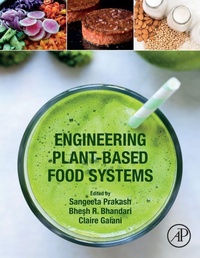
Engineering Plant-Based Food Systems
Published on 18. November 2022
Book
Paperback/Softback
352 pages
978-0-323-89842-3 (ISBN)
Description
Engineering Plant-Based Food Systems provides a comprehensive, in-depth understanding on the technologies used to create quality plant-based foods. This title helps researchers and food processors gain an understanding of the diverse aspects of plant-based foods, with a focus to meet the current consumers' demand of alternatives to animal products. This is a one-stop source that provides maximum information related to plant-based foods to food science researchers, food engineers and food processing/manufacturers. This book will enhance their understanding of plant-based protein sources, their application, product manufacturing, and bioavailability.
In recent years, the emphasis on minimizing environmental footprints (climate change, greenhouse gas emissions, deforestation, and loss of biodiversity) and human health issues related to animal source food intakes has shifted the attention of researchers, dietitians and health professionals from animal-based diets to diets rich in plant-based foods (legumes, nuts, seeds).
In recent years, the emphasis on minimizing environmental footprints (climate change, greenhouse gas emissions, deforestation, and loss of biodiversity) and human health issues related to animal source food intakes has shifted the attention of researchers, dietitians and health professionals from animal-based diets to diets rich in plant-based foods (legumes, nuts, seeds).
More details
Language
English
Place of publication
Oxford
United Kingdom
Publishing group
Elsevier Science & Technology
Target group
College/higher education
Dimensions
Height: 273 mm
Width: 211 mm
Thickness: 20 mm
Weight
994 gr
ISBN-13
978-0-323-89842-3 (9780323898423)
Copyright in bibliographic data and cover images is held by Nielsen Book Services Limited or by the publishers or by their respective licensors: all rights reserved.
Schweitzer Classification
Other editions
Additional editions
Sangeeta Prakash | Bhesh Bhandari | Claire Gaiani
Engineering Plant-Based Food Systems
E-Book
11/2022
Academic Press
€131.00
Available for download
Persons
Dr Prakash is an academic at UQ with over a decade of experience focused on research related to food processing and the oral and gastrointestinal dynamics of complex food systems. Coordinate and teach - Food Sensory and Structures and Functional Food. Her experimental approaches span from the use of processing devices (3D food printers, ultra-high-temperature processing plants, homogenisers), mechanical measurements (tribology, rheology), imaging (confocal laser scanning microscopy), electrophoresis, in vitro oral-gastrointestinal model with extension to in vivo human trials (sensory) to understand the changes during food processing from a nano-to-human scale. Dr Prakash has commenced several projects in food 3D printing. She is also a guest editor of Journal of Food Engineering managing the special issue on the recent development on food 3D printing technology. Professor Bhesh Bhandari has been associated with the University of Queensland for the last 30 years. His research and teaching areas include food materials science, processing, physical and engineering properties of foods. Prof Bhandari has published three co-edited books and more than 500 book chapters and research papers. His publications have been cited more than 36000 times (Google scholar) and is recognised as one of the leading researchers globally in glass transition and encapsulation technologies in food science discipline. He has patented two significant technologies, a continuous microgel particle formation device for encapsulation of food and pharmaceuticals and a technology to produce ethylene powder by applying materials science approach. He has currently several projects on 3D food printing. Claire Gaiani is Professor at Universite de Lorraine - Laboratoire d'Ingenierie des Biomolecules. She has successfully managed fundamental competitive programs including the French ANR (French National Agency for Research) and European projects and manages many industrial partnerships with leading international food companies (including Nestle, Lactalis, Bel, Bongrain, and Senoble).
Content
1. Plant-based food as a sustainable source of food for the future
2. General health benefits and sensory perception of plant-based foods
SECTION 1 Plant-based proteins
3. Sustainable plant-based protein sources and their extraction
4. Reducing allergenicity in plant-based proteins
5. Functionality of plant-based proteins
SECTION 2 Plant-based dairy alternatives
6. Plant-based beverages
7. Plant Based Gels
8. Plant-based butter like spreads
SECTION 3 Plant-based meat alternatives
9. Plant-based meat analogue
10. Plant-based imitated fish
11. Plant-based imitated seafood
SECTION 4 Fermented plant-based beverages and foods
12. Fermented plant-based beverage: Kombucha
13. Fermented plant-based foods (e.g. tofu, sauerkraut, sourdough)
SECTION 5 Plant-based functional components
14. Polyphenols, phytosterols, aromatics and essential oils
15. Food processing interventions to improve the bioaccessibility and bioavailability of plant food nutrients
SECTION 6 Plant-based food - future outlook
16. 3D printing of plant-based foods
17. Plant-based foods - future outlook
2. General health benefits and sensory perception of plant-based foods
SECTION 1 Plant-based proteins
3. Sustainable plant-based protein sources and their extraction
4. Reducing allergenicity in plant-based proteins
5. Functionality of plant-based proteins
SECTION 2 Plant-based dairy alternatives
6. Plant-based beverages
7. Plant Based Gels
8. Plant-based butter like spreads
SECTION 3 Plant-based meat alternatives
9. Plant-based meat analogue
10. Plant-based imitated fish
11. Plant-based imitated seafood
SECTION 4 Fermented plant-based beverages and foods
12. Fermented plant-based beverage: Kombucha
13. Fermented plant-based foods (e.g. tofu, sauerkraut, sourdough)
SECTION 5 Plant-based functional components
14. Polyphenols, phytosterols, aromatics and essential oils
15. Food processing interventions to improve the bioaccessibility and bioavailability of plant food nutrients
SECTION 6 Plant-based food - future outlook
16. 3D printing of plant-based foods
17. Plant-based foods - future outlook