

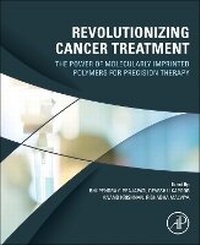
Revolutionizing Cancer Treatment
The Power of Molecularly Imprinted Polymers for Precision Therapy
Will be published approx. on 1. April 2026
Book
Paperback/Softback
220 pages
978-0-443-41778-8 (ISBN)
Description
Revolutionizing Cancer Treatment: The Power of Molecularly Imprinted Polymers for Precision Therapy explores the innovative use of molecularly imprinted polymers (MIPs) in developing targeted drug delivery systems for cancer types such as breast, prostate, and lung. This comprehensive guide highlights how molecular imprinting techniques can enhance treatment specificity, reduce systemic toxicity, and improve therapeutic outcomes, addressing the critical need for precision medicine in oncology. Organized with detailed chapters, flowcharts, and case studies, it provides valuable insights for researchers, clinicians, and pharmaceutical developers aiming to advance cancer therapies through cutting-edge drug delivery technologies.
More details
Language
English
Place of publication
San Diego
United States
Publishing group
Elsevier Science Publishing Co Inc
Target group
Professional and scholarly
Product notice
Paperback (trade)
Unsewn / adhesive bound
Dimensions
Height: 235 mm
Width: 191 mm
Weight
450 gr
ISBN-13
978-0-443-41778-8 (9780443417788)
Copyright in bibliographic data and cover images is held by Nielsen Book Services Limited or by the publishers or by their respective licensors: all rights reserved.
Schweitzer Classification
Other editions
Additional editions
Bhupendra G. Prajapati | Devesh U. Kapoor | Anand Krishnan
Revolutionizing Cancer Treatment
The Power of Molecularly Imprinted Polymers for Precision Therapy
E-Book
03/2026
Elsevier
€162.99
Available for download
Persons
Dr. Bhupendra Gopalbhai Prajapati is a Professor (Research Cadre) at Parul Institute of Pharmacy, Parul University, Gujarat, India. He is also acting as Adjunct Professor at Department of Industrial Pharmacy, Faculty of Pharmacy, Silpakorn University, Thailand. With over 22 years of experience in academia, research, and industry, he specializes in lipid-based formulations, nano/microparticulate drug delivery, and bioavailability enhancement. A recipient of several prestigious awards including the AICTE Young Teacher Award and Ganpat University's Staff Excellence honors, Dr. Prajapati has published over 350 research/review papers, and has contributed to more than 170 book chapters. He actively mentors Ph.D. and PG scholars and serves as editor or section editor for several international publications in pharmaceutical sciences. Dr. Devesh U. Kapoor is a Professor at Dr. Dayaram Patel Pharmacy College, Bardoli, Gujarat, where he has served since September 2010. He holds a B.Pharm from the University of Rajasthan and an M.Pharm in Pharmaceutics from Rajasthan University of Health Sciences, along with a PhD in pharmaceutical sciences. With 14 years of teaching and administrative experience, Dr. Kapoor has authored over 35 research and review articles in esteemed national and international journals and contributed to several books published by Elsevier, Bentham Science, MDPI, Springer, and Wiley. His research focuses on osmotic drug delivery systems, solid lipid nanoparticles, and microspheres. He has received significant grants for organizing national seminars and faculty development programs. Dr. Kapoor holds three design patents and has delivered over 10 expert talks at various national conferences. He is currently the editor of three international books with prominent publishers.
Dr. Anand Krishnan, Principal Investigator in Chemical Pathology, Office of the Dean, Faculty of Health Sciences, University of the Free State, South Africa. He leads the Precision Medicine Integrative Nano Diagnostics (P-MIND) laboratories, which focus on the biological functions of extracellular vesicles (EVs) in synthetic biology. His research encompasses cell surface protein modification, biomarker discovery through EVs derived from liquid biopsies, and the role of circulating biomarkers in disease development and stem cell biology. Dr. Krishnan has authored over 150 articles and edited eight books published by Elsevier, Springer, and Wiley. He received the National Research Foundation (NRF) rating for Next Generation Researchers in South Africa. In the latest list published by Stanford University, Dr. Krishnan was named among the Top 2% of the most influential scientists worldwide. He is an active member of the International Society of Extracellular Vesicles (ISEV), the African Organisation for Research and Training in Cancer (AORTIC), and the American Association of Cancer Research (AACR). Recently, he has been serving as an editor for the eLife journal, focusing on the Africa region.
Rishabha Malviya, did his PhD (Pharmacy) work in the area of novel formulation development techniques. He has 12 years of research experience and presently works as an Associate Professor in the Department of Pharmacy, School of Medical and Allied Sciences, Galgotias University. His area of research interest includes formulation optimization, nano formulation, nanorobotic targeted drug delivery, localized drug delivery and characterization of natural polymers as pharmaceutical drugs. He has authored more than 200 research/review papers for national/international journals of repute. He has 51 patents and has received an Outstanding Reviewer award from Elsevier. He has authored/edited/editing more than 70 books (Wiley, CRC Press, Springer Nature, River Publishers, De Gryuter, IOP publishing, Nova Science Publishers and Apple Academic Press) and authored 125 book chapters. His name is included in the world's top 2% of scientists in 2020, 2021 and 2022 by Elsevier and Stanford University.
Dr. Anand Krishnan, Principal Investigator in Chemical Pathology, Office of the Dean, Faculty of Health Sciences, University of the Free State, South Africa. He leads the Precision Medicine Integrative Nano Diagnostics (P-MIND) laboratories, which focus on the biological functions of extracellular vesicles (EVs) in synthetic biology. His research encompasses cell surface protein modification, biomarker discovery through EVs derived from liquid biopsies, and the role of circulating biomarkers in disease development and stem cell biology. Dr. Krishnan has authored over 150 articles and edited eight books published by Elsevier, Springer, and Wiley. He received the National Research Foundation (NRF) rating for Next Generation Researchers in South Africa. In the latest list published by Stanford University, Dr. Krishnan was named among the Top 2% of the most influential scientists worldwide. He is an active member of the International Society of Extracellular Vesicles (ISEV), the African Organisation for Research and Training in Cancer (AORTIC), and the American Association of Cancer Research (AACR). Recently, he has been serving as an editor for the eLife journal, focusing on the Africa region.
Rishabha Malviya, did his PhD (Pharmacy) work in the area of novel formulation development techniques. He has 12 years of research experience and presently works as an Associate Professor in the Department of Pharmacy, School of Medical and Allied Sciences, Galgotias University. His area of research interest includes formulation optimization, nano formulation, nanorobotic targeted drug delivery, localized drug delivery and characterization of natural polymers as pharmaceutical drugs. He has authored more than 200 research/review papers for national/international journals of repute. He has 51 patents and has received an Outstanding Reviewer award from Elsevier. He has authored/edited/editing more than 70 books (Wiley, CRC Press, Springer Nature, River Publishers, De Gryuter, IOP publishing, Nova Science Publishers and Apple Academic Press) and authored 125 book chapters. His name is included in the world's top 2% of scientists in 2020, 2021 and 2022 by Elsevier and Stanford University.
Editor
Parul Institute of Pharmacy, Faculty of Pharmacy, Parul University, Waghodia, Vadodara, Gujarat, India
Professor, Dr. Dayaram Patel Pharmacy College, Bardoli, Gujarat, India
Precision Medicine and Integrated Nano-Diagnostics (P-MIND) Research Group, Office of the Dean, Faculty of Health Sciences, University of the Free State, Bloemfontein, South Africa
Galgotias University, India
Content
1. Introduction
2. Molecular imprinting techniques in the development of molecularly imprinted polymers-based drug delivery systems for cancer
3. Targeting Breast Cancer: Innovations with Molecularly Imprinted Polymers.
4. Targeting Prostate Cancer: Innovations with Molecularly Imprinted Polymers.
5. Targeting Pancreatic Cancer: Innovations with Molecularly Imprinted Polymers.
6. Targeting Lung Cancer: Innovations with Molecularly Imprinted Polymers.
7. Targeting Brain Cancer: Innovations with Molecularly Imprinted Polymers.
8. Targeting Ovarian Cancer: Innovations with Molecularly Imprinted Polymers.
9. Targeting Liver Cancer: Innovations with Molecularly Imprinted Polymers.
10. Targeting Cervical Cancer: Innovations with Molecularly Imprinted Polymers.
11. Targeting Colon Cancer: Innovations with Molecularly Imprinted Polymers.
12. Molecularly imprinted polymers as precision tools in cancer
2. Molecular imprinting techniques in the development of molecularly imprinted polymers-based drug delivery systems for cancer
3. Targeting Breast Cancer: Innovations with Molecularly Imprinted Polymers.
4. Targeting Prostate Cancer: Innovations with Molecularly Imprinted Polymers.
5. Targeting Pancreatic Cancer: Innovations with Molecularly Imprinted Polymers.
6. Targeting Lung Cancer: Innovations with Molecularly Imprinted Polymers.
7. Targeting Brain Cancer: Innovations with Molecularly Imprinted Polymers.
8. Targeting Ovarian Cancer: Innovations with Molecularly Imprinted Polymers.
9. Targeting Liver Cancer: Innovations with Molecularly Imprinted Polymers.
10. Targeting Cervical Cancer: Innovations with Molecularly Imprinted Polymers.
11. Targeting Colon Cancer: Innovations with Molecularly Imprinted Polymers.
12. Molecularly imprinted polymers as precision tools in cancer