

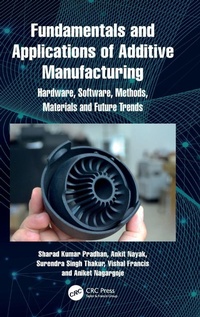
Fundamentals and Applications of Additive Manufacturing
Hardware, Software, Methods, Materials and Future Trends
1st Edition
Published on 28. July 2025
Book
Hardback
366 pages
978-1-032-89804-9 (ISBN)
Description
Through nine chapters covering software, hardware, solid-based, liquid-based, and powder-based 3D printing processes, this textbook provides a comprehensive but easy-to-understand and application-oriented guide to the fundamentals and applications of 3D printing.
Readers are guided through various topics in a structured and logical manner that takes them from an initial comprehensive discussion of the topic to specialized chapters on advanced areas. The authors compare additive manufacturing with conventional processes; introduce computer-aided design; explore data preparation techniques including 3D printing interfaces; and provide information regarding STL files, model slicing, toolpath generation, 3D printing material, solid-liquid-powder-based 3D printing processes, post-processing techniques, advancements and future trends in 3D printing. The book also discusses printing accuracy, precision and tolerance and open-source data preparation software such as Fusion 360 and Tinkercad. To ensure readers' comprehensive understanding of the different printing methods, the book discusses solid-, liquid- and powder-based 3D printing processes and their principles, workings, applications, post-processing techniques and future trends. Images and descriptive figures effectively illustrate the concepts and processes throughout, aiding in the understanding and retention of the concepts and processes. Every chapter includes learning outcomes, discussion topics, self-check exercises and multiple-choice questions help teachers and students to assess their learning.
The broad coverage and engaging discussion format make this an ideal textbook for undergraduate and postgraduate students and an accessible reference for enthusiasts with elementary knowledge. In guiding readers from the basic concepts through to individual methodologies and printing techniques, it is invaluable to any reader who aims for a career related to any related application and industry.
Readers are guided through various topics in a structured and logical manner that takes them from an initial comprehensive discussion of the topic to specialized chapters on advanced areas. The authors compare additive manufacturing with conventional processes; introduce computer-aided design; explore data preparation techniques including 3D printing interfaces; and provide information regarding STL files, model slicing, toolpath generation, 3D printing material, solid-liquid-powder-based 3D printing processes, post-processing techniques, advancements and future trends in 3D printing. The book also discusses printing accuracy, precision and tolerance and open-source data preparation software such as Fusion 360 and Tinkercad. To ensure readers' comprehensive understanding of the different printing methods, the book discusses solid-, liquid- and powder-based 3D printing processes and their principles, workings, applications, post-processing techniques and future trends. Images and descriptive figures effectively illustrate the concepts and processes throughout, aiding in the understanding and retention of the concepts and processes. Every chapter includes learning outcomes, discussion topics, self-check exercises and multiple-choice questions help teachers and students to assess their learning.
The broad coverage and engaging discussion format make this an ideal textbook for undergraduate and postgraduate students and an accessible reference for enthusiasts with elementary knowledge. In guiding readers from the basic concepts through to individual methodologies and printing techniques, it is invaluable to any reader who aims for a career related to any related application and industry.
More details
Language
English
Place of publication
London
United Kingdom
Publishing group
Taylor & Francis Ltd
Target group
College/higher education
General, Postgraduate, Undergraduate Advanced, and Undergraduate Core
Illustrations
132 s/w Abbildungen, 20 s/w Photographien bzw. Rasterbilder, 112 s/w Zeichnungen, 28 s/w Tabellen
28 Tables, black and white; 112 Line drawings, black and white; 20 Halftones, black and white; 132 Illustrations, black and white
Dimensions
Height: 240 mm
Width: 161 mm
Thickness: 25 mm
Weight
731 gr
ISBN-13
978-1-032-89804-9 (9781032898049)
Copyright in bibliographic data and cover images is held by Nielsen Book Services Limited or by the publishers or by their respective licensors: all rights reserved.
Schweitzer Classification
Other editions
Additional editions
Sharad Kumar Pradhan | Ankit Nayak | Surendra Singh Thakur
Fundamentals and Applications of Additive Manufacturing
Hardware, Software, Methods, Materials and Future Trends
E-Book
07/2025
1st Edition
CRC Press
€178.99
Available for download
Sharad Kumar Pradhan | Ankit Nayak | Surendra Singh Thakur
Fundamentals and Applications of Additive Manufacturing
Hardware, Software, Methods, Materials and Future Trends
E-Book
07/2025
1st Edition
CRC Press
€178.99
Available for download
Persons
Sharad Kumar Pradhan is Director of THDC Institute of Hydropower Engineering and Technology, Tehri, India (on deputation) and is a Professor Mechanical Engineering at the National Institute of Technical Teachers' Training and Research (NITTTR), Bhopal. Before joining NITTTR Bhopal he was a Scientist at 'Central Mechanical Engineering Research Institute' (CMERI), Durgapur, (WB), India. He attained his Ph.D. from the Indian Institute of Technology, Delhi, India.
Ankit Nayak is an Assistant Professor at UPES, Dehradun, India. Prior to this, he was a Postdoctoral Fellow in Oral and Maxillofacial Surgery at the University of Hong Kong. He obtained his Ph.D. in 2020 from the Indian Institute of Information Technology, Design & Manufacturing (IIITDM) Jabalpur.
Surendra Singh Thakur is a Senior Project Engineer at 3D Engineering Automation LLP, Pune, India. He obtained his B.Tech from the National Institute of Technology (NIT) Surat, followed by his M.Tech and Ph.D.
Vishal Francis is an Associate Professor in the School of Mechanical Engineering at Lovely Professional University, India. He obtained his PhD from the Indian Institute of Information Technology, Design and Manufacturing, Jabalpur, India.
Aniket Nagargoje is an Assistant Professor at MIT Academy of Engineering, India. He obtained his BE from Savitribai Phule Pune University in 2014, his M.Tech from GGV, Bilaspur in 2017, and his Ph.D from Indian Institute of Information Technology Design and Manufacturing, Jabalpur in June 2022.
Ankit Nayak is an Assistant Professor at UPES, Dehradun, India. Prior to this, he was a Postdoctoral Fellow in Oral and Maxillofacial Surgery at the University of Hong Kong. He obtained his Ph.D. in 2020 from the Indian Institute of Information Technology, Design & Manufacturing (IIITDM) Jabalpur.
Surendra Singh Thakur is a Senior Project Engineer at 3D Engineering Automation LLP, Pune, India. He obtained his B.Tech from the National Institute of Technology (NIT) Surat, followed by his M.Tech and Ph.D.
Vishal Francis is an Associate Professor in the School of Mechanical Engineering at Lovely Professional University, India. He obtained his PhD from the Indian Institute of Information Technology, Design and Manufacturing, Jabalpur, India.
Aniket Nagargoje is an Assistant Professor at MIT Academy of Engineering, India. He obtained his BE from Savitribai Phule Pune University in 2014, his M.Tech from GGV, Bilaspur in 2017, and his Ph.D from Indian Institute of Information Technology Design and Manufacturing, Jabalpur in June 2022.
Content
1. Overview of Additive Manufacturing Processes 2. Hardware and Software for 3D Printing 3. Preprocessing-The Digital Model 4. Preprocessing - Setting 3D Printing Parameters 5. Preprocessing- Selecting the Material for 3D Printing 6. Printing using Solid-based Raw Material 7. Printing using Liquid-based Raw Material 8. Printing using Powder-based Raw Material 9. Post Processing Techniques and Future Trends