

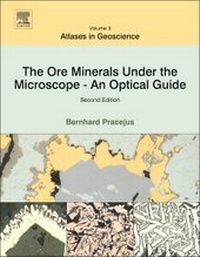
The Ore Minerals Under the Microscope: Volume 3
An Optical Guide
2nd Edition
Published on 27. July 2015
Book
Hardback
1118 pages
978-0-444-62725-4 (ISBN)
Description
The Ore Minerals Under the Microscope: An Optical Guide, Second Edition, is a very detailed color atlas for ore/opaque minerals (ore microscopy), with a main emphasis on name and synonyms, short descriptions, mineral groups, chemical compositions, information on major formation environments, optical data, reflection color/shade comparison with four common/standard minerals of a similar color or grey shade, and up to five high-quality photos for each mineral with scale.
In addition, the atlas contains a compilation from some of the prominent publications in the field of ore microscopy presented on a list of 431 minerals.
In addition, the atlas contains a compilation from some of the prominent publications in the field of ore microscopy presented on a list of 431 minerals.
More details
Series
Edition
2nd edition
Language
English
Place of publication
Oxford
United Kingdom
Publishing group
Elsevier Science & Technology
Target group
Professional and scholarly
earth scientists, evironmental scientists, geologists
Dimensions
Height: 297 mm
Width: 210 mm
Weight
3450 gr
ISBN-13
978-0-444-62725-4 (9780444627254)
Copyright in bibliographic data and cover images is held by Nielsen Book Services Limited or by the publishers or by their respective licensors: all rights reserved.
Schweitzer Classification
Other editions
Additional editions
E-Book
06/2015
2nd Edition
Elsevier
€290.00
Available for download
Previous edition
Book
10/2008
Elsevier
€372.01
Article exhausted; check for reprint
Person
Dr. Bernhard Pracejus currently works as Associate Professor at the Earth Science Department, Sultan Qaboos University, Sultanate of Oman. He is specialised in Mineralogy, Geochemistry, and Economic Geology and his research concentrates on topics such as the alteration of geologic bodies over time (particularly metal deposits), environmentally friendly remediation of heavy metal polluted effluents and solid wastes from mining activities and other industries, and processes at the Bio-Geo-Interface. He has published various articles in journals such as Ore Geology Reviews, Marine Geology, and Chemical Geology.
Content
Acknowledgements and Sample Sources.
Instrument Settings.
Preface.
Mineral Description. Explanations and Abbreviations.
I Elements.
II. Sulfides and Sulphosalts.
III. Halogenides.
IV. Oxides.
V. Nitratesm Carbonates and Borates.
VI. Sulfates, Chromates, Molybdates and Tungstates.
VII Phosphates, Arsenates and Vanadates.
VIII. Silicates.
Bibliography
Index.
Instrument Settings.
Preface.
Mineral Description. Explanations and Abbreviations.
I Elements.
II. Sulfides and Sulphosalts.
III. Halogenides.
IV. Oxides.
V. Nitratesm Carbonates and Borates.
VI. Sulfates, Chromates, Molybdates and Tungstates.
VII Phosphates, Arsenates and Vanadates.
VIII. Silicates.
Bibliography
Index.