

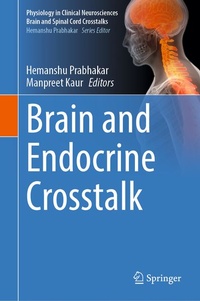
Brain and Endocrine Crosstalk
Description
This book explores the physiology and neurophysiology of the endocrine system, emphasizing the intricate brain-endocrine crosstalk, from pathophysiology to clinical applications. The dynamic interplay between neural and endocrine system regulates nearly every function of human body, from metabolism and growth to circadian rhythm. It bridges the gap between physiology, neurology, endocrinology and clinical practice thus empowering the readers to explore innovative therapeutic strategies and deepen their expertise in the rapidly evolving field of neuroendocrinology.
The book is divided into three sections - the first section covers the endocrine physiology, the second section discusses the neurophysiology of the endocrine system, and the final section includes the crosstalk of the brain and endocrine system. Chapters focus on the key topics, such as the physiology of the endocrine system, endocrine control of metabolism and diagnostic approaches to endocrine disorders, neural regulation of endocrine system, neuroendocrine response to stress, hormonal regulation of circadian rhythm, crosstalk of neuroendocrine system, clinical implications and recent research trends.
This volume of the book series ' Physiology in Clinical Neurosciences - Brain and Spinal Cord Crosstalks' serves as a valuable resource for clinicians, researchers, and postgraduate and super-speciality students in neurology, neuroscience, endocrinology, physiology and biomedical sciences. It is also helpful for allied health professionals, as well as researchers working in the domain of neuroendocrinology.
More details
Other editions
Additional editions
Persons
Dr. Hemanshu Prabhakar is a Professor at the Department of Neuroanesthesiology and Critical Care at All India Institute of Medical Sciences (AIIMS), New Delhi, India. He has published over 350 papers in peer-reviewed national and international journals and more than 27 books on neuroanesthesia and neurocritical care. He is featured in the Limca Book of Records as a prolific writer in the field of neuroanesthesiology. Dr. Prabhakar is a reviewer for various national and international journals and is also a review author for the Cochrane Collaboration. He has a special interest in evidence-based practice of neuroanesthesia and enhanced recovery after surgery. He is a member of various national and international neuroanesthesia societies and is the past secretary of the Indian Society of Neuroanesthesia and Critical Care (ISNACC) and Society of Neurocritical Care (SNCC). Dr. Prabhakar is the immediate past president of SNCC. He is an honorary fellow of SNCC. He is actively involved in the research activities for the low-income and middle-income countries (LMICs) and in the Curing Coma Campaign by the Neurocritical Care Society (NCS). He is a recipient of the AIIMS Excellence Award 2012 for his notable contribution to academia.
Dr. Manpreet Kaur is a Professor at the Department of Physiology at Vardhman Mahavir Medical College and Safdarjung Hospital, New Delhi, India. She has been a recipient of numerous awards and recognitions for her immense contribution to the field of research. She has published several papers in peer-reviewed national and international journals and authored many book chapters. Dr. Kaur is an associate editor of the Indian Journal of Physiology and Pharmacology and is a regular reviewer for various national and international journals. Her area of interest is cardiovascular, autonomic and renal physiology. Dr. Kaur is a member of various national and international physiological societies.
Content
Section I: Physiology of Endocrine Organs.- 1. Introduction to Endocrine Physiology.- 2. Physiology of Hypothalamus and Pituitary Gland.- 3. Physiology of Thyroid Gland.- 4. Physiology of Hormones in Calcium Homeostasis.- 5. Physiology of Adrenal Glands.- 6. Physiology of Pineal Gland and Circadian Rhythms.- 7. Physiology of Endocrine Control of Metabolism.- 8. Diagnostic approaches to endocrine disorders.- Section II: Neurophysiology of endocrine organs.- 1. Introduction to neuroendocrinology.- 2. Physiology of Neural regulation of endocrine system.- 3. Physiology of Hypophysiotropic neuroendocrine axes and neuroendocrine regulation.- hypophysiotropic neuroendocrine axes regulation.- 4. Physiology of Neuroendocrine adaptations to physiological and clinical conditions.- Section III: Brain and Endocrine crosstalk.- 1. Introduction to Brain and Endocrine crosstalk.- 2. Focal brain lesions and their impact on endocrine systems.- 3. Clinical implications of Brain-Endocrine crosstalk.