

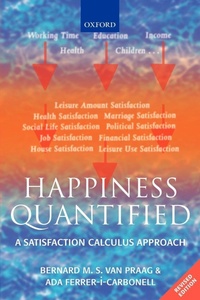
Happiness Quantified
A Satisfaction Calculus Approach
Published on 27. December 2007
Book
Paperback/Softback
392 pages
978-0-19-922614-6 (ISBN)
Description
How do we measure happiness? Focusing on subjective measures as a proxy for welfare and well-being, this book finds ways to do that. Subjective measures have been used by psychologists, sociologists, political scientists, and, more recently, economists to answer a variety of scientifically and politically relevant questions. Van Praag, a pioneer in this field since 1971, and Ferrer-i-Carbonell present in this book a generally applicable methodology for the analysis of subjective satisfaction.
Drawing on a range of surveys on people's satisfaction with their jobs, income, housing, marriages, and government policy, among other areas of life, this book shows how satisfaction with life "as a whole" is an aggregate of these domain satisfactions. Using German, British, Dutch, and Russian data, the authors cover a wide range of topics. This groundbreaking book presents a new and fruitful methodology that constitutes a welcome addition to the social sciences. The paperback edition has been revised to bring the literature review up-to-date and the chapter on poverty has been revised and extended to take account of new research.
Drawing on a range of surveys on people's satisfaction with their jobs, income, housing, marriages, and government policy, among other areas of life, this book shows how satisfaction with life "as a whole" is an aggregate of these domain satisfactions. Using German, British, Dutch, and Russian data, the authors cover a wide range of topics. This groundbreaking book presents a new and fruitful methodology that constitutes a welcome addition to the social sciences. The paperback edition has been revised to bring the literature review up-to-date and the chapter on poverty has been revised and extended to take account of new research.
Reviews / Votes
Unlike other books that were published on this same topic before it, Hapiness Quantified is jam-packed with statistical theories, econometric models, policy applications, and not to mention a whole lot of numbers. * Journal of Economic Literature * ...provides a very good quantitative overview and a significant methodological contribution on what can be done with subjective well-being data in the economics disclipline. * Journal of Economic Literature * Happiness Quantified does what it promises: Provides excellent quantitative analysis on happiness research, and thus provides an important contribution to the literature. * The Journal of Economic Inequality * Simultaneously an authoritative and readable introduction to happiness economics for the novice and a treasure trove for all scholars in this field...refreshing * Economica *More details
Edition
Revised edition
Language
English
Place of publication
Oxford
United Kingdom
Target group
College/higher education
Academics and students in economics, sociology, and other social sciences concerned with the study of happiness and personal income in particular
Edition type
Revised edition
Illustrations
24 figures and 140 tables
Dimensions
Height: 234 mm
Width: 156 mm
Thickness: 21 mm
Weight
594 gr
ISBN-13
978-0-19-922614-6 (9780199226146)
Copyright in bibliographic data and cover images is held by Nielsen Book Services Limited or by the publishers or by their respective licensors: all rights reserved.
Schweitzer Classification
Other editions
Additional editions
E-Book
12/2007
OUP eBook
€44.99
Available for download
Book
04/2004
Oxford University Press
€181.00
Shipment within 15-20 days
Persons
B. M. S. van Praag studied econometrics at the University of Amsterdam where he defended his dissertation on "Individual Welfare and the Theory of Consumer Behaviour" cum laude in 1968. Between 1969 and 1992 he held consecutive positions as Professor at the Free University of Brussels, Associate Professor at Erasmus University, Rotterdam, Professor of Economics at the University of Leiden, and Professor at Erasmus University. In 1992 he was appointed Professor in Applied Economic Research at the University of Amsterdam and Managing Director of the Foundation for Economic Research. In 2000 he became University Professor at the University of Amsterdam. He was the founding president of the European Society for Population Economics, and has been co-editor of the Journal of Population Economics, a member of the Dutch Social Economic Council, and a member of the Dutch Scientific Council for Government Policy.
Ada Ferrer-i-Carbonell graduated in Economics at the Universitat Autonoma de Barcelona in 1994. In 1997 she received a Fulbright scholarship to do graduate studies at Rensselaer Polytechnic Institute (RPI) (Troy, NY, USA), where she obtained an M.S. in Economics and did research and teaching. In 2003 she obtained a PhD from the Faculty of Economics and Econometrics at the University of Amsterdam and the Tinbergen Institute, and then another PhD from RPI. She works for the Amsterdam Institute for Advanced Labour Studies at the University of Amsterdam.
Ada Ferrer-i-Carbonell graduated in Economics at the Universitat Autonoma de Barcelona in 1994. In 1997 she received a Fulbright scholarship to do graduate studies at Rensselaer Polytechnic Institute (RPI) (Troy, NY, USA), where she obtained an M.S. in Economics and did research and teaching. In 2003 she obtained a PhD from the Faculty of Economics and Econometrics at the University of Amsterdam and the Tinbergen Institute, and then another PhD from RPI. She works for the Amsterdam Institute for Advanced Labour Studies at the University of Amsterdam.
Content
1. Introduction ; 2. The Analysis of Income Satisfaction with an Application to Family Equivalence Scales ; 3. Domain Satisfactions ; 4. The Aggregation of Satisfactions: General Satisfaction as an Aggregate ; 5. Political Satisfaction ; 6. Males, Females, and Households ; 7. The Impact on Past and Future on Present Satisfaction ; 8. The Influence of the Reference Group on our Norms ; 9. Health and Subjective Well-being ; 10. The Effects of Climate on Welfare and Well-being: External Effects ; 11. How to Find Compensations for Aircraft Noise Nuisance ; 12. Taxation and Well-being ; 13. Subjective Income Inequalities ; 14. A generalized approach to subjective inequalities ; 15. Poverty ; 16. Epilogue ; References