

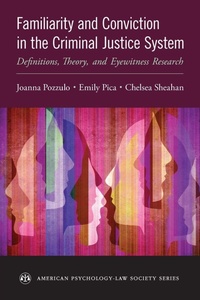
Familiarity and Conviction in the Criminal Justice System
Definitions, Theory, and Eyewitness Research
Published on 20. December 2019
Book
Paperback/Softback
144 pages
978-0-19-087481-0 (ISBN)
Description
Eyewitness research has focused mainly on stranger identification, but identification is also critical for the "familiar stranger", and understanding how variability in an eyewitness's familiarity with the perpetrator may influence recall and recognition accuracy will facilitate swifter and more just resolutions to crime. Familiarity and Conviction in the Criminal Justice System examines the notion of familiarity between an eyewitness/victim and a perpetrator, ranging from complete unfamiliarity (as with a total stranger) to a very familiar other. Authors Joanna Pozzulo, Emily Pica, and Chelsea Sheahan define what is meant by "familiarity" in an eyewitness context and how it has been operationalized and manipulated, exploring factors that may interact with familiarity and examining jurors' perceptions of it. The first half of the book draws on various sub-areas of psychology to understand familiarity against the backdrop of eyewitness identification: social psychology theories of how familiarity is established; cognitive psychology and its theories of recognition; face processing literature; and eyewitness literature. The second half of the book surveys system and estimator variables that influence identification, such as lineup procedures, interviewing techniques, the role of age, race, and more; as well as how familiarity is weighed in juror decision-making. A final chapter issues a call for continuing research examining the notion of familiarity and its impact on the criminal justice system.
Reviews / Votes
Given how often familiarity is at issue in criminal investigations and trials, I hope that this concise, valuable book provides a springboard for empirical research and improvements to law and policy. * Brandon L. Garrett, Duke University School of Law, Rutgers * Pozzulo, Pica, and Sheahan's new monograph bridges the gap in knowledge between the more commonly studied 'stranger identification' and the understudied but nevertheless important problem of mistaken identifications of familiar others. * Brian Cutler, PhD, Professor, Faculty of Social Science and Humanities, Ontario Tech University *More details
Series
Language
English
Place of publication
New York
United States
Target group
Professional and scholarly
Dimensions
Height: 234 mm
Width: 156 mm
Thickness: 8 mm
Weight
231 gr
ISBN-13
978-0-19-087481-0 (9780190874810)
Copyright in bibliographic data and cover images is held by Nielsen Book Services Limited or by the publishers or by their respective licensors: all rights reserved.
Schweitzer Classification
Other editions
Additional editions
Joanna Pozzulo | Emily Pica | Chelsea Sheahan
Familiarity and Conviction in the Criminal Justice System
Definitions, Theory, and Eyewitness Research
E-Book
11/2019
OUP eBook
€33.99
Available for download
Joanna Pozzulo | Emily Pica | Chelsea Sheahan
Familiarity and Conviction in the Criminal Justice System
Definitions, Theory, and Eyewitness Research
E-Book
11/2019
OUP eBook
€33.99
Available for download
Persons
Joanna Pozzulo is a Full Professor and the Chair of the Department of Psychology at Carleton University. Dr. Pozzulo's research and teaching broadly falls under the domain of Forensic Psychology (borrowing from developmental, social, and cognitive psychology). Dr. Pozzulo has published widely on the "young eyewitness".
Emily Pica is an assistant professor in the Department of Psychological Science and Counseling at Austin Peay State University. Dr. Pica's research interests include ways in which we can improve identification accuracy, factors that influence jurors' decision making, and the perceptions of the wrongfully convicted.
Chelsea Sheahan is an Adjunct Professor at Carleton University. Her research focuses primarily on factors that impact eyewitness memory within a developmental context. Her secondary research interests are broadly in the area of juror decision making and corrections.
Emily Pica is an assistant professor in the Department of Psychological Science and Counseling at Austin Peay State University. Dr. Pica's research interests include ways in which we can improve identification accuracy, factors that influence jurors' decision making, and the perceptions of the wrongfully convicted.
Chelsea Sheahan is an Adjunct Professor at Carleton University. Her research focuses primarily on factors that impact eyewitness memory within a developmental context. Her secondary research interests are broadly in the area of juror decision making and corrections.
Content
Chapter 1
Defining Familiarity and Overview of Concepts
Chapter 2
Theoretical Underpinnings: A Social Psychological Perspective
Chapter 3
Theoretical Underpinnings: A Cognitive Psychological Perspective
Chapter 4
Eyewitness Descriptions and Identifications of Familiar Perpetrators
Chapter 5
Factors that can Interact with Familiarity: System Variables
Chapter 6
Factors that can Interact with Familiarity: Estimator Variables
Chapter 7
Considering "Familiarity" as a Dependent Variable
Chapter 8
How Persuasive is an Eyewitness who is "Familiar" with the Defendant?
Chapter 9
Future Directions for Research Examining the Notion of "Familiarity" and its Impact on the Criminal Justice System
Defining Familiarity and Overview of Concepts
Chapter 2
Theoretical Underpinnings: A Social Psychological Perspective
Chapter 3
Theoretical Underpinnings: A Cognitive Psychological Perspective
Chapter 4
Eyewitness Descriptions and Identifications of Familiar Perpetrators
Chapter 5
Factors that can Interact with Familiarity: System Variables
Chapter 6
Factors that can Interact with Familiarity: Estimator Variables
Chapter 7
Considering "Familiarity" as a Dependent Variable
Chapter 8
How Persuasive is an Eyewitness who is "Familiar" with the Defendant?
Chapter 9
Future Directions for Research Examining the Notion of "Familiarity" and its Impact on the Criminal Justice System