

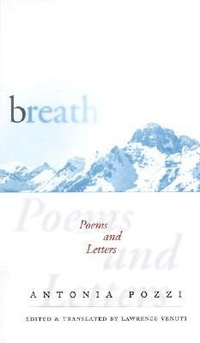
Breath
Poems and Letters
Published on 31. October 2002
Book
Paperback/Softback
224 pages
978-0-8195-6544-0 (ISBN)
Description
At the start of a promising career, Antonia Pozzi (1912-1938) committed suicide, leaving behind several hundred poems known only to her closest friends. The posthumous publication of this work led Eugenio Montale to praise Pozzi's "desire to reduce the weight of words to the minimum." Her Modernist verse is lyrical and experimental, pastoral and erotic, powerfully evoking the northern Italian landscape and her personal tragedies amid the repressive climate of Fascism. Breath contains a representative selection of Pozzi's poems in an Italian/ English bilingual format along with a number of her letters. In an introductory essay, editor-translator Lawrence Venuti documents her tormented life, considers her sophisticated thinking about her writing, and sketches the rich literary traditions that she inherited, creating a detailed context in which her poems can be more fully appreciated. The translations affiliate Pozzi's poetry with the work of comparable English-language writers such as H.D., Mina Loy, and Lorine Niedecker, establishing in translation what Pozzi lacked in Italian: a tradition of Modernist women's poetries.
CONTRIBUTORS: Lawrence Venuti.
CONTRIBUTORS: Lawrence Venuti.
More details
Edition
Bilingual Italian-English edition
Language
English
Place of publication
United States
Product notice
Paperback (trade)
Unsewn / adhesive bound
Illustrations
5 illus.
Dimensions
Height: 237 mm
Width: 138 mm
Thickness: 14 mm
Weight
348 gr
ISBN-13
978-0-8195-6544-0 (9780819565440)
Copyright in bibliographic data and cover images is held by Nielsen Book Services Limited or by the publishers or by their respective licensors: all rights reserved.
Schweitzer Classification