

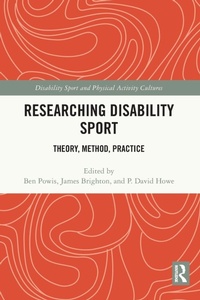
Researching Disability Sport
Theory, Method, Practice
1st Edition
Published on 26. August 2024
Book
Paperback/Softback
207 pages
978-0-367-72158-9 (ISBN)
Description
Marking a new direction for disability sport scholarship, this book explores cutting-edge issues and engages creatively with contemporary approaches to research in this important emerging discipline.
Featuring contributions from leading and up-and-coming scholars around the world, the book's wide-ranging chapters offer novel perspectives on the relationship between theory, method, and empiricism in disability sport research and highlight how researchers can be both innovative and informed when entering the field. It also explores methodological considerations when conducting disability sport research, including social, cultural, and political reflections of the research process from disabled and non-disabled academics. This much-needed resource supports disability sport scholars in developing a conceptual grounding in the subject and establishes a space for intersectional accounts of sport and physical activity which challenge homogenous understandings of disability.
This book is essential reading for any student or researcher working in disability sport, adapted physical activity, or adapted physical education, and a valuable reference for anybody with an interest in the sociology of sport, disability studies, cultural studies, the body, or research methodology.
Featuring contributions from leading and up-and-coming scholars around the world, the book's wide-ranging chapters offer novel perspectives on the relationship between theory, method, and empiricism in disability sport research and highlight how researchers can be both innovative and informed when entering the field. It also explores methodological considerations when conducting disability sport research, including social, cultural, and political reflections of the research process from disabled and non-disabled academics. This much-needed resource supports disability sport scholars in developing a conceptual grounding in the subject and establishes a space for intersectional accounts of sport and physical activity which challenge homogenous understandings of disability.
This book is essential reading for any student or researcher working in disability sport, adapted physical activity, or adapted physical education, and a valuable reference for anybody with an interest in the sociology of sport, disability studies, cultural studies, the body, or research methodology.
More details
Series
Language
English
Place of publication
London
United Kingdom
Publishing group
Taylor & Francis Ltd
Target group
College/higher education
Professional and scholarly
Academic, Postgraduate, and Undergraduate Advanced
Dimensions
Height: 234 mm
Width: 156 mm
Thickness: 12 mm
Weight
342 gr
ISBN-13
978-0-367-72158-9 (9780367721589)
Copyright in bibliographic data and cover images is held by Nielsen Book Services Limited or by the publishers or by their respective licensors: all rights reserved.
Schweitzer Classification
Other editions
Additional editions
Book
12/2022
1st Edition
Routledge
€196.10
Shipment within 15-20 days
E-Book
12/2022
1st Edition
Routledge
€59.49
Available for download
E-Book
12/2022
1st Edition
Routledge
€59.49
Available for download
Persons
Ben Powis is a Course Leader in the Faculty of Sport, Health and Social Sciences at Solent University, UK. His current research interests lie in the sociology of disability sport, the embodied experiences of visually impaired people in sport and physical activity, and investigating the significance of sensuous sporting experiences.
James Brighton is a Senior Lecturer in the Sociology of Sport and Exercise at Canterbury Christ Church University, UK. His theoretical and empirical research interests lie in disability studies, the sociology of the body and the social and cultural analyses of sport and fitness. Methodologically, he is interested in interpretive forms of qualitative inquiry including ethnography, life history, and narrative analyses.
P. David Howe is a social anthropologist and holds the Dr. Frank J. Hayden Endowed Chair in Sport and Social Impact in the School of Kinesiology at Western University, Canada. His ethnographic research focuses on unpacking the embodied sociocultural milieu surrounding inclusive physical activity and disability sport. He is also editor of the Routledge book series Disability, Sport and Physical Activity Cultures.
James Brighton is a Senior Lecturer in the Sociology of Sport and Exercise at Canterbury Christ Church University, UK. His theoretical and empirical research interests lie in disability studies, the sociology of the body and the social and cultural analyses of sport and fitness. Methodologically, he is interested in interpretive forms of qualitative inquiry including ethnography, life history, and narrative analyses.
P. David Howe is a social anthropologist and holds the Dr. Frank J. Hayden Endowed Chair in Sport and Social Impact in the School of Kinesiology at Western University, Canada. His ethnographic research focuses on unpacking the embodied sociocultural milieu surrounding inclusive physical activity and disability sport. He is also editor of the Routledge book series Disability, Sport and Physical Activity Cultures.
Content
1. Researching Disability Sport: An Introduction, Part I: Foundations for Disability Sport Scholarship, 2. Theorising Disability Sport, 3. Cultural Politics, Disability Sport and Physical Activity Research, 4. What Are We Doing Here? Confessional Tales of Non-Disabled Researchers in Disability Sport, 5. Barriers to Disability Sport Research and the Global South: A Personal View, Part II: Disability, Sport and Intersectionality, 6. Disabled Female Sporting Bodies: Reflections on (In)Visibility of disAbility in Sport, 7. Playing, Passing, and Pageantry: A Collaborative Autoethnography on Sport, Disability, Sexuality, and Belonging, 8. Race, Disability and Sport: The Experience of Black Deaf Individuals, 9. Disability and Ageing: Dads, Sons, Sport and Impairment, Part III: From Theory to Practice: Contemporary Issues in Disability Sport, 10. Seeing without Sight: The Athlete/Guide Partnership in Disability Sport, 11. Confronting Ableism from within: Reflections on Anti-Ableism Research in Disability Sport, 12. Exercise, Rehabilitation and Posthuman Disability Studies: Four Responses, 13. Para-Sport Activism in South Korea, 14. Conclusion: The Future of Disability Sport Research