


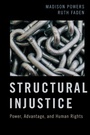
Structural Injustice
Power, Advantage, and Human Rights
Published on 25. October 2019
Book
Hardback
324 pages
978-0-19-005398-7 (ISBN)
Description
Madison Powers and Ruth Faden here develop an innovative theory of structural injustice that links human rights norms and fairness norms. Norms of both kinds are grounded in an account of well-being. Their well-being account provides the foundation for human rights, explains the depth of unfairness of systematic patterns of disadvantage, and locates the unfairness of power relations in forms of control some groups have over the well-being of other groups. They explain how human rights violations and structurally unfair patterns of power and advantage are so often interconnected.
Unlike theories of structural injustice tailored for largely benign social processes, Powers and Faden's theory addresses typical patterns of structural injustice-those in which the wrongful conduct of identifiable agents creates or sustains mutually reinforcing forms of injustice. These patterns exist both within nation-states and across national boundaries. However, this theory rejects the claim that for a structural theory to be broadly applicable both within and across national boundaries its central claims must be universally endorsable. Instead, Powers and Faden find support for their theory in examples of structural injustice around the world, and in the insights and perspectives of related social movements. Their theory also differs from approaches that make enhanced democratic decision-making or the global extension of republican institutions the centerpiece of proposed remedies. Instead, the theory focuses on justifiable forms of resistance in circumstances in which institutions are unwilling or unable to address pressing problems of injustice.
The insights developed in Structural Injustice will interest not only scholars and students in a range of disciplines from political philosophy to feminist theory and environmental justice, but also activists and journalists engaged with issues of social justice.
Unlike theories of structural injustice tailored for largely benign social processes, Powers and Faden's theory addresses typical patterns of structural injustice-those in which the wrongful conduct of identifiable agents creates or sustains mutually reinforcing forms of injustice. These patterns exist both within nation-states and across national boundaries. However, this theory rejects the claim that for a structural theory to be broadly applicable both within and across national boundaries its central claims must be universally endorsable. Instead, Powers and Faden find support for their theory in examples of structural injustice around the world, and in the insights and perspectives of related social movements. Their theory also differs from approaches that make enhanced democratic decision-making or the global extension of republican institutions the centerpiece of proposed remedies. Instead, the theory focuses on justifiable forms of resistance in circumstances in which institutions are unwilling or unable to address pressing problems of injustice.
The insights developed in Structural Injustice will interest not only scholars and students in a range of disciplines from political philosophy to feminist theory and environmental justice, but also activists and journalists engaged with issues of social justice.
Reviews / Votes
a profound and fascinating essay on the structural injustices shaking our times... genuinely a philosophical essay. Yet one of its most significant merits is that it is written for various audiences, including researchers in bioethics and public health ethics, political philosophers, journalists, and activists. * Ryoa Chung, Hastings Center Report * This is an urgently needed book. Madison Powers and Ruth Faden have constructed a powerfully reasoned, deeply learned, and richly perceptive theory that places the problem of structural injustice at the heart of political philosophy... The authors make conceptual breakthroughs that open new perspectives on old debates, and they write with authority and clarity on every issue they address. Their discussion is filled with wisdom and discernment, informed by a deep understanding of philosophical and social science literatures. I hope this book influences scholars, activists, policymakers, and the public at large; it should be widely studied and discussed, its arguments and insights put to productive use. * Jamie Mayerfeld, Ethics and International Affairs * The notion of 'structural injustice' is now commonplace among academics and activists, but this book is rare in giving it a rigorous philosophical elucidation, tying it to human rights violations, unfair disadvantage, and unfair power relations. It is a book richly informed by contemporary philosophical debates, yet written in a clear and accessible style with plenty of references to real-world examples. And it is attentive to the global dimension of the structural injustices that disfigure the contemporary world. It is a model of what philosophy that is engaged with realworld problems can be. * John Tasioulas, University of Oxford *More details
Language
English
Place of publication
New York
United States
Dimensions
Height: 240 mm
Width: 161 mm
Thickness: 22 mm
Weight
655 gr
ISBN-13
978-0-19-005398-7 (9780190053987)
Copyright in bibliographic data and cover images is held by Nielsen Book Services Limited or by the publishers or by their respective licensors: all rights reserved.
Schweitzer Classification
Other editions
Additional editions
Madison Powers | Ruth Faden
Structural Injustice
Book
11/2023
Oxford University Press Inc
€36.20
Shipment within 15-20 days
E-Book
08/2019
OUP eBook
€19.49
Available for download
E-Book
08/2019
OUP eBook
€19.49
Available for download
Persons
Madison Powers is Professor of Philosophy, Francis J. McNamara, Jr. Chair, and Senior Research Scholar, Kennedy Institute of Ethics, Georgetown University. His current research focus is on environmental justice, especially issues of natural resource ownership and use, human rights, global supply chains, and global development.
Ruth Faden is the founder of the Johns Hopkins Berman Institute of Bioethics, it's Director from 1995 until 2016, and the inaugural Philip Franklin Wagley Professor of Biomedical Ethics. Dr. Faden's current research focuses on structural injustice theory, and on justice challenges in food and agriculture, health systems, and biomedical science.
Ruth Faden is the founder of the Johns Hopkins Berman Institute of Bioethics, it's Director from 1995 until 2016, and the inaugural Philip Franklin Wagley Professor of Biomedical Ethics. Dr. Faden's current research focuses on structural injustice theory, and on justice challenges in food and agriculture, health systems, and biomedical science.
Content
- Preface
- Chapter 1: Introduction
- 1.1 Structural Injustice
- 1.2 Plan of the Chapters
- Chapter 2: Well-Being
- 2.1. The place of well-being in our theory
- 2.2. The Socratic and structural dependence arguments
- 2.3. The core elements
- 2.4. A decent human life
- 2.5. An alternative to universal endorsement approaches to justification
- 2.6. Three implications of the roles of our conception of well-being
- Chapter 3: What justice is
- 3.1. Moral importance and stringency
- 3.2. Claimability and specificity
- 3.3. Rightful enforceability
- 3.4. Unfairness norms
- Chapter 4: what structural injustice is
- 4.1. Significant impacts, structural components, and social groups
- 4.2. Social structural components and their systematic influence
- 4.3. Power, advantage, and social position
- 4.4. Background assumptions
- Chapter 5: Well-being ad human rights
- 5.1. The function of rights
- 5.2. Dignity and well-being interests
- 5.3. The social functions of human rights
- 5.4. Counterpart duties and general responsibilities: a pragmatic approach
- Chapter 6: The Responsibility of States
- 6.1. The normative uniqueness of state agency and its implications
- 6.2. The Strong Statist Challenge
- 6.3. National self-determination arguments
- 6.4. The Principle of Interstate Reciprocity
- 6.5. The power of non-State institutions in the current global order
- Chapter 7: Real-World Examples
- 7.1. National sacrifice zones: from Appalachia to Warren County
- 7.2. The globalization of sacrifice zones
- 7.3. Segregated cities: "two societies,... separate and unequal"
- 7.4. Urban 'slums': the proliferation of informal human settlements
- Chapter 8: Resistance to injustice: activism and social movements
- 8.1. Individual responsibility in a nearly just society
- 8.2. Means and goals of resistance in less ideal circumstances
- 8.3. Targets of resistance: contributors and beneficiaries
- 8.4. Conclusion: well-being and social movements
- Bibliography