

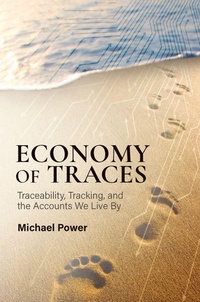
Economy of Traces
Traceability, Tracking, and the Accounts We Live By
Will be published approx. on 19. June 2026
Book
Hardback
370 pages
978-0-19-768149-7 (ISBN)
Description
Practices of tracking and tracing have a long history, yet they are expanding in scale and scope in the digital age with important consequences for the accounts which shape our organizational and everyday lives. At a time when the benefits of traceability for assuring quality, maintaining security, and supporting knowledge-creation must be balanced with needs for privacy and accountability, Economy of Traces delivers an analysis of the implications of traceability for the many accounts we live by. Issues about why we trace, what we trace, and how we trace have become critical, and the book draws upon thinking in accounting, philosophy, and sociology to understand the different facets of traceability, including connectivity, organization, governance, risk, personhood, and knowledge generation.
Through these themes, the book locates a key tension at the heart of our digital economy of traces; namely, that the more we are technically able to produce and track traces of human behaviour, the more fragile the traditional organizational forms of human oversight and accountability become. Economy of Traces develops a traceological theory of accounting to understand this tension and how tracking and oversight, while intertwined, are changing their mix in the digital age. In particular, audit trails which have traditionally underpinned human capacities for observation and governance, are being displaced and de-centered. Economy of Traces avoids both wholesale humanist critique of digital technologies on the one hand and uncritical celebration of their augmenting power on the other, in order to understand and theorize the dynamics of change in the organization of traceability and accounts production.
Through these themes, the book locates a key tension at the heart of our digital economy of traces; namely, that the more we are technically able to produce and track traces of human behaviour, the more fragile the traditional organizational forms of human oversight and accountability become. Economy of Traces develops a traceological theory of accounting to understand this tension and how tracking and oversight, while intertwined, are changing their mix in the digital age. In particular, audit trails which have traditionally underpinned human capacities for observation and governance, are being displaced and de-centered. Economy of Traces avoids both wholesale humanist critique of digital technologies on the one hand and uncritical celebration of their augmenting power on the other, in order to understand and theorize the dynamics of change in the organization of traceability and accounts production.
More details
Language
English
Place of publication
New York
United States
Target group
College/higher education
Product notice
sewn/stitched
Cloth over boards
Dimensions
Height: 234 mm
Width: 156 mm
Thickness: 24 mm
Weight
694 gr
ISBN-13
978-0-19-768149-7 (9780197681497)
Copyright in bibliographic data and cover images is held by Nielsen Book Services Limited or by the publishers or by their respective licensors: all rights reserved.
Schweitzer Classification
Other editions
Additional editions
Book
approx. 09/2026
Oxford University Press Inc
€35.50
Not yet published
Person
Michael Power is Professor of Accounting at the London School of Economics and a Fellow of the British Academy. He has authored several OUP projects including Organized Uncertainty: Designing a World of Risk Management (2007) and edited Riskwork: Essays on the Organizational Life of Risk Management (2016).
Content
- To follow